> ## Documentation Index
> Fetch the complete documentation index at: https://documentation.onesignal.com/llms.txt
> Use this file to discover all available pages before exploring further.
# Web push: Notifications not shown
> Troubleshoot web push notifications that show as Delivered in OneSignal but don't appear on a subscriber's device.
When a notification shows as "Delivered" in OneSignal, it means we have successfully sent the notification to the FCM (Google) / APNs (Apple) / WNS (Microsoft) servers which then distribute the notifications to your subscribers. The following are reasons why notifications may show as "Delivered", but are not visible on your device.
## Device settings
Device Notification Settings are the **most common cause** of web push not appearing on a device. Check the following settings including Focus modes (Do Not Disturb, Low Battery, etc.) before looking elsewhere.
Select the correct operating system from the tabs below. You should see Windows, macOS, Android, and iOS.
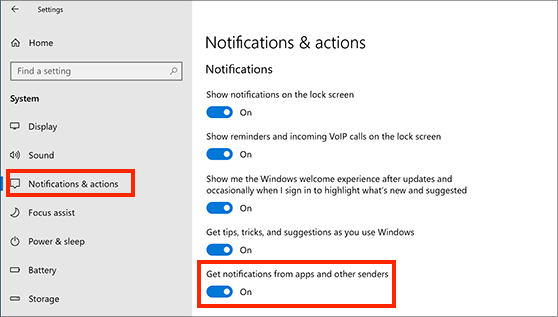
1. Select **Start > Settings > Notifications & Actions > Get notifications from apps and other senders**
2. **Make sure your site and browser are also enabled.**
 **Windows 11 Notification Settings:**
1. Select **Start > Settings > System > Notifications**
**Windows 11 Notification Settings:**
1. Select **Start > Settings > System > Notifications**
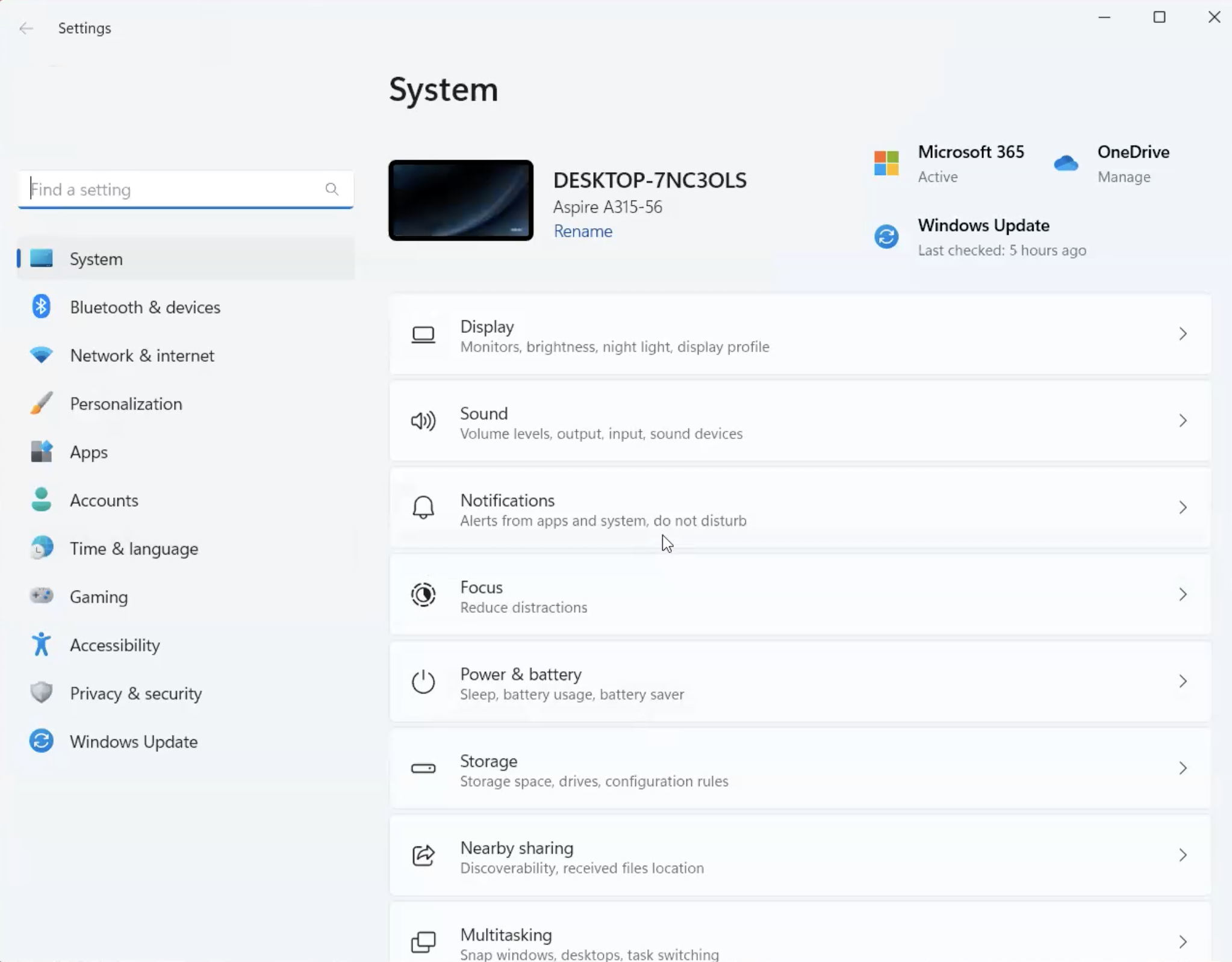 2. Turn On **Notifications**
3. Turn Off **Do not disturb** (while testing, push will show when this is disabled)
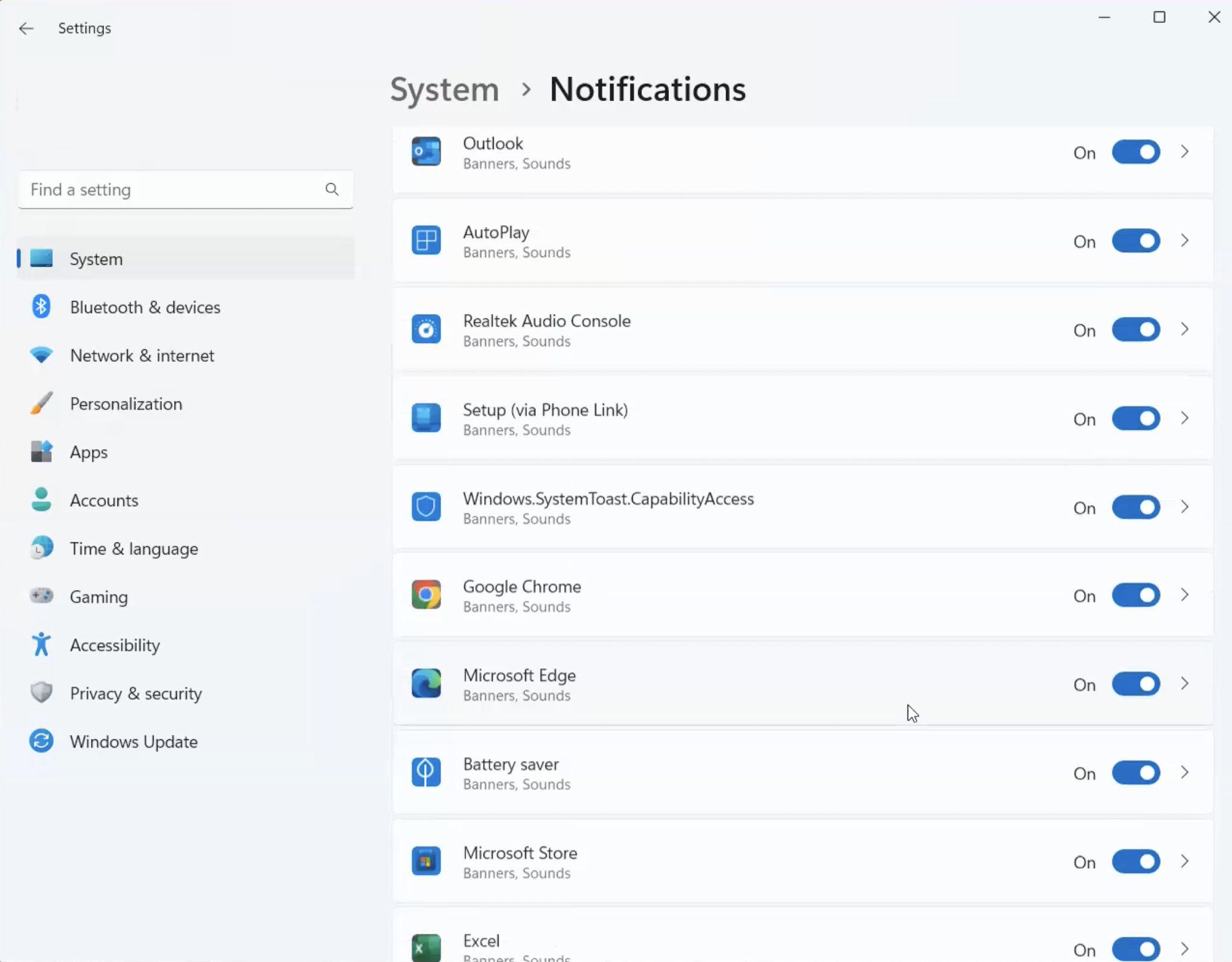
4. Scroll down to **Notifications from apps and other senders**
2. Turn On **Notifications**
3. Turn Off **Do not disturb** (while testing, push will show when this is disabled)
4. Scroll down to **Notifications from apps and other senders**
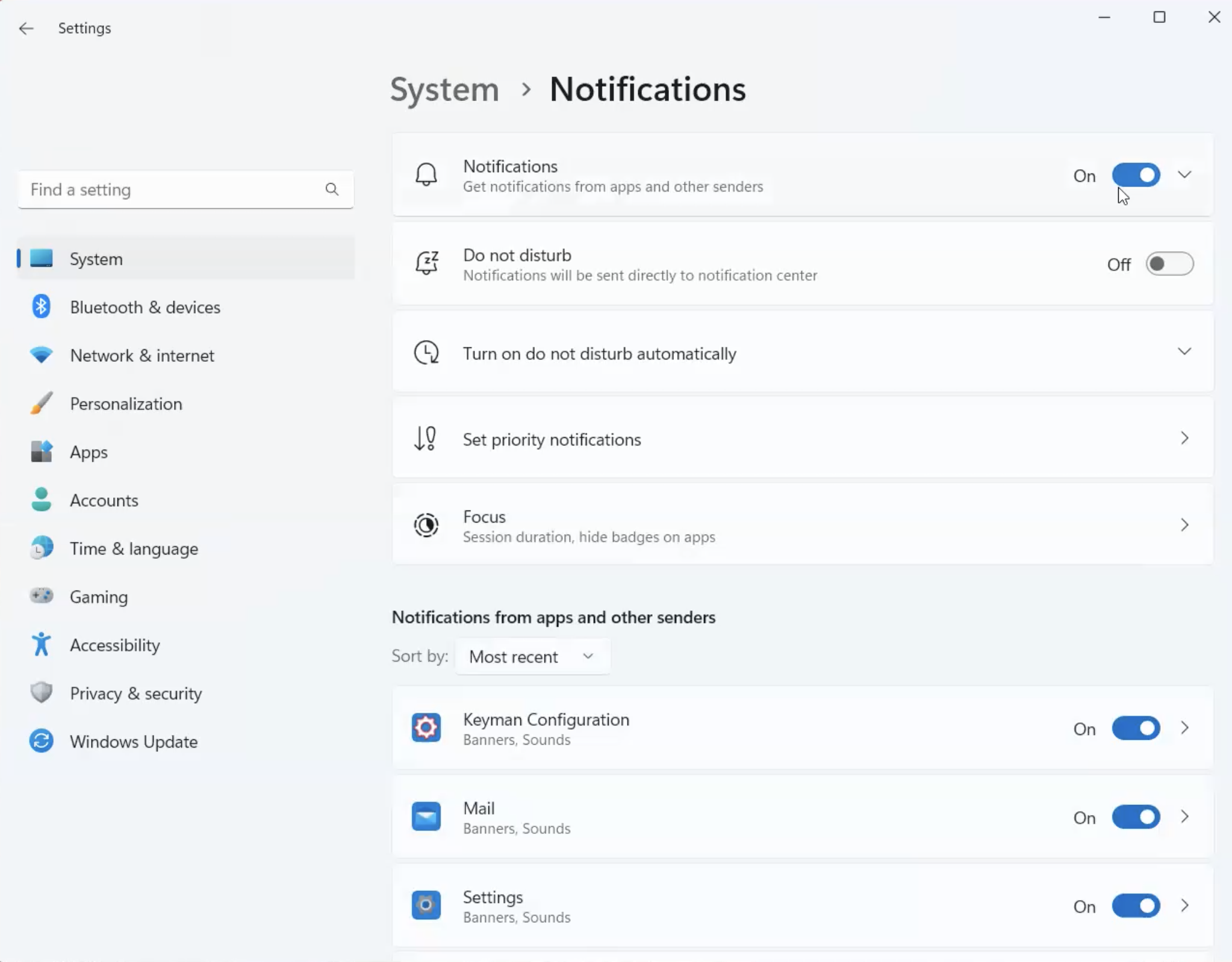 5. Make sure your browsers are turned **On**.
 1. Navigate to **System Settings > Notifications**
2. Make sure **Notifications** is enabled in Notification Center.
You may need to select **Allow notifications when mirroring or sharing the display**.
1. Navigate to **System Settings > Notifications**
2. Make sure **Notifications** is enabled in Notification Center.
You may need to select **Allow notifications when mirroring or sharing the display**.
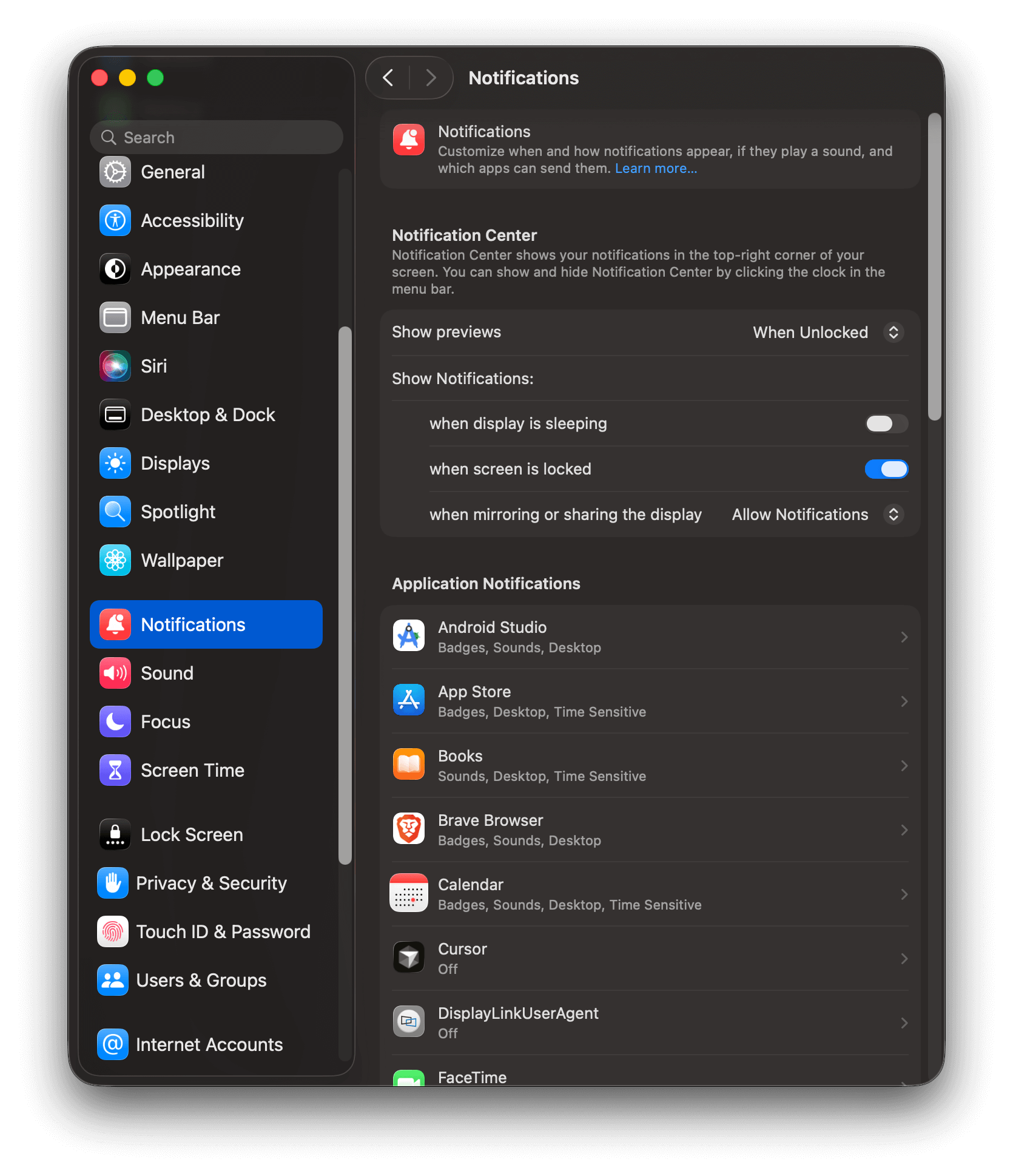 3. Scroll down to **Application Notifications** list and make sure your browser is turned on.
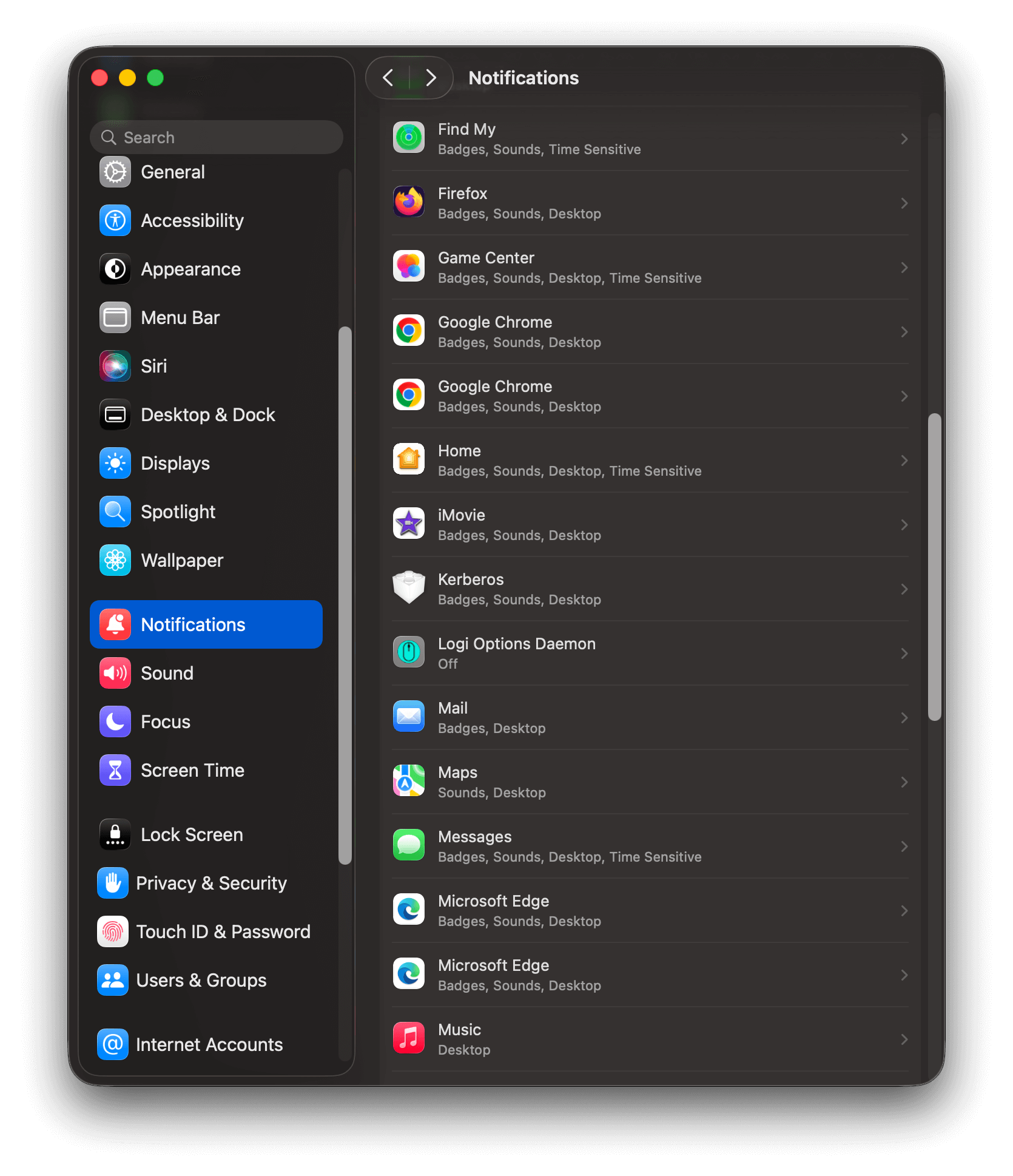
Some browsers like Chrome and Edge show 2 different application entries.
1. Standard web push notifications
2. Internal alerts e.g Google calendar
Make sure both are enabled.
3. Scroll down to **Application Notifications** list and make sure your browser is turned on.
Some browsers like Chrome and Edge show 2 different application entries.
1. Standard web push notifications
2. Internal alerts e.g Google calendar
Make sure both are enabled.
 4. Select the Application and toggle on the settings. Select how you want notifications to be displayed.
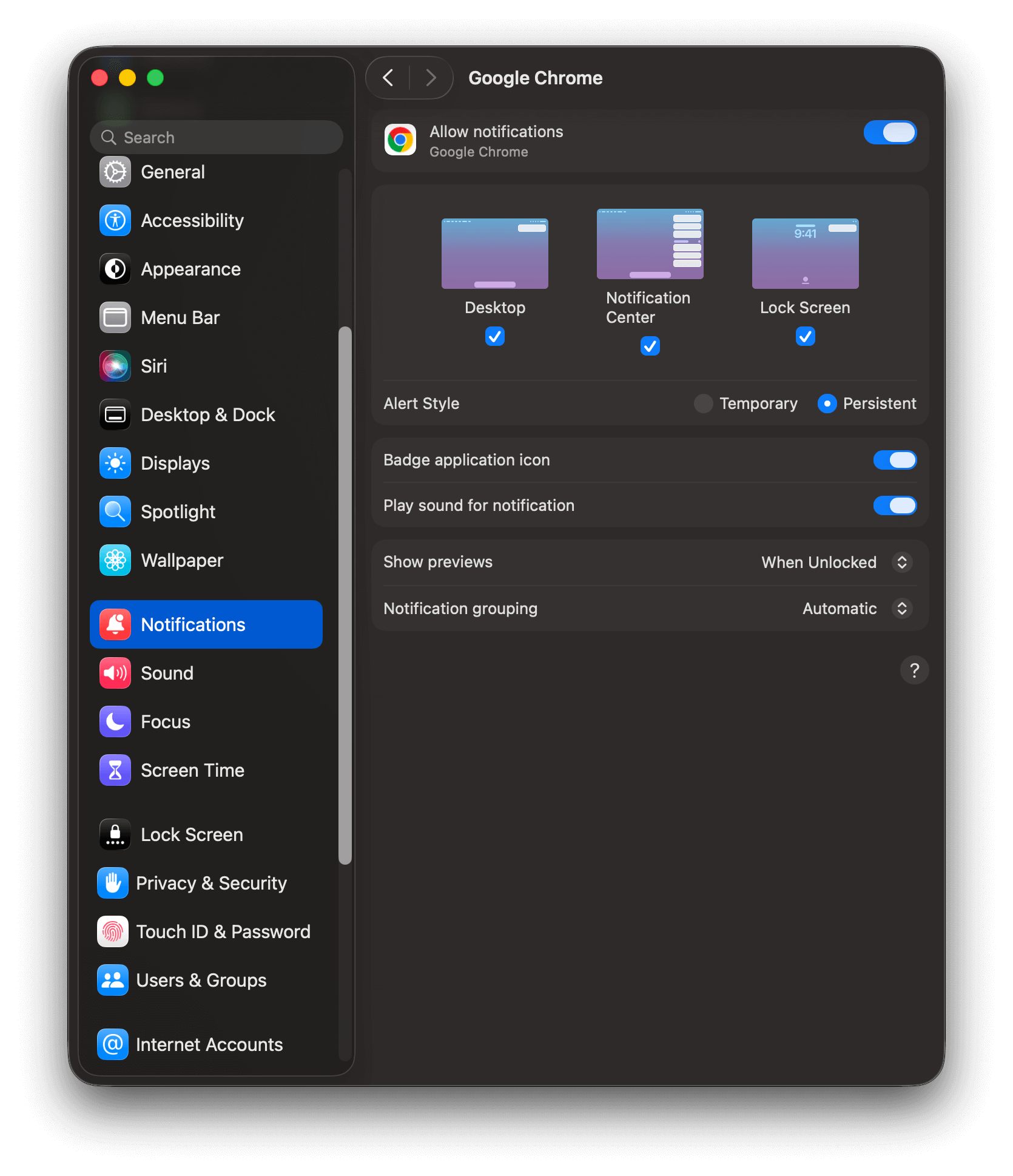 Some older versions of Safari may show the website in your Application Notifications list. Make sure to check the website is turned on in this case.
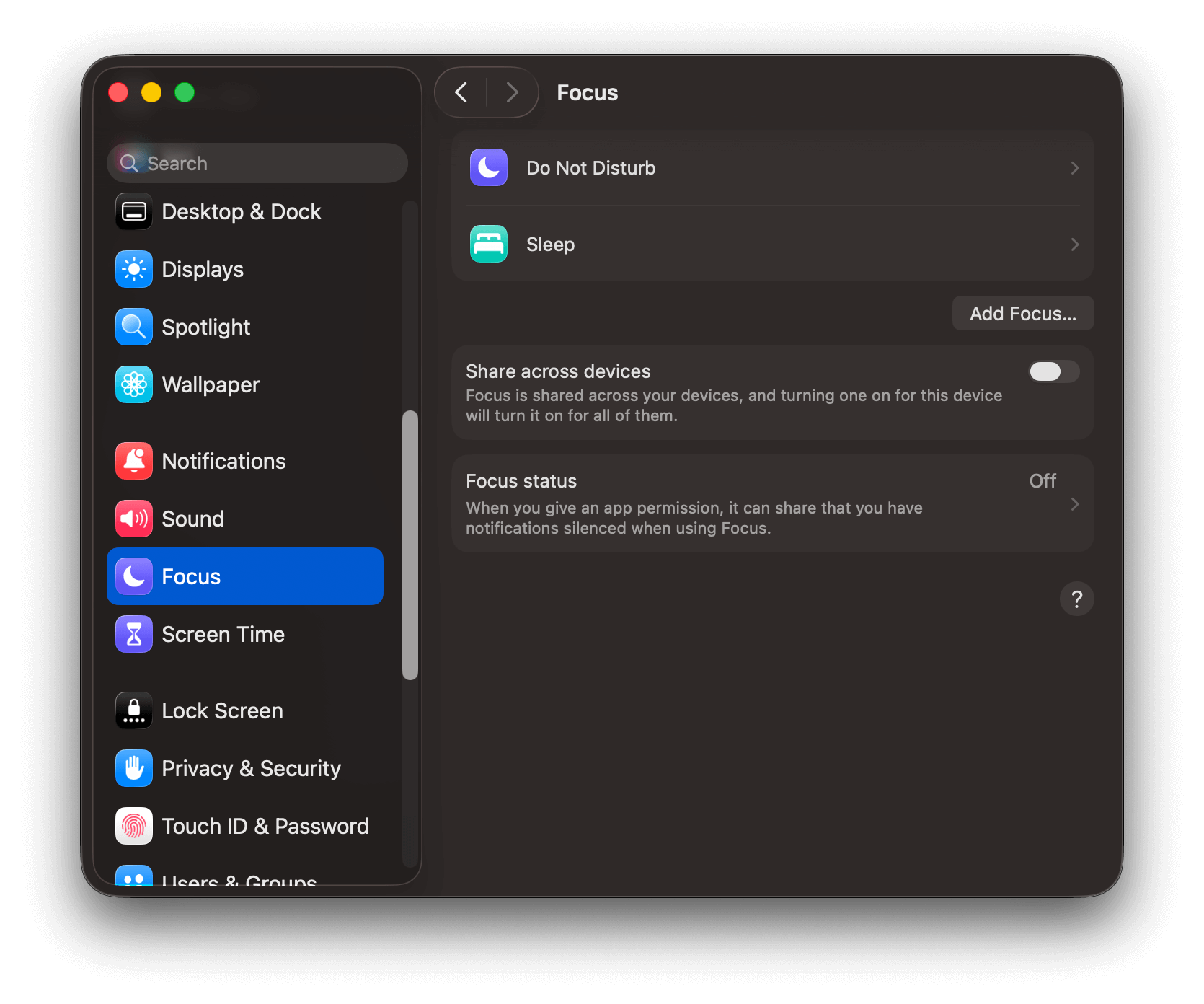
5. Navigate to **System Settings > Focus** and make sure no Focus modes are active while testing.
Some older versions of Safari may show the website in your Application Notifications list. Make sure to check the website is turned on in this case.
5. Navigate to **System Settings > Focus** and make sure no Focus modes are active while testing.
 1. Navigate to **Settings > Notifications > your browser of choice**.
2. Make sure **"Show notifications"** and your website are checked.
1. Navigate to **Settings > Notifications > your browser of choice**.
2. Make sure **"Show notifications"** and your website are checked.
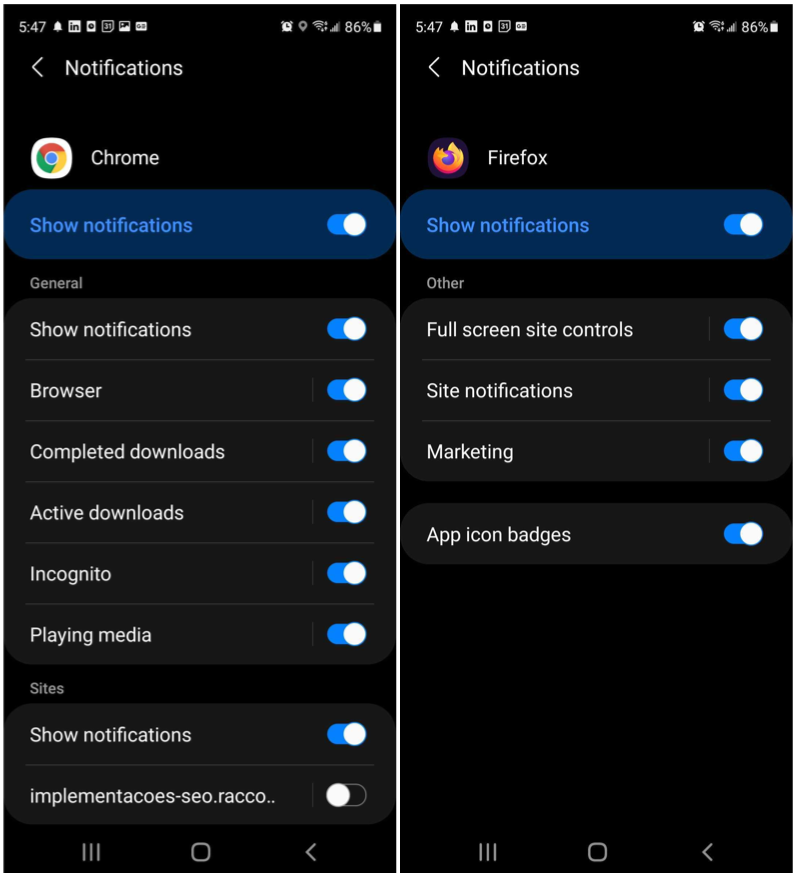 Android uses per-app notification channels. If your browser's notification channel is set to silent or turned off, push notifications won't appear even if the top-level toggle is on. In Settings, tap the browser entry and check that each notification channel is enabled and set to a visible alert style.
iOS requires you to add your site to the Home Screen before subscribers can receive push notifications on iPhones and iPads. Complete the [iOS web push setup](/docs/en/web-push-for-ios) before troubleshooting.
1. Click the browser's **Share** button and select **Add to Home Screen**.
2. Open your site from the Home Screen and allow notifications when the permission prompt appears.
3. Go to device's **Settings > Notifications > your site** and make sure **Allow Notifications** is toggled on.
### Network issues - no internet
Devices must be online to receive push notifications. If the device is turned off, in airplane mode, has unstable or no internet connection, the push will not show until a proper connection is made. You can set the timeframe FCM and APNs will wait for a connection with the Time To Live (TTL) Parameter (the default is 3 days).
If the device is on a WiFi network with a firewall or VPN, that network may be blocking the connection to Apple or Google servers. Test by switching to cellular data.
If you are managing network traffic through a firewall, configure it to allow the following:
* **FCM (Chrome, Android):** outbound TCP ports 5228, 5229, and 5230. See [FCM documentation](https://firebase.google.com/docs/cloud-messaging/concept-options) for full requirements.
* **APNS (Safari, iOS):** outbound TCP port 5223 and TCP port 443 or 2197. See [Apple's documentation](https://support.apple.com/en-us/HT203609) for full requirements.
***
## Browser settings
Your browser has its own notification permission settings separate from your OS settings. A site can be blocked at the browser level even if OS notifications are enabled for the browser.
* **Chrome**: Go to `chrome://settings/content/notifications` and confirm your site is listed under "Allowed to send notifications", not "Not allowed to send notifications".
* **Firefox**: Go to `about:preferences#privacy`, scroll to **Permissions > Notifications**, and click **Settings** to check your site's status.
* **Edge**: Go to `edge://settings/content/notifications` and verify your site is allowed.
* **Safari**: Go to **Safari > Settings > Websites > Notifications** and check that your site is set to **Allow**.
### Browser is closed
Browsers won't show push notifications unless they are running. If you open the browser before the [Time to live (TTL)](./push#time-to-live-ttl) expires on a sent notification, it will pop up.
### Unsupported browser
Users must subscribe to notifications on their desktop or mobile device to receive notifications and it must be a browser that supports push notifications. Please see [Web Push FAQ](./web-push-setup-faq) for Supported Web Platforms.
### Mobile browser app data full
If your mobile browser app has reached its data limit or its data is full, you will need to clear the data on the app.
If your mobile browser app has many unread push notifications and/or many tabs open, this can cause notifications to not show.
***
## User subscription
Make sure your device is still subscribed and targeted for push notifications.
### Subscription eligibility
Check the message audience to verify that your web push Subscription is included:
* **[Segments](./segmentation)**: Verify your Subscription meets all audience filter conditions.
* **Direct send**: Confirm the ID you are targeting is correct:
* The Subscription is still subscribed to push.
* It has a recent last session date — you may be sending to an old or inactive Subscription.
Use the [troubleshooting steps](#troubleshooting-web-push-notifications) below to look up your Subscription ID and confirm it is subscribed and active.
***
## Website codebase
### Unregistering service worker or adding pwa
Check your site's codebase for the `.unregister()` method. Calling this method will delete Service Workers. See [this guide](https://developer.mozilla.org/en-US/docs/Web/API/ServiceWorkerRegistration/unregister) for details on this method.
If you have another service worker like for your PWA you will need to follow our [Service Worker guide on integrating multiple service workers](./onesignal-service-worker).
***
## Troubleshooting web push notifications
Follow these steps to get a clean web push Subscription and confirm web push is working end-to-end.
These steps use Chrome but Edge, Firefox, and others follow the same pattern. Do not use Incognito or Guest Browser mode, and close any other tabs open to your site.
**Android**
Plug your Android device into your desktop with a USB cable.
* **Chrome**: Open `chrome://inspect/#devices` on desktop, then follow the steps below on your mobile device.
* **Firefox**: See [about:debugging](https://developer.mozilla.org/en-US/docs/Tools/about:debugging).
**iOS** (Mac only)
iOS web push is only supported in Safari via a site added to the Home Screen. To inspect it:
1. On your iPhone or iPad, go to **Settings > Safari > Advanced** and enable **Web Inspector**.
2. Connect your device to your Mac with a USB cable.
3. Open Safari on your Mac, then go to **Develop > \[your device name] > \[your site's page]**.
4. Follow the steps below using your mobile device.
This resets the site to simulate a first-time visitor state.
1. Click the **site information icon** next to your URL.
2. If you see **Notifications**, select **Reset permission** (you want to see "Can ask to send notifications").
3. Click **Cookies and site data**.
Android uses per-app notification channels. If your browser's notification channel is set to silent or turned off, push notifications won't appear even if the top-level toggle is on. In Settings, tap the browser entry and check that each notification channel is enabled and set to a visible alert style.
iOS requires you to add your site to the Home Screen before subscribers can receive push notifications on iPhones and iPads. Complete the [iOS web push setup](/docs/en/web-push-for-ios) before troubleshooting.
1. Click the browser's **Share** button and select **Add to Home Screen**.
2. Open your site from the Home Screen and allow notifications when the permission prompt appears.
3. Go to device's **Settings > Notifications > your site** and make sure **Allow Notifications** is toggled on.
### Network issues - no internet
Devices must be online to receive push notifications. If the device is turned off, in airplane mode, has unstable or no internet connection, the push will not show until a proper connection is made. You can set the timeframe FCM and APNs will wait for a connection with the Time To Live (TTL) Parameter (the default is 3 days).
If the device is on a WiFi network with a firewall or VPN, that network may be blocking the connection to Apple or Google servers. Test by switching to cellular data.
If you are managing network traffic through a firewall, configure it to allow the following:
* **FCM (Chrome, Android):** outbound TCP ports 5228, 5229, and 5230. See [FCM documentation](https://firebase.google.com/docs/cloud-messaging/concept-options) for full requirements.
* **APNS (Safari, iOS):** outbound TCP port 5223 and TCP port 443 or 2197. See [Apple's documentation](https://support.apple.com/en-us/HT203609) for full requirements.
***
## Browser settings
Your browser has its own notification permission settings separate from your OS settings. A site can be blocked at the browser level even if OS notifications are enabled for the browser.
* **Chrome**: Go to `chrome://settings/content/notifications` and confirm your site is listed under "Allowed to send notifications", not "Not allowed to send notifications".
* **Firefox**: Go to `about:preferences#privacy`, scroll to **Permissions > Notifications**, and click **Settings** to check your site's status.
* **Edge**: Go to `edge://settings/content/notifications` and verify your site is allowed.
* **Safari**: Go to **Safari > Settings > Websites > Notifications** and check that your site is set to **Allow**.
### Browser is closed
Browsers won't show push notifications unless they are running. If you open the browser before the [Time to live (TTL)](./push#time-to-live-ttl) expires on a sent notification, it will pop up.
### Unsupported browser
Users must subscribe to notifications on their desktop or mobile device to receive notifications and it must be a browser that supports push notifications. Please see [Web Push FAQ](./web-push-setup-faq) for Supported Web Platforms.
### Mobile browser app data full
If your mobile browser app has reached its data limit or its data is full, you will need to clear the data on the app.
If your mobile browser app has many unread push notifications and/or many tabs open, this can cause notifications to not show.
***
## User subscription
Make sure your device is still subscribed and targeted for push notifications.
### Subscription eligibility
Check the message audience to verify that your web push Subscription is included:
* **[Segments](./segmentation)**: Verify your Subscription meets all audience filter conditions.
* **Direct send**: Confirm the ID you are targeting is correct:
* The Subscription is still subscribed to push.
* It has a recent last session date — you may be sending to an old or inactive Subscription.
Use the [troubleshooting steps](#troubleshooting-web-push-notifications) below to look up your Subscription ID and confirm it is subscribed and active.
***
## Website codebase
### Unregistering service worker or adding pwa
Check your site's codebase for the `.unregister()` method. Calling this method will delete Service Workers. See [this guide](https://developer.mozilla.org/en-US/docs/Web/API/ServiceWorkerRegistration/unregister) for details on this method.
If you have another service worker like for your PWA you will need to follow our [Service Worker guide on integrating multiple service workers](./onesignal-service-worker).
***
## Troubleshooting web push notifications
Follow these steps to get a clean web push Subscription and confirm web push is working end-to-end.
These steps use Chrome but Edge, Firefox, and others follow the same pattern. Do not use Incognito or Guest Browser mode, and close any other tabs open to your site.
**Android**
Plug your Android device into your desktop with a USB cable.
* **Chrome**: Open `chrome://inspect/#devices` on desktop, then follow the steps below on your mobile device.
* **Firefox**: See [about:debugging](https://developer.mozilla.org/en-US/docs/Tools/about:debugging).
**iOS** (Mac only)
iOS web push is only supported in Safari via a site added to the Home Screen. To inspect it:
1. On your iPhone or iPad, go to **Settings > Safari > Advanced** and enable **Web Inspector**.
2. Connect your device to your Mac with a USB cable.
3. Open Safari on your Mac, then go to **Develop > \[your device name] > \[your site's page]**.
4. Follow the steps below using your mobile device.
This resets the site to simulate a first-time visitor state.
1. Click the **site information icon** next to your URL.
2. If you see **Notifications**, select **Reset permission** (you want to see "Can ask to send notifications").
3. Click **Cookies and site data**.
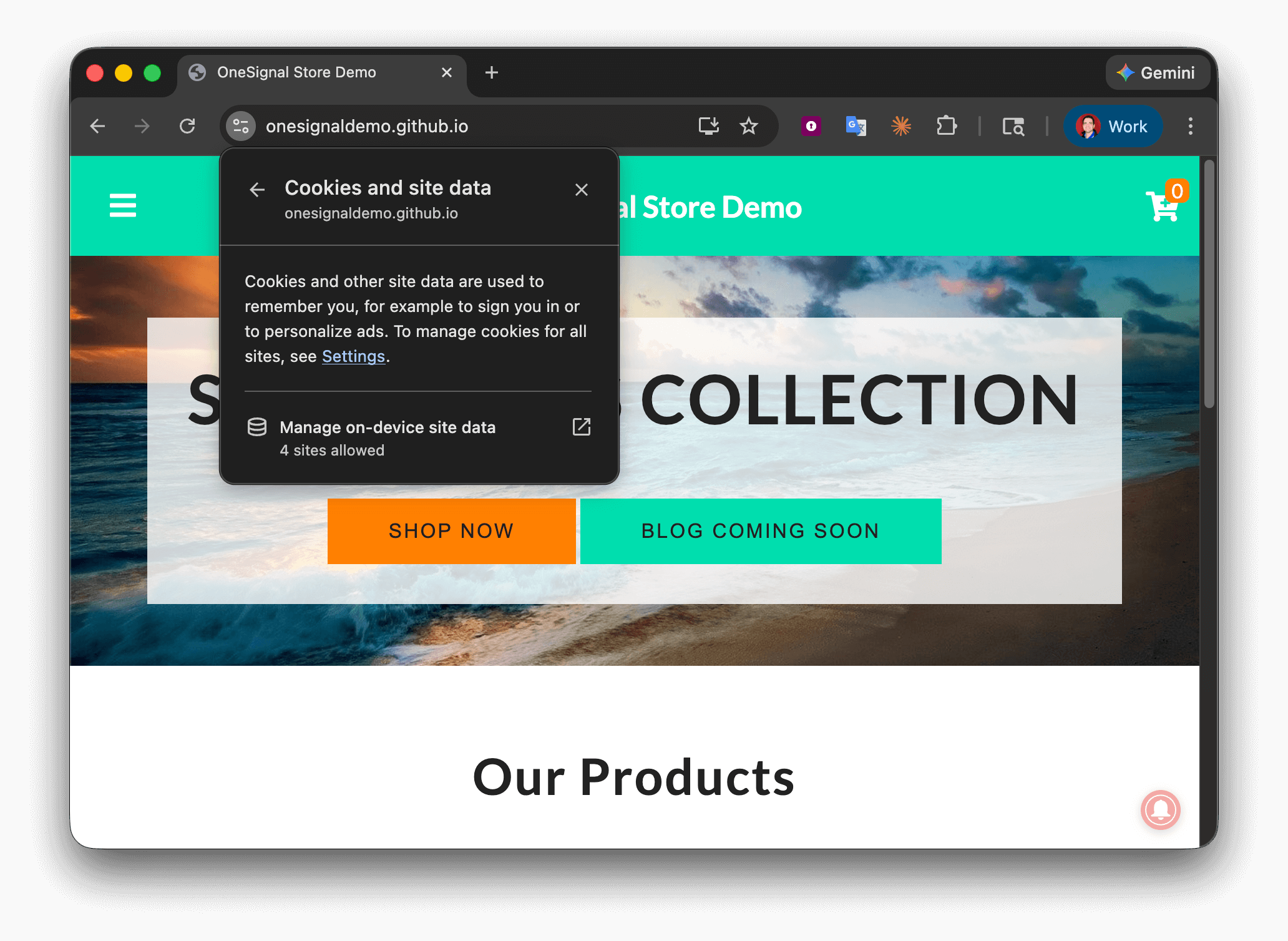
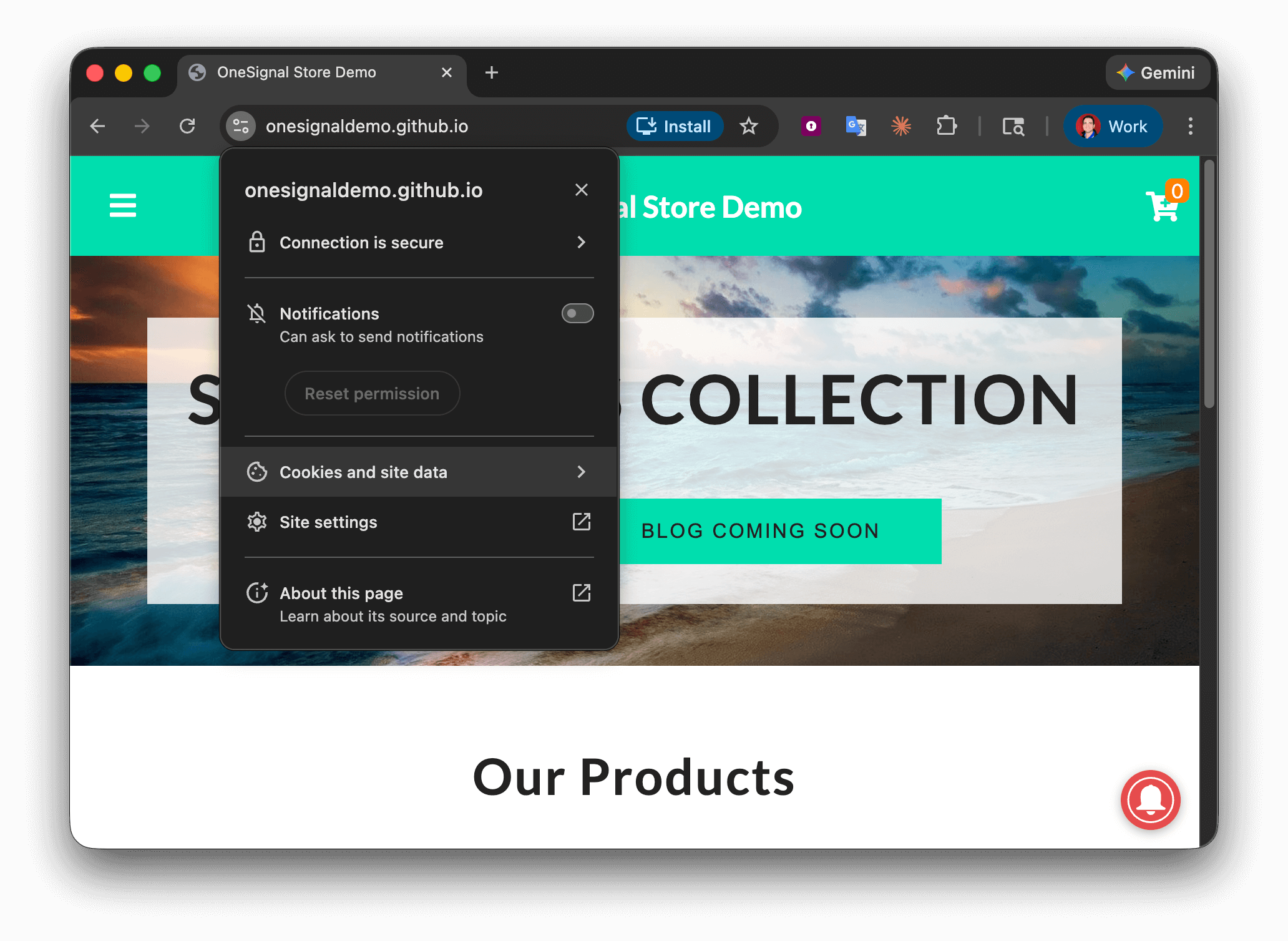 4. Click **Manage on-device site data**.
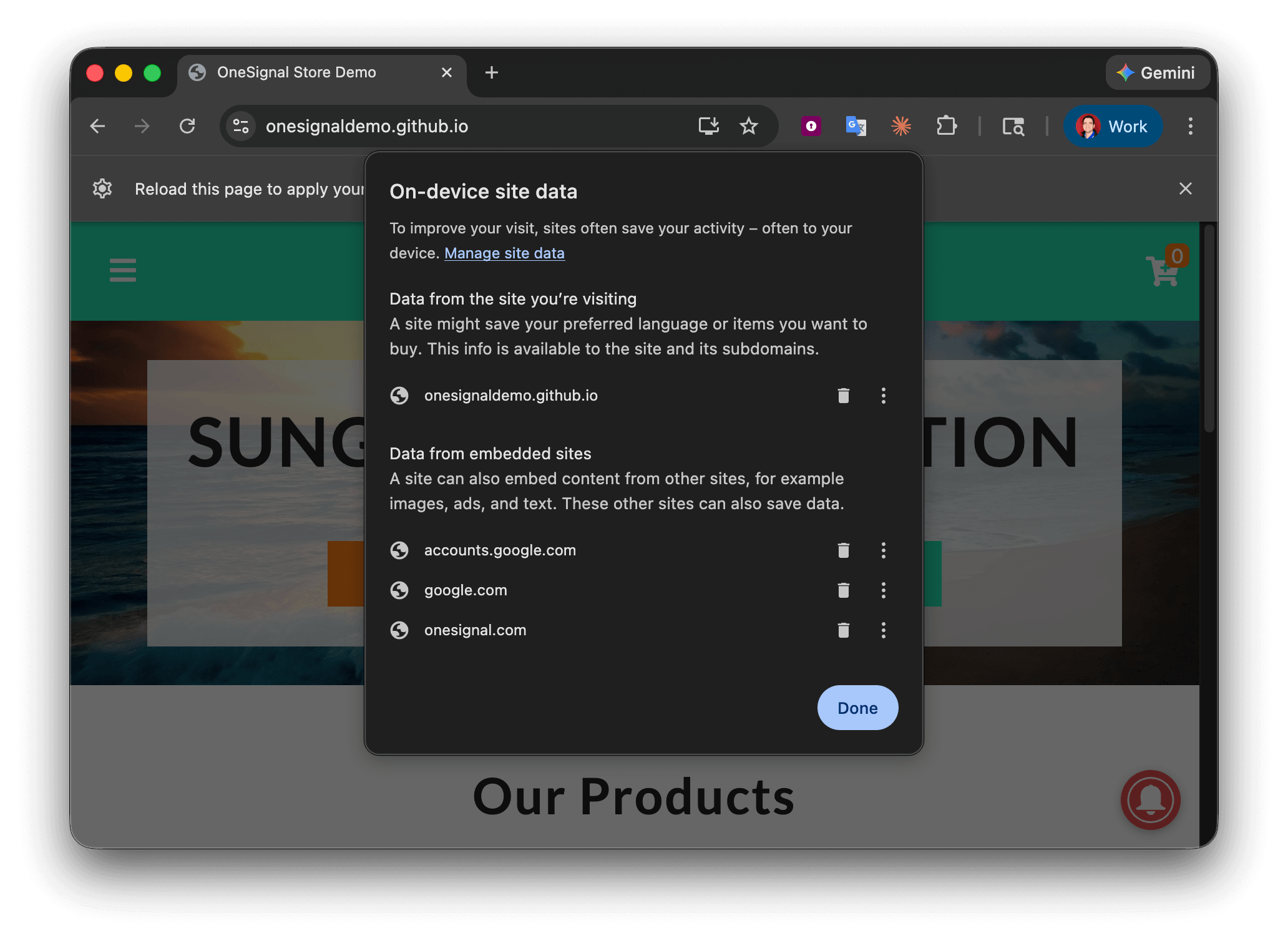
 5. Click the **Trash Icon** next to:
* Your site URL
* `onesignal.com`
Then click **Done**.
5. Click the **Trash Icon** next to:
* Your site URL
* `onesignal.com`
Then click **Done**.
 6. Close the tab and open your site again in a new tab.
1. When you return to your site in a new tab, right click the page and select **Inspect** to open the Console.
2. Follow the steps you set up to trigger the native browser permission prompt and allow notifications. See [Web permission prompts](./permission-requests) for more details.
6. Close the tab and open your site again in a new tab.
1. When you return to your site in a new tab, right click the page and select **Inspect** to open the Console.
2. Follow the steps you set up to trigger the native browser permission prompt and allow notifications. See [Web permission prompts](./permission-requests) for more details.
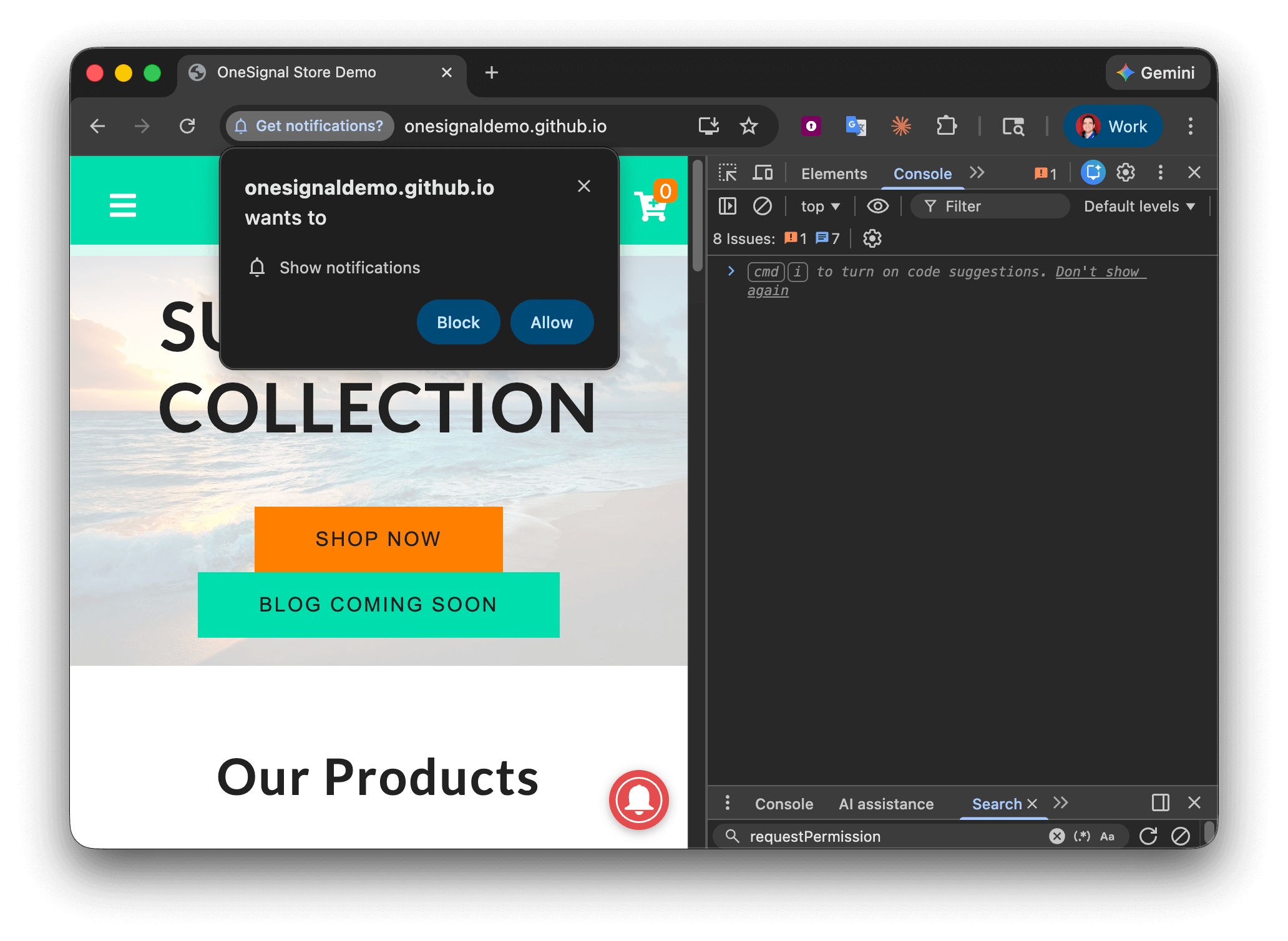 3. Click **Allow** to subscribe to push notifications.
4. Check the **Console** for any errors. If you see anything in red related to OneSignal, see our [Web SDK troubleshooting](./troubleshooting-web-push) docs.
1. In the **Console**, run the following code to get your Subscription ID:
```javascript JavaScript theme={null}
OneSignal.User.PushSubscription.id
```
3. Click **Allow** to subscribe to push notifications.
4. Check the **Console** for any errors. If you see anything in red related to OneSignal, see our [Web SDK troubleshooting](./troubleshooting-web-push) docs.
1. In the **Console**, run the following code to get your Subscription ID:
```javascript JavaScript theme={null}
OneSignal.User.PushSubscription.id
```
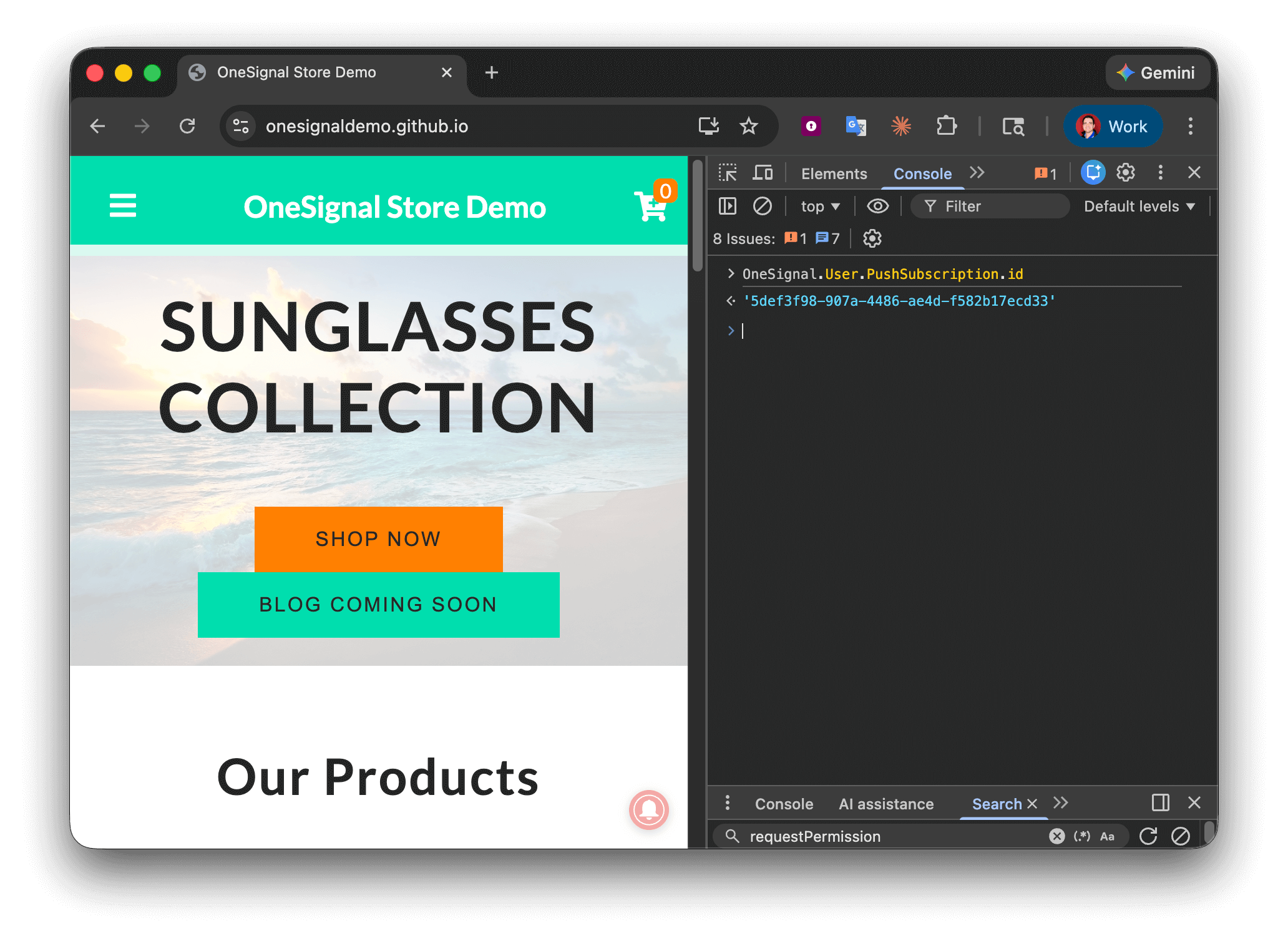 2. Copy the ID without quotes.
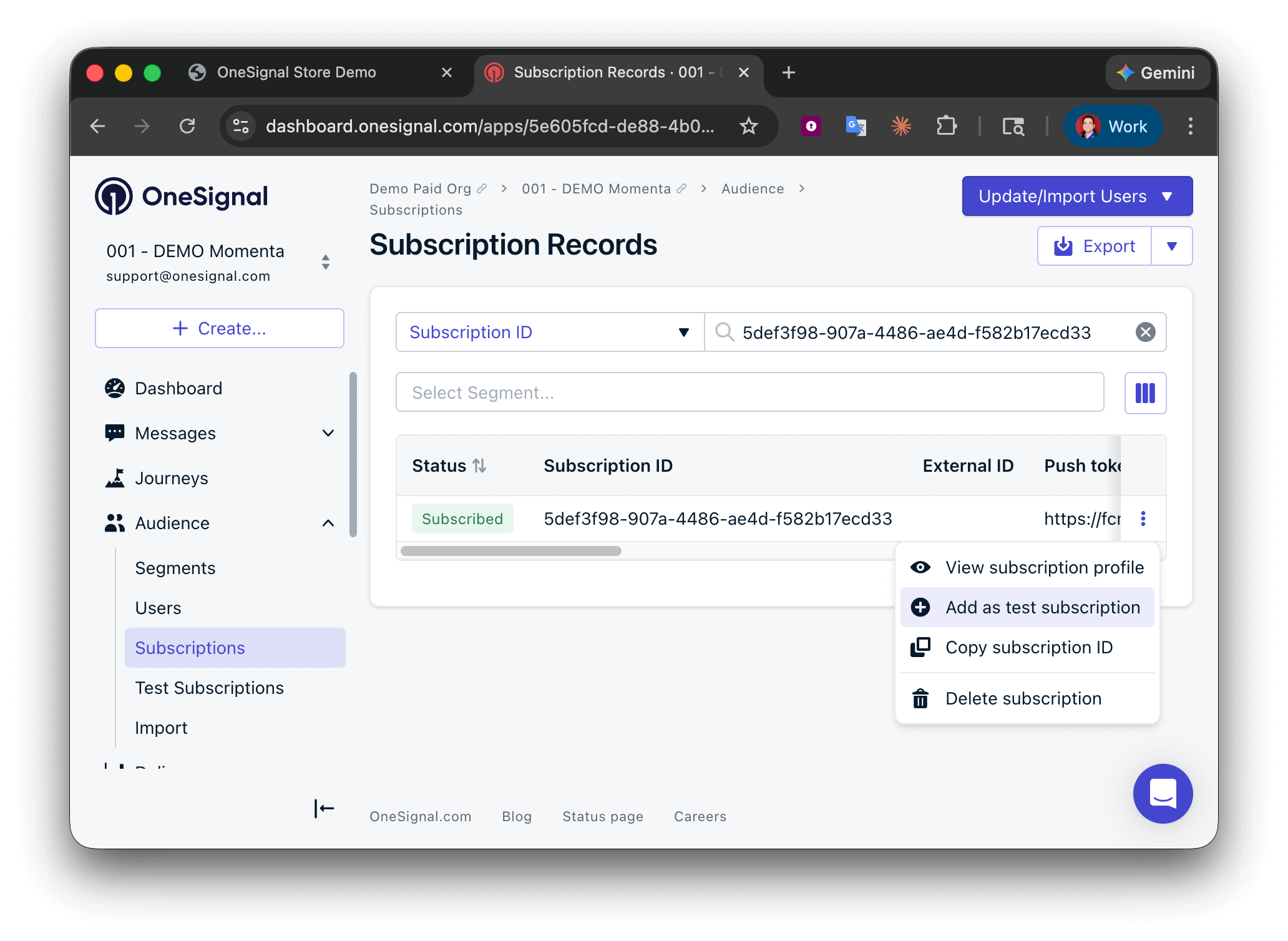
3. In the OneSignal dashboard, navigate to **Audience > Subscriptions**, paste the Subscription ID (without quotes) in the search bar, click the **Options** button, and select **Add as test user**.
2. Copy the ID without quotes.
3. In the OneSignal dashboard, navigate to **Audience > Subscriptions**, paste the Subscription ID (without quotes) in the search bar, click the **Options** button, and select **Add as test user**.
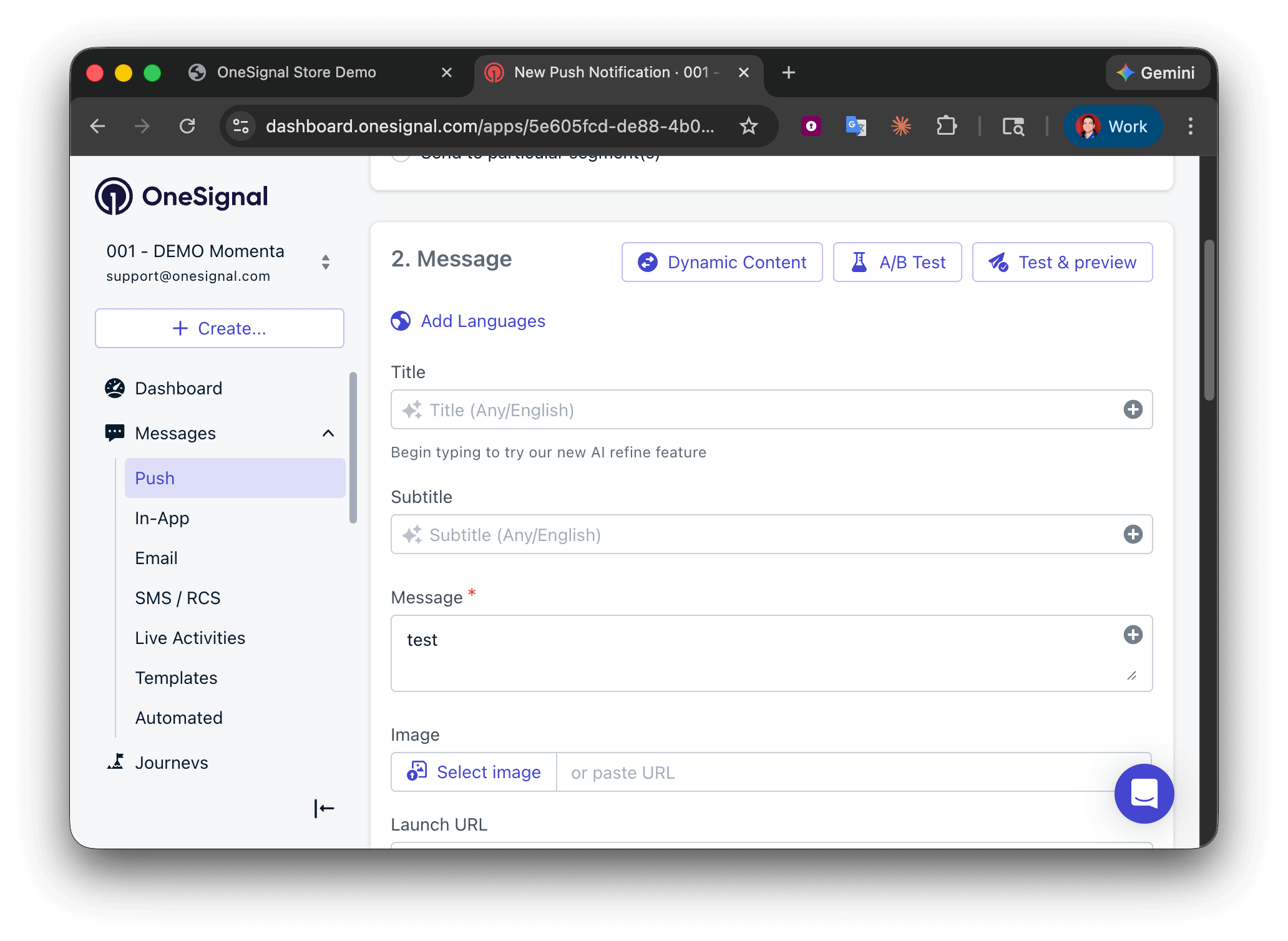
 1. Navigate to **Messages > New Push** and write a message in the **Message** field.
2. Under **Test & Preview**, select your test user and send the push to yourself.
1. Navigate to **Messages > New Push** and write a message in the **Message** field.
2. Under **Test & Preview**, select your test user and send the push to yourself.
 Success! You should receive the push you tested.
If you did not receive the push, review this entire guide one more time and try again.
Need help?
Chat with our Support team or email `support@onesignal.com`
Please include:
* Your OneSignal App ID
* The Subscription ID or External ID
* The URL to the message you tested in the OneSignal Dashboard
* The URL to your site with the OneSignal web SDK code
We're happy to help!
Success! You should receive the push you tested.
If you did not receive the push, review this entire guide one more time and try again.
Need help?
Chat with our Support team or email `support@onesignal.com`
Please include:
* Your OneSignal App ID
* The Subscription ID or External ID
* The URL to the message you tested in the OneSignal Dashboard
* The URL to your site with the OneSignal web SDK code
We're happy to help!