> ## Documentation Index
> Fetch the complete documentation index at: https://documentation.onesignal.com/llms.txt
> Use this file to discover all available pages before exploring further.
# Delete template
> Permanently delete a specific message template from your OneSignal app using its template ID. Templates used in Journeys must be removed from those Journeys before deletion.
## Overview
This endpoint allows you to delete a single template associated with your OneSignal app. Deletion is **immediate and irreversible**.
If the template is currently used in a Journey, it cannot be deleted until that Journey has been deleted.
***
## How to use this API
Required Parameters
* `template_id` (path param): The OneSignal-generated UUID of the template to delete.
* `app_id` (query param): Your OneSignal App ID.
### Where to Find `template_id`
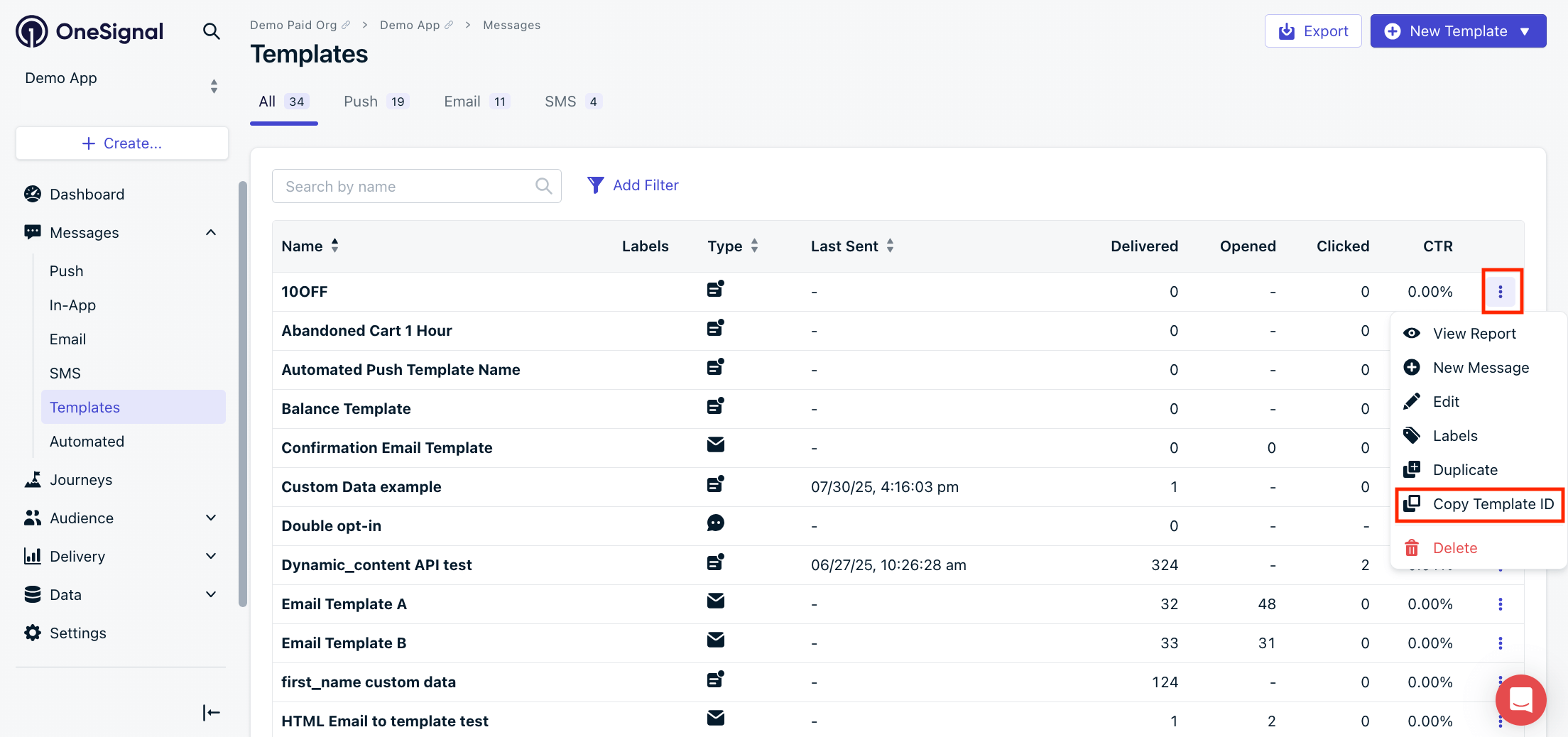
Each template has a unique OneSignal-generated `template_id` (UUID v4). You can find it:
* Using the [View Templates API](/reference/view-templates)
* In the OneSignal Dashboard under **Messages > Templates > Options > Copy Template ID**
 ***
## OpenAPI
````yaml DELETE /templates/{template_id}?app_id={app_id}
openapi: 3.1.0
info:
title: api.onesignal.com
version: '11.6'
servers:
- url: https://api.onesignal.com
security:
- {}
paths:
/templates/{template_id}?app_id={app_id}:
delete:
summary: Delete template
description: >-
Permanently delete a specific message template from your OneSignal app
using its template ID. Templates used in Journeys must be removed from
those Journeys before deletion.
operationId: delete-template
parameters:
- name: template_id
in: path
description: The template ID in UUID v4 format. See [Templates](/docs/templates).
schema:
type: string
default: YOUR_TEMPLATE_ID
required: true
- name: app_id
in: query
description: >-
Your OneSignal App ID in UUID v4 format. See [Keys &
IDs](/docs/en/keys-and-ids).
required: true
schema:
type: string
default: YOUR_APP_ID
- name: Authorization
in: header
description: >-
Your App's API key found in [Settings > Keys &
IDs](/docs/en/keys-and-ids).
required: true
schema:
type: string
default: Key YOUR_APP_API_KEY
responses:
'200':
description: '200'
content:
application/json:
schema:
type: object
properties:
success:
type: boolean
example: true
'400':
description: '400'
content:
application/json:
schema:
oneOf:
- title: Bad Request (Missing App ID)
type: object
properties:
errors:
type: array
items:
type: string
example: >-
Request is malformed: Failed to parse app_id from
request
- title: Bad Request (Template In Use)
type: object
properties:
success:
type: boolean
example: false
default: true
errors:
type: array
items:
type: string
example: >-
Can not delete a template that has journeys using
it.
'404':
description: '404'
content:
application/json:
schema:
$ref: '#/components/schemas/BasicErrorResponse'
example:
errors:
- template not found
'429':
description: '429'
content:
application/json:
schema:
$ref: '#/components/schemas/StructuredErrorResponse'
example:
errors:
- code: Rate Limit Exceeded
title: Example error title
headers:
Retry-After:
description: >-
Number of seconds to wait before retrying the request. Always
emitted on 429 responses.
schema:
type: integer
minimum: 0
'503':
description: >-
Service temporarily unavailable. Retry after a short backoff. The
body may be empty or non-JSON in some failure modes.
headers:
Retry-After:
description: >-
Number of seconds to wait before retrying. Optional — may be
absent when the response is generated upstream.
schema:
type: integer
minimum: 0
content:
application/json:
schema:
$ref: '#/components/schemas/BasicErrorResponse'
example:
errors:
- Service temporarily unavailable
deprecated: false
security: []
x-codeSamples:
- lang: typescript
label: Node.js SDK
source: |-
import Onesignal from '@onesignal/node-onesignal';
const configuration = Onesignal.createConfiguration({
restApiKey: 'YOUR_REST_API_KEY',
});
const apiInstance = new Onesignal.DefaultApi(configuration);
// string
const templateId: string = "e4d3c2b1-a09f-4f1e-8d7c-6b5a4f3e2d1c";
// string
const appId: string = "00000000-0000-0000-0000-000000000000";
try {
const response = await apiInstance.deleteTemplate(templateId, appId);
console.log(response);
} catch (e) {
if (e instanceof Onesignal.ApiException) {
// `e.errorMessages` flattens any error-envelope shape to a `string[]`;
// the raw parsed body remains on `e.body`.
console.error("deleteTemplate failed: HTTP " + e.code, e.errorMessages);
} else {
throw e;
}
}
- lang: python
label: Python SDK
source: >-
import onesignal
from onesignal.api import default_api
from onesignal.models import *
from pprint import pprint
# See configuration.py for a list of all supported configuration
parameters.
# Some of the OneSignal endpoints require ORGANIZATION_API_KEY token
for authorization, while others require REST_API_KEY.
# We recommend adding both of them in the configuration page so that
you will not need to figure it out yourself.
configuration = onesignal.Configuration(
rest_api_key = "YOUR_REST_API_KEY", # App REST API key required for most endpoints
organization_api_key = "YOUR_ORGANIZATION_API_KEY" # Organization key is only required for creating new apps and other top-level endpoints
)
# Enter a context with an instance of the API client
with onesignal.ApiClient(configuration) as api_client:
# Create an instance of the API class
api_instance = default_api.DefaultApi(api_client)
template_id = "e4d3c2b1-a09f-4f1e-8d7c-6b5a4f3e2d1c"
app_id = "00000000-0000-0000-0000-000000000000"
try:
# Delete template
api_response = api_instance.delete_template(template_id, app_id)
pprint(api_response)
except onesignal.ApiException as e:
print("Exception when calling DefaultApi->delete_template: %s\n" % e)
print("Status Code: %s" % e.status)
print("Response Body: %s" % e.body)
- lang: php
label: PHP SDK
source: |-
setRestApiKeyToken('YOUR_REST_API_KEY')
->setOrganizationApiKeyToken('YOUR_ORGANIZATION_API_KEY');
$apiInstance = new onesignal\client\Api\DefaultApi(
// If you want use custom http client, pass your client which implements `GuzzleHttp\ClientInterface`.
// This is optional, `GuzzleHttp\Client` will be used as default.
new GuzzleHttp\Client(),
$config
);
$template_id = 'e4d3c2b1-a09f-4f1e-8d7c-6b5a4f3e2d1c'; // string
$app_id = '00000000-0000-0000-0000-000000000000'; // string
try {
$result = $apiInstance->deleteTemplate($template_id, $app_id);
print_r($result);
} catch (\onesignal\client\ApiException $e) {
echo 'Exception when calling DefaultApi->deleteTemplate: ', $e->getMessage(), PHP_EOL;
echo 'Status Code: ', $e->getCode(), PHP_EOL;
// getErrorMessages() flattens any error-envelope shape to a string[];
// the raw body remains on getResponseBody().
echo 'Error Messages: ', implode(', ', $e->getErrorMessages()), PHP_EOL;
echo 'Response Body: ', $e->getResponseBody(), PHP_EOL;
} catch (\Exception $e) {
echo 'Exception when calling DefaultApi->deleteTemplate: ', $e->getMessage(), PHP_EOL;
}
- lang: go
label: Go SDK
source: |-
package main
import (
"context"
"fmt"
"os"
"github.com/OneSignal/onesignal-go-api/v5"
)
func main() {
templateId := "e4d3c2b1-a09f-4f1e-8d7c-6b5a4f3e2d1c" // string |
appId := "00000000-0000-0000-0000-000000000000" // string |
configuration := onesignal.NewConfiguration()
apiClient := onesignal.NewAPIClient(configuration)
restAuth := context.WithValue(context.Background(), onesignal.RestApiKey, "YOUR_REST_API_KEY") // App REST API key required for most endpoints
resp, r, err := apiClient.DefaultApi.DeleteTemplate(restAuth, templateId).AppId(appId).Execute()
if err != nil {
fmt.Fprintf(os.Stderr, "Error when calling `DefaultApi.DeleteTemplate``: %v\n", err)
fmt.Fprintf(os.Stderr, "Full HTTP response: %v\n", r)
if apiErr, ok := err.(*onesignal.GenericOpenAPIError); ok {
// ErrorMessages() flattens any error-envelope shape to a []string;
// the raw body remains on Body().
fmt.Fprintf(os.Stderr, "Error Messages: %v\n", apiErr.ErrorMessages())
fmt.Fprintf(os.Stderr, "Response Body: %s\n", apiErr.Body())
}
}
// response from `DeleteTemplate`: GenericSuccessBoolResponse
fmt.Fprintf(os.Stdout, "Response from `DefaultApi.DeleteTemplate`: %v\n", resp)
}
- lang: ruby
label: Ruby SDK
source: |-
require 'onesignal'
# setup authorization
OneSignal.configure do |config|
# Configure Bearer authorization: rest_api_key
config.rest_api_key = 'YOUR_REST_API_KEY'
end
api_instance = OneSignal::DefaultApi.new
template_id = 'e4d3c2b1-a09f-4f1e-8d7c-6b5a4f3e2d1c' # String |
app_id = '00000000-0000-0000-0000-000000000000' # String |
begin
# Delete template
result = api_instance.delete_template(template_id, app_id)
p result
rescue OneSignal::ApiError => e
puts "Error when calling DefaultApi->delete_template: #{e}"
puts "Status Code: #{e.code}"
# `e.error_messages` flattens any error-envelope shape to an Array;
# the raw body remains on `e.response_body`.
puts "Error Messages: #{e.error_messages}"
puts "Response Body: #{e.response_body}"
end
- lang: java
label: Java SDK
source: |-
// Import classes:
import com.onesignal.client.ApiClient;
import com.onesignal.client.ApiException;
import com.onesignal.client.Configuration;
import com.onesignal.client.auth.*;
import com.onesignal.client.model.*;
import com.onesignal.client.api.DefaultApi;
public class Example {
public static void main(String[] args) {
ApiClient defaultClient = Configuration.getDefaultApiClient();
defaultClient.setBasePath("https://api.onesignal.com");
// Configure HTTP bearer authorization: rest_api_key
HttpBearerAuth rest_api_key = (HttpBearerAuth) defaultClient.getAuthentication("rest_api_key");
rest_api_key.setBearerToken("YOUR_REST_API_KEY");
DefaultApi apiInstance = new DefaultApi(defaultClient);
String templateId = "e4d3c2b1-a09f-4f1e-8d7c-6b5a4f3e2d1c"; // String |
String appId = "00000000-0000-0000-0000-000000000000"; // String |
try {
GenericSuccessBoolResponse result = apiInstance.deleteTemplate(templateId, appId);
System.out.println(result);
} catch (ApiException e) {
System.err.println("Exception when calling DefaultApi#deleteTemplate");
System.err.println("Status code: " + e.getCode());
// getErrorMessages() flattens any error-envelope shape to a List;
// the raw body remains on getResponseBody().
System.err.println("Error messages: " + e.getErrorMessages());
System.err.println("Reason: " + e.getResponseBody());
System.err.println("Response headers: " + e.getResponseHeaders());
e.printStackTrace();
}
}
}
- lang: csharp
label: C# SDK
source: |-
using System;
using System.Collections.Generic;
using System.Diagnostics;
using OneSignalApi.Api;
using OneSignalApi.Client;
using OneSignalApi.Model;
namespace Example
{
public class DeleteTemplateExample
{
public static void Main()
{
Configuration config = new Configuration();
config.BasePath = "https://api.onesignal.com";
// Configure Bearer token for authorization: rest_api_key
config.AccessToken = "YOUR_REST_API_KEY";
var apiInstance = new DefaultApi(config);
var templateId = "e4d3c2b1-a09f-4f1e-8d7c-6b5a4f3e2d1c"; // string |
var appId = "00000000-0000-0000-0000-000000000000"; // string |
try
{
// Delete template
GenericSuccessBoolResponse result = apiInstance.DeleteTemplate(templateId, appId);
Debug.WriteLine(result);
}
catch (ApiException e)
{
Debug.Print("Exception when calling DefaultApi.DeleteTemplate: " + e.Message );
Debug.Print("Status Code: "+ e.ErrorCode);
// e.ErrorMessages flattens any error-envelope shape to an IReadOnlyList;
// the raw body remains on e.ErrorContent.
Debug.Print("Error Messages: " + string.Join(", ", e.ErrorMessages));
Debug.Print("Response Body: " + e.ErrorContent);
Debug.Print(e.StackTrace);
}
}
}
}
- lang: rust
label: Rust SDK
source: |-
use onesignal_rust_api::apis::configuration::Configuration;
use onesignal_rust_api::apis::default_api;
#[tokio::main]
async fn main() {
let mut configuration = Configuration::new();
configuration.rest_api_key_token = Some("YOUR_REST_API_KEY".to_string());
// Realistic values are pulled from the spec's `example:` fields where present.
let template_id: &str = "e4d3c2b1-a09f-4f1e-8d7c-6b5a4f3e2d1c";
let app_id: &str = "00000000-0000-0000-0000-000000000000";
match default_api::delete_template(&configuration, template_id, app_id).await {
Ok(resp) => println!("{:?}", resp),
Err(e @ onesignal_rust_api::apis::Error::ResponseError(_)) => {
// `e.error_messages()` flattens any error-envelope shape to a Vec;
// the raw response remains on the ResponseError variant.
eprintln!("delete_template failed: {:?}", e.error_messages());
}
Err(e) => eprintln!("delete_template failed: {:?}", e),
}
}
components:
schemas:
BasicErrorResponse:
type: object
properties:
errors:
type: array
items:
type: string
description: One or more human-readable error messages.
success:
type: boolean
description: >-
Present (and `false`) on some endpoints (notifications, templates,
segments). Not emitted by every endpoint.
reference:
type: array
items:
type: string
description: >-
Documentation URL fragments related to the error. Only emitted by
the API-key auth error helpers.
StructuredErrorResponse:
type: object
properties:
errors:
type: array
items:
$ref: '#/components/schemas/StructuredErrorItem'
StructuredErrorItem:
type: object
required:
- code
- title
properties:
code:
type: string
description: >-
Stable error-code identifier. Use this for programmatic branching in
your integration.
title:
type: string
description: >-
Human-readable error message intended for logs and operator-facing
surfaces.
meta:
type: object
additionalProperties: true
description: >-
Optional structured details about this specific error. The shape of
`meta` varies by `code` — for example, the create-user `Conflict`
code returns `{ conflicting_aliases: { [alias_label]: alias_id } }`.
````
***
## OpenAPI
````yaml DELETE /templates/{template_id}?app_id={app_id}
openapi: 3.1.0
info:
title: api.onesignal.com
version: '11.6'
servers:
- url: https://api.onesignal.com
security:
- {}
paths:
/templates/{template_id}?app_id={app_id}:
delete:
summary: Delete template
description: >-
Permanently delete a specific message template from your OneSignal app
using its template ID. Templates used in Journeys must be removed from
those Journeys before deletion.
operationId: delete-template
parameters:
- name: template_id
in: path
description: The template ID in UUID v4 format. See [Templates](/docs/templates).
schema:
type: string
default: YOUR_TEMPLATE_ID
required: true
- name: app_id
in: query
description: >-
Your OneSignal App ID in UUID v4 format. See [Keys &
IDs](/docs/en/keys-and-ids).
required: true
schema:
type: string
default: YOUR_APP_ID
- name: Authorization
in: header
description: >-
Your App's API key found in [Settings > Keys &
IDs](/docs/en/keys-and-ids).
required: true
schema:
type: string
default: Key YOUR_APP_API_KEY
responses:
'200':
description: '200'
content:
application/json:
schema:
type: object
properties:
success:
type: boolean
example: true
'400':
description: '400'
content:
application/json:
schema:
oneOf:
- title: Bad Request (Missing App ID)
type: object
properties:
errors:
type: array
items:
type: string
example: >-
Request is malformed: Failed to parse app_id from
request
- title: Bad Request (Template In Use)
type: object
properties:
success:
type: boolean
example: false
default: true
errors:
type: array
items:
type: string
example: >-
Can not delete a template that has journeys using
it.
'404':
description: '404'
content:
application/json:
schema:
$ref: '#/components/schemas/BasicErrorResponse'
example:
errors:
- template not found
'429':
description: '429'
content:
application/json:
schema:
$ref: '#/components/schemas/StructuredErrorResponse'
example:
errors:
- code: Rate Limit Exceeded
title: Example error title
headers:
Retry-After:
description: >-
Number of seconds to wait before retrying the request. Always
emitted on 429 responses.
schema:
type: integer
minimum: 0
'503':
description: >-
Service temporarily unavailable. Retry after a short backoff. The
body may be empty or non-JSON in some failure modes.
headers:
Retry-After:
description: >-
Number of seconds to wait before retrying. Optional — may be
absent when the response is generated upstream.
schema:
type: integer
minimum: 0
content:
application/json:
schema:
$ref: '#/components/schemas/BasicErrorResponse'
example:
errors:
- Service temporarily unavailable
deprecated: false
security: []
x-codeSamples:
- lang: typescript
label: Node.js SDK
source: |-
import Onesignal from '@onesignal/node-onesignal';
const configuration = Onesignal.createConfiguration({
restApiKey: 'YOUR_REST_API_KEY',
});
const apiInstance = new Onesignal.DefaultApi(configuration);
// string
const templateId: string = "e4d3c2b1-a09f-4f1e-8d7c-6b5a4f3e2d1c";
// string
const appId: string = "00000000-0000-0000-0000-000000000000";
try {
const response = await apiInstance.deleteTemplate(templateId, appId);
console.log(response);
} catch (e) {
if (e instanceof Onesignal.ApiException) {
// `e.errorMessages` flattens any error-envelope shape to a `string[]`;
// the raw parsed body remains on `e.body`.
console.error("deleteTemplate failed: HTTP " + e.code, e.errorMessages);
} else {
throw e;
}
}
- lang: python
label: Python SDK
source: >-
import onesignal
from onesignal.api import default_api
from onesignal.models import *
from pprint import pprint
# See configuration.py for a list of all supported configuration
parameters.
# Some of the OneSignal endpoints require ORGANIZATION_API_KEY token
for authorization, while others require REST_API_KEY.
# We recommend adding both of them in the configuration page so that
you will not need to figure it out yourself.
configuration = onesignal.Configuration(
rest_api_key = "YOUR_REST_API_KEY", # App REST API key required for most endpoints
organization_api_key = "YOUR_ORGANIZATION_API_KEY" # Organization key is only required for creating new apps and other top-level endpoints
)
# Enter a context with an instance of the API client
with onesignal.ApiClient(configuration) as api_client:
# Create an instance of the API class
api_instance = default_api.DefaultApi(api_client)
template_id = "e4d3c2b1-a09f-4f1e-8d7c-6b5a4f3e2d1c"
app_id = "00000000-0000-0000-0000-000000000000"
try:
# Delete template
api_response = api_instance.delete_template(template_id, app_id)
pprint(api_response)
except onesignal.ApiException as e:
print("Exception when calling DefaultApi->delete_template: %s\n" % e)
print("Status Code: %s" % e.status)
print("Response Body: %s" % e.body)
- lang: php
label: PHP SDK
source: |-
setRestApiKeyToken('YOUR_REST_API_KEY')
->setOrganizationApiKeyToken('YOUR_ORGANIZATION_API_KEY');
$apiInstance = new onesignal\client\Api\DefaultApi(
// If you want use custom http client, pass your client which implements `GuzzleHttp\ClientInterface`.
// This is optional, `GuzzleHttp\Client` will be used as default.
new GuzzleHttp\Client(),
$config
);
$template_id = 'e4d3c2b1-a09f-4f1e-8d7c-6b5a4f3e2d1c'; // string
$app_id = '00000000-0000-0000-0000-000000000000'; // string
try {
$result = $apiInstance->deleteTemplate($template_id, $app_id);
print_r($result);
} catch (\onesignal\client\ApiException $e) {
echo 'Exception when calling DefaultApi->deleteTemplate: ', $e->getMessage(), PHP_EOL;
echo 'Status Code: ', $e->getCode(), PHP_EOL;
// getErrorMessages() flattens any error-envelope shape to a string[];
// the raw body remains on getResponseBody().
echo 'Error Messages: ', implode(', ', $e->getErrorMessages()), PHP_EOL;
echo 'Response Body: ', $e->getResponseBody(), PHP_EOL;
} catch (\Exception $e) {
echo 'Exception when calling DefaultApi->deleteTemplate: ', $e->getMessage(), PHP_EOL;
}
- lang: go
label: Go SDK
source: |-
package main
import (
"context"
"fmt"
"os"
"github.com/OneSignal/onesignal-go-api/v5"
)
func main() {
templateId := "e4d3c2b1-a09f-4f1e-8d7c-6b5a4f3e2d1c" // string |
appId := "00000000-0000-0000-0000-000000000000" // string |
configuration := onesignal.NewConfiguration()
apiClient := onesignal.NewAPIClient(configuration)
restAuth := context.WithValue(context.Background(), onesignal.RestApiKey, "YOUR_REST_API_KEY") // App REST API key required for most endpoints
resp, r, err := apiClient.DefaultApi.DeleteTemplate(restAuth, templateId).AppId(appId).Execute()
if err != nil {
fmt.Fprintf(os.Stderr, "Error when calling `DefaultApi.DeleteTemplate``: %v\n", err)
fmt.Fprintf(os.Stderr, "Full HTTP response: %v\n", r)
if apiErr, ok := err.(*onesignal.GenericOpenAPIError); ok {
// ErrorMessages() flattens any error-envelope shape to a []string;
// the raw body remains on Body().
fmt.Fprintf(os.Stderr, "Error Messages: %v\n", apiErr.ErrorMessages())
fmt.Fprintf(os.Stderr, "Response Body: %s\n", apiErr.Body())
}
}
// response from `DeleteTemplate`: GenericSuccessBoolResponse
fmt.Fprintf(os.Stdout, "Response from `DefaultApi.DeleteTemplate`: %v\n", resp)
}
- lang: ruby
label: Ruby SDK
source: |-
require 'onesignal'
# setup authorization
OneSignal.configure do |config|
# Configure Bearer authorization: rest_api_key
config.rest_api_key = 'YOUR_REST_API_KEY'
end
api_instance = OneSignal::DefaultApi.new
template_id = 'e4d3c2b1-a09f-4f1e-8d7c-6b5a4f3e2d1c' # String |
app_id = '00000000-0000-0000-0000-000000000000' # String |
begin
# Delete template
result = api_instance.delete_template(template_id, app_id)
p result
rescue OneSignal::ApiError => e
puts "Error when calling DefaultApi->delete_template: #{e}"
puts "Status Code: #{e.code}"
# `e.error_messages` flattens any error-envelope shape to an Array;
# the raw body remains on `e.response_body`.
puts "Error Messages: #{e.error_messages}"
puts "Response Body: #{e.response_body}"
end
- lang: java
label: Java SDK
source: |-
// Import classes:
import com.onesignal.client.ApiClient;
import com.onesignal.client.ApiException;
import com.onesignal.client.Configuration;
import com.onesignal.client.auth.*;
import com.onesignal.client.model.*;
import com.onesignal.client.api.DefaultApi;
public class Example {
public static void main(String[] args) {
ApiClient defaultClient = Configuration.getDefaultApiClient();
defaultClient.setBasePath("https://api.onesignal.com");
// Configure HTTP bearer authorization: rest_api_key
HttpBearerAuth rest_api_key = (HttpBearerAuth) defaultClient.getAuthentication("rest_api_key");
rest_api_key.setBearerToken("YOUR_REST_API_KEY");
DefaultApi apiInstance = new DefaultApi(defaultClient);
String templateId = "e4d3c2b1-a09f-4f1e-8d7c-6b5a4f3e2d1c"; // String |
String appId = "00000000-0000-0000-0000-000000000000"; // String |
try {
GenericSuccessBoolResponse result = apiInstance.deleteTemplate(templateId, appId);
System.out.println(result);
} catch (ApiException e) {
System.err.println("Exception when calling DefaultApi#deleteTemplate");
System.err.println("Status code: " + e.getCode());
// getErrorMessages() flattens any error-envelope shape to a List;
// the raw body remains on getResponseBody().
System.err.println("Error messages: " + e.getErrorMessages());
System.err.println("Reason: " + e.getResponseBody());
System.err.println("Response headers: " + e.getResponseHeaders());
e.printStackTrace();
}
}
}
- lang: csharp
label: C# SDK
source: |-
using System;
using System.Collections.Generic;
using System.Diagnostics;
using OneSignalApi.Api;
using OneSignalApi.Client;
using OneSignalApi.Model;
namespace Example
{
public class DeleteTemplateExample
{
public static void Main()
{
Configuration config = new Configuration();
config.BasePath = "https://api.onesignal.com";
// Configure Bearer token for authorization: rest_api_key
config.AccessToken = "YOUR_REST_API_KEY";
var apiInstance = new DefaultApi(config);
var templateId = "e4d3c2b1-a09f-4f1e-8d7c-6b5a4f3e2d1c"; // string |
var appId = "00000000-0000-0000-0000-000000000000"; // string |
try
{
// Delete template
GenericSuccessBoolResponse result = apiInstance.DeleteTemplate(templateId, appId);
Debug.WriteLine(result);
}
catch (ApiException e)
{
Debug.Print("Exception when calling DefaultApi.DeleteTemplate: " + e.Message );
Debug.Print("Status Code: "+ e.ErrorCode);
// e.ErrorMessages flattens any error-envelope shape to an IReadOnlyList;
// the raw body remains on e.ErrorContent.
Debug.Print("Error Messages: " + string.Join(", ", e.ErrorMessages));
Debug.Print("Response Body: " + e.ErrorContent);
Debug.Print(e.StackTrace);
}
}
}
}
- lang: rust
label: Rust SDK
source: |-
use onesignal_rust_api::apis::configuration::Configuration;
use onesignal_rust_api::apis::default_api;
#[tokio::main]
async fn main() {
let mut configuration = Configuration::new();
configuration.rest_api_key_token = Some("YOUR_REST_API_KEY".to_string());
// Realistic values are pulled from the spec's `example:` fields where present.
let template_id: &str = "e4d3c2b1-a09f-4f1e-8d7c-6b5a4f3e2d1c";
let app_id: &str = "00000000-0000-0000-0000-000000000000";
match default_api::delete_template(&configuration, template_id, app_id).await {
Ok(resp) => println!("{:?}", resp),
Err(e @ onesignal_rust_api::apis::Error::ResponseError(_)) => {
// `e.error_messages()` flattens any error-envelope shape to a Vec;
// the raw response remains on the ResponseError variant.
eprintln!("delete_template failed: {:?}", e.error_messages());
}
Err(e) => eprintln!("delete_template failed: {:?}", e),
}
}
components:
schemas:
BasicErrorResponse:
type: object
properties:
errors:
type: array
items:
type: string
description: One or more human-readable error messages.
success:
type: boolean
description: >-
Present (and `false`) on some endpoints (notifications, templates,
segments). Not emitted by every endpoint.
reference:
type: array
items:
type: string
description: >-
Documentation URL fragments related to the error. Only emitted by
the API-key auth error helpers.
StructuredErrorResponse:
type: object
properties:
errors:
type: array
items:
$ref: '#/components/schemas/StructuredErrorItem'
StructuredErrorItem:
type: object
required:
- code
- title
properties:
code:
type: string
description: >-
Stable error-code identifier. Use this for programmatic branching in
your integration.
title:
type: string
description: >-
Human-readable error message intended for logs and operator-facing
surfaces.
meta:
type: object
additionalProperties: true
description: >-
Optional structured details about this specific error. The shape of
`meta` varies by `code` — for example, the create-user `Conflict`
code returns `{ conflicting_aliases: { [alias_label]: alias_id } }`.
````