

セットアップとデバッグ
これらのメソッドは、アプリにOneSignal SDKを統合するためのリファレンスです。プラットフォーム固有の完全なセットアップ手順については、モバイルSDKセットアップを参照してください。initialize()
OneSignal SDKを初期化します。これはアプリケーションの起動時に呼び出す必要があります。ONESIGNAL_APP_IDはキーとIDで確認できます。
OneSignal SDKの初期化を遅延させたい場合は、プライバシーメソッドの使用をお勧めします。
OneSignal.initWithContext(this, ONESIGNAL_APP_ID)
OneSignal.initWithContext(this, ONESIGNAL_APP_ID);
import OneSignalFramework

OneSignal.initialize("ONESIGNAL_APP_ID", withLaunchOptions: launchOptions)
#import <OneSignalFramework/OneSignalFramework.h>

[OneSignal initialize:@"ONESIGNAL_APP_ID" withLaunchOptions:launchOptions];
OneSignal.Initialize("ONESIGNAL_APP_ID");
OneSignal.initialize("ONESIGNAL_APP_ID");
OneSignal.initialize("ONESIGNAL_APP_ID");
// Ionic
OneSignal.initialize("ONESIGNAL_APP_ID");

// Cordova
window.plugins.OneSignal.initialize("ONESIGNAL_APP_ID");
setLogLevel()
Android LogCatまたはXcodeログに追加のログを出力するようにログ記録を設定します。
OneSignalを初期化する前にこれを呼び出します。詳細については、デバッグログの取得を参照してください。
// LogLevel: .None | .Fatal | .Error | .Warn | .Info | .Debug | .Verbose
OneSignal.Debug.logLevel = LogLevel.Verbose
// LogLevel: NONE | FATAL | ERROR | WARN | INFO | DEBUG | VERBOSE
OneSignal.getDebug().setLogLevel(OneSignal.LOG_LEVEL.VERBOSE);
// LogLevel: ONE_S_LL_NONE | ONE_S_LL_FATAL | ONE_S_LL_ERROR | ONE_S_LL_WARN | ONE_S_LL_INFO | ONE_S_LL_DEBUG | ONE_S_LL_VERBOSE
OneSignal.Debug.setLogLevel(.LL_VERBOSE)
// LogLevel: ONE_S_LL_NONE | ONE_S_LL_FATAL | ONE_S_LL_ERROR | ONE_S_LL_WARN | ONE_S_LL_INFO | ONE_S_LL_DEBUG | ONE_S_LL_VERBOSE
[OneSignal.Debug setLogLevel:ONE_S_LL_VERBOSE];
// LogLevel: None | Fatal | Error | Warn | Info | Debug | Verbose
OneSignal.Debug.LogLevel = LogLevel.Verbose;
OneSignal.Debug.setLogLevel(LogLevel.Verbose);
OneSignal.Debug.setLogLevel(OSLogLevel.verbose);
// Ionic
// 0 = None, 1 = Fatal, 2 = Errors, 3 = Warnings, 4 = Info, 5 = Debug, 6 = Verbose
OneSignal.Debug.setLogLevel(6);

// Cordova
// 0 = None, 1 = Fatal, 2 = Errors, 3 = Warnings, 4 = Info, 5 = Debug, 6 = Verbose
window.plugins.OneSignal.Debug.setLogLevel(6);
setAlertLevel()
アプリでアラートダイアログとして表示するログレベルを設定します。アプリストアに提出する前に、これを必ず削除してください。
OneSignal.Debug.alertLevel = LogLevel.Exception
OneSignal.getDebug.setAlertLevel(LogLevel.Exception);
OneSignal.Debug.setAlertLevel(.LL_NONE)
[OneSignal.Debug setAlertLevel:ONE_S_LL_NONE];
// LogLevel: None | Fatal | Error | Warn | Info | Debug | Verbose
OneSignal.Debug.AlertLevel = LogLevel.None;
OneSignal.Debug.setAlertLevel(LogLevel.Verbose);
OneSignal.Debug.setAlertLevel(OSLogLevel.none);
// Ionic
// 0 = None, 1 = Fatal, 2 = Errors, 3 = Warnings, 4 = Info, 5 = Debug, 6 = Verbose
OneSignal.Debug.setAlertLevel(0);

// Cordova
// 0 = None, 1 = Fatal, 2 = Errors, 3 = Warnings, 4 = Info, 5 = Debug, 6 = Verbose
window.plugins.OneSignal.Debug.setAlertLevel(0);
ユーザーIDとプロパティ
ユーザーがアプリを開くと、OneSignalは自動的にOneSignal ID(ユーザーレベル)とサブスクリプションID(デバイスレベル)を作成します。一意のユーザー識別子を使用してlogin()を呼び出すことで、複数のサブスクリプション(デバイス、メール、電話番号など)を単一のユーザーに関連付けることができます。
login(external_id)
提供されたexternal_idにユーザーコンテキストを設定します。このexternal_idに関連付けられたすべてのサブスクリプションとプロパティが単一のonesignal_idの下に統合されることを保証します。詳細については、ユーザーを参照してください。
主な動作:
external_idが既に存在する場合、SDKはそのユーザーに切り替えます。ログイン前に収集された匿名データはマージされず、破棄されます。external_idが存在しない場合、ローカル状態は現在のonesignal_idの下に保存されます。ユーザーが匿名だった間に収集されたデータは保持されます。- SDKはネットワーク障害またはサーバーエラーで自動的に再試行します。
ユーザーがアプリを開くたびにこのメソッドを呼び出して、外部IDが設定され、サブスクリプションがユーザーにリンクされていることを確認してください。
OneSignal.login("external_id")
OneSignal.login("external_id");
OneSignal.login("external_id")
[OneSignal login:@"external_id"];
OneSignal.Login("external_id");
OneSignal.login("external_id");
OneSignal.login("external_id");
// Ionic
OneSignal.login("external_id");

// Cordova
window.plugins.OneSignal.login("external_id");
logout()
現在のユーザーをサブスクリプションからリンク解除します。
- 現在のプッシュサブスクリプションから
external_idを削除します。 - OneSignal IDを新しい匿名ユーザーにリセットします。
- 新しいデータ(タグ、サブスクリプション、セッションデータなど)は、
loginメソッドで識別されるまで、新しい匿名ユーザーに設定されます。
サブスクリプションを新しい匿名ユーザーに設定する場合、ユーザーがアプリからサインアウトするときにこれを使用します。
OneSignal.logout()
OneSignal.logout();
OneSignal.logout()
[OneSignal logout]
OneSignal.Logout();
OneSignal.logout();
OneSignal.logout();
// Ionic
OneSignal.logout();

// Cordova
window.plugins.OneSignal.logout();
getOnesignalId()
デバイスにローカルに保存されている現在のユーザーのOneSignal IDを取得します。ユーザー状態が初期化される前に呼び出された場合、nullになる可能性があります。代わりに、ユーザー状態addObserver()を使用してユーザー状態の変更をリッスンしてください。
val id = OneSignal.User.onesignalId
String id = OneSignal.getUser().getOnesignalId();
let id = OneSignal.User.onesignalId

//Example
func getOneSignalId() async {
    if let id = OneSignal.User.onesignalId {
        print("OneSignal ID:", id)
    } else {
        print("OneSignal ID not available, try again.")
    }
}
NSString* id = OneSignal.User.onesignalId
OneSignal.User.OneSignalId;
await OneSignal.User.getOnesignalId();

//Example
const getOneSignalId = async () => {
  try {
    const id = await OneSignal.User.getOnesignalId();
    console.log('OneSignal ID:', id);
    Alert.alert('OneSignal ID', id || 'No ID available');
  } catch (error) {
    console.error('Error getting OneSignal ID:', error);
    Alert.alert('Error', 'Failed to get OneSignal ID');
  }
};
await OneSignal.User.getOnesignalId();
// Ionic
await OneSignal.User.getOnesignalId();

// Cordova
await window.plugins.OneSignal.User.getOnesignalId();
getExternalId()
デバイスにローカルに保存されている現在のユーザーの外部IDを取得します。loginメソッドで設定されていない場合、またはユーザー状態が初期化される前に呼び出された場合、nullになる可能性があります。代わりに、ユーザー状態addObserver()を使用してユーザー状態の変更をリッスンしてください。
val id = OneSignal.User.externalId
String id = OneSignal.getUser().getExternalId();
let id: String? = OneSignal.User.externalId
NSString* id = OneSignal.User.externalId
OneSignal.User.ExternalId
await OneSignal.User.getExternalId();

//Example
const getExternalId = async () => {
  try {
    const id = await OneSignal.User.getExternalId();
    console.log('External ID:', id);
    Alert.alert('External ID', id || 'No ID available');
  } catch (error) {
    console.error('Error getting External ID:', error);
    Alert.alert('Error', 'Failed to get External ID');
  }
};
await OneSignal.User.getExternalId();
// Ionic
await OneSignal.User.getExternalId();

// Cordova
await window.plugins.OneSignal.User.getExternalId();
addObserver() ユーザー状態
ユーザーコンテキストの変更(ログイン、ログアウト、ID割り当てなど)をリッスンします。
OneSignal.User.addObserver(object : IUserStateObserver {
    override fun onUserStateChange(state: UserChangedState) {
        println("User State Changed: onesignalId=${state.current.onesignalId}, externalId=${state.current.externalId}")
    }
})
OneSignal.getUser().addObserver(userChangedState -> {
	Log.d("User State Changed", String.valueof(userChangedState.toJSONObject()));
});
// AppDelegate.swift
// Add OSUserStateObserver after UIApplicationDelegate
class AppDelegate: UIResponder, UIApplicationDelegate, OSUserStateObserver {

    func application(_ application: UIApplication, didFinishLaunchingWithOptions launchOptions: [UIApplicationLaunchOptionsKey: Any]?) -> Bool {
        // Add your AppDelegate as an observer
        OneSignal.User.addObserver(self)
    }

    // Add this new method
    func onUserStateDidChange(state: OSUserChangedState) {
        // prints out all properties
        print("OSUserChangedState: \n\(state.jsonRepresentation())")
        print(state.current.externalId)
        print(state.current.onesignalId)
    }
}

// Remove the observer
OneSignal.User.removeObserver(self)
// AppDelegate.h
// Add OSUserStateObserver after UIApplicationDelegate
@interface AppDelegate : UIResponder <UIApplicationDelegate, OSUserStateObserver>
@end

// AppDelegate.m
@implementation AppDelegate

- (BOOL)application:(UIApplication*)application didFinishLaunchingWithOptions:(NSDictionary *)launchOptions {
    // Add your AppDelegate as an observer
    [OneSignal.User addObserver:self];
}

// Add this new method
- (void)onUserStateDidChangeWithState:(OSUserChangedState * _Nonnull)state {
    // prints out all properties
    NSLog(@"OSUserChangedState:\n%@", [state jsonRepresentation]);
    NSLog(@"current externalId: %@", state.current.externalId);
    NSLog(@"current onesignalId: %@", state.current.onesignalId);
}
@end

// Remove the observer
[OneSignal.User removeObserver:self];
OneSignal.User.Changed += _userStateChanged;

private void _userStateChanged(object sender, UserStateChangedEventArgs e) {
    ...
}
const listener = (event: UserChangedState) => {
    console.log("User changed: " + (event));
};

OneSignal.User.addEventListener("change", listener);
// Remove the listener
OneSignal.User.removeEventListener("change", listener);
OneSignal.User.addObserver((state) {
	var userState = state.jsonRepresentation();
    print('OneSignal user changed: $userState');
});

/// Remove a user state observer that has been previously added.
OneSignal.User.removeObserver(observer);
// Ionic
const listener = (event: UserChangedState) => {
    console.log("User changed: " + (event));
};
OneSignal.User.addEventListener("change", listener);
// Remove the listener
OneSignal.User.removeEventListener("change", listener);

// Cordova
window.plugins.OneSignal.User.addEventListener("change", listener);
window.plugins.OneSignal.User.removeEventListener("change", listener);
addAlias(), addAliases(), removeAlias(), removeAliases()
エイリアスは代替識別子(ユーザー名やCRM IDなど)です。
- エイリアスを追加する前に、
login()でexternal_idを設定してください。external_idなしでサブスクリプションに追加されたエイリアスは、複数のサブスクリプション間で同期されません。 - 詳細については、エイリアスを参照してください。
// Add a single alias
OneSignal.User.addAlias("ALIAS_LABEL", "ALIAS_ID")

// Add multiple aliases
var aliases = mapOf("ALIAS_LABEL_01" to "ALIAS_ID_01", "ALIAS_LABEL_02" to "ALIAS_ID_02")
OneSignal.User.addAliases(aliases)

// Remove a single alias
OneSignal.User.removeAlias("ALIAS_LABEL")

// Remove multiple aliases
OneSignal.User.removeAliases(["ALIAS_LABEL_01", "ALIAS_LABEL_02"])
// Add a single alias
OneSignal.getUser().addAlias("ALIAS_LABEL", "ALIAS_ID");

// Add multiple aliases
HashMap<String, String> aliases = new HashMap<String, String>();
aliases.put("ALIAS_LABEL_01", "ALIAS_ID_01");
aliases.put("ALIAS_LABEL_02", "ALIAS_ID_02");
OneSignal.getUser().addAliases(aliases);

// Remove a single alias
OneSignal.getUser().removeAlias("ALIAS_LABEL")

// Remove multiple aliases
HashSet<String> labels = new HashSet<String>();
labels.add("ALIAS_LABEL_01");
labels.add("ALIAS_LABEL_02");
OneSignal.getUser().removeAliases(labels);
// Add a single alias
OneSignal.User.addAlias(label: "ALIAS_LABEL", id: "ALIAS_ID")

// Add multiple aliases
OneSignal.User.addAliases(["ALIAS_LABEL_01": "ALIAS_ID_01", "ALIAS_LABEL_02": "ALIAS_ID_02"])

// Remove a single alias
OneSignal.User.removeAlias("ALIAS_LABEL")

// Remove multiple aliases
OneSignal.User.removeAliases(["ALIAS_LABEL_01", "ALIAS_LABEL_02"])
// Add a single alias
[OneSignal.User addAliasWithLabel:@"ALIAS_LABEL" id:@"ALIAS_ID"];

// Add multiple aliases
[OneSignal.User addAliases:@{@"ALIAS_LABEL_01": @"ALIAS_ID_01", @"ALIAS_LABEL_02": @"ALIAS_ID_02"}]

// Remove a single alias
[OneSignal.User removeAlias:@"ALIAS_LABEL"]

// Remove multiple aliases
[OneSignal.User removeAliases:@[@"ALIAS_LABEL_01", @"ALIAS_LABEL_02"]]
// Add a single alias
OneSignal.User.AddAlias("ALIAS_LABEL", "ALIAS_ID");

// Add multiple aliases
OneSignal.User.AddAliases(new Dictionary<string, string> {
  { "ALIAS_LABEL_01", "ALIAS_ID_01" },
  { "ALIAS_LABEL_02", "ALIAS_ID_02" }
});

// Remove a single alias
OneSignal.User.RemoveAlias("ALIAS_LABEL");

// Remove multiple aliases
OneSignal.User.RemoveAliases(new[] {"ALIAS_LABEL_01", "ALIAS_LABEL_02"});
// Add a single alias
OneSignal.User.addAlias("ALIAS_LABEL", "ALIAS_ID");

// Add multiple aliases
OneSignal.User.addAliases({ALIAS_LABEL_01: "ALIAS_ID_01", ALIAS_LABEL_02: "ALIAS_ID_02"});

// Remove a single alias
OneSignal.User.removeAlias("ALIAS_LABEL");

// Remove multiple aliases
OneSignal.User.removeAliases(["ALIAS_LABEL_01", "ALIAS_LABEL_02"]);
// Add a single alias
OneSignal.User.addAlias("ALIAS_LABEL", "ALIAS_ID");

// Add multiple aliases
var aliases = <String, String>{
  "alias_key_1": "alias_id_1",
  "alias_key_2": "alias_id_2"
};
OneSignal.User.addAliases(aliases);

// Remove a single alias
OneSignal.User.removeAlias("ALIAS_LABEL");

// Remove multiple aliases
var aliases = <String>["alias_key_1", "alias_key_2"];
OneSignal.User.removeAliases(aliases);
// Add a single alias - Ionic
OneSignal.User.addAlias("ALIAS_LABEL", "ALIAS_ID");
// Add a single alias - Cordova
window.plugins.OneSignal.User.addAlias("ALIAS_LABEL", "ALIAS_ID");

// Add multiple aliases - Ionic
OneSignal.User.addAliases({ALIAS_LABEL_01: "ALIAS_ID_01", ALIAS_LABEL_02: "ALIAS_ID_02"});
// Add multiple aliases - Cordova
window.plugins.OneSignal.User.addAliases({ALIAS_LABEL_01: "ALIAS_ID_01", ALIAS_LABEL_02: "ALIAS_ID_02"});

// Remove a single alias - Ionic
OneSignal.User.removeAlias("ALIAS_LABEL");
// Remove a single alias - Cordova
window.plugins.OneSignal.User.removeAlias("ALIAS_LABEL");

// Remove multiple aliases - Ionic
OneSignal.User.removeAliases(["ALIAS_LABEL_01", "ALIAS_LABEL_02"]);
// Remove multiple aliases - Cordova
window.plugins.OneSignal.User.removeAliases(["ALIAS_LABEL_01", "ALIAS_LABEL_02"]);
setLanguage()
ユーザーの自動検出された言語を上書きします。ISO 639-1言語コードを使用してください。
OneSignal.User.setLanguage("en")
OneSignal.getUser().setLanguage("en");
OneSignal.User.setLanguage("en")
[OneSignal.User setLanguage:@"en"]
OneSignal.User.Language = "en";
OneSignal.User.setLanguage("en");
OneSignal.User.setLanguage("en");
window.plugins.OneSignal.User.setLanguage("en");
カスタムイベント
関連するプロパティを使用してユーザーアクションを追跡します。詳細については、カスタムイベントを参照してください。カスタムイベントには次の最小SDKバージョンが必要です:iOS
5.4.0、Android 5.6.1、React Native 5.3.0、Flutter 5.4.0、Unity 5.2.0。name- 必須。 イベントの名前を文字列として指定します。properties- オプション。 イベントに追加するキーと値のペア。propertiesディクショナリまたはマップは有効なJSONオブジェクトにシリアライズ可能である必要があります。ネストされた値をサポートします。
os_sdkの下にアプリ固有のデータをpropertiesペイロードに自動的に含めます。これは利用可能になります。たとえば、デバイスタイプ別にイベントをターゲティングするには、os_sdk.device_typeにアクセスします。
json
{
  "os_sdk": {
    "sdk": "050213",
    "device_os": "18.5",
    "type": "iOSPush",
    "device_model": "iPhone14,4",
    "device_type": "ios",
    "app_version": "5.4.0"
  }
}
trackEvent()
詳細については、カスタムイベントを参照してください。
// You can track an event by name without additional properties
OneSignal.User.trackEvent("my_event_name")

// You can track an event by name with additional properties
OneSignal.User.trackEvent(
   name = "started_free_trial",
   properties = mapOf(
       "promo_code" to "NEW50",
       "membership_details" to mapOf(
           "vip" to true,
           "products_viewed_count" to 15
       )
   )
)
// You can track an event by name without additional properties
OneSignal.getUser().trackEvent("my_event_name", null);

// You can track an event by name with additional properties
Map<String, Object> membershipDetails = new HashMap<>();
membershipDetails.put("vip", true);
membershipDetails.put("products_viewed_count", 15);

Map<String, Object> properties = new HashMap<>();
properties.put("promo_code", "NEW50");
properties.put("membership_details", membershipDetails);

OneSignal.getUser().trackEvent("started_free_trial", properties);
// You can track an event by name without additional properties
OneSignal.User.trackEvent(name: "my_event_name", properties: nil)

// The properties dictionary must be serializable into a valid JSON Object.
// You can track an event by name with additional properties
let myProperties = [
  "promo_code": "NEW50",
  "membership_details": [
    "vip": true,
    "products_viewed_count": 15
  ]
]
OneSignal.User.trackEvent(name: "started_free_trial", properties: myProperties)
// You can track an event by name without additional properties
[OneSignal.User trackEventWithName:@"my_event_name" properties:nil];

// The properties dictionary must be serializable into a valid JSON Object.
// You can track an event by name with additional properties
NSDictionary *myProperties = @{
  @"promo_code" : @"NEW50",
  @"membership_details" : @{
    @"vip" : @true,
    @"products_viewed_count" : @15
  }
};
[OneSignal.User trackEventWithName:@"started_free_trial" properties:myProperties];
COMING SOON
// You can track an event by name without additional properties
OneSignal.User.trackEvent("my_event_name")

// You can track an event by name with additional properties
OneSignal.User.trackEvent("started_free_trial", {
  "promo_code": "NEW50",
  "membership_details": {
    "vip": true,
    "products_viewed_count": 15
  }
})
// You can track an event by name without additional properties
OneSignal.User.trackEvent("my_event_name")

// You can track an event by name with additional properties
OneSignal.User.trackEvent("started_free_trial", {
  "promo_code": "NEW50",
  "membership_details": {
    "vip": true,
    "products_viewed_count": 15
  }
})
COMING SOON
データタグ
タグは、イベントまたはユーザープロパティに基づいてユーザーに設定するカスタムkey : valueペアの文字列データです。詳細については、データタグを参照してください。
addTag(), addTags()
現在のユーザーに単一または複数のタグを設定します。
- キーが既に存在する場合、値は置き換えられます。
- プランのタグ制限を超えると、操作は静かに失敗します。
OneSignal.User.addTag("KEY", "VALUE")

OneSignal.User.addTags(mapOf("KEY_01" to "VALUE_01", "KEY_02" to "VALUE_02"))
OneSignal.getUser().addTag("KEY", "VALUE");

OneSignal.getUser().addTags(new HashMap<String, String>() {{
  put("KEY_01", "VALUE_01");
  put("KEY_02", "VALUE_02");
}});
OneSignal.User.addTag(key: "KEY", value: "VALUE")

OneSignal.User.addTags(["KEY_01": "VALUE_01", "KEY_02": "VALUE_02"])
[OneSignal.User addTag:@"KEY" value:@"VALUE"];

[OneSignal.User addTags:@{@""KEY_01"": @""VALUE_01"", @""KEY_02"": @""VALUE_02""}];
OneSignal.User.AddTag("KEY", "VALUE");

OneSignal.User.AddTags(new Dictionary<string, string> {
  { "KEY_01", "VALUE_01" },
  { "KEY_02", "VALUE_02" }
});
OneSignal.User.addTag('KEY', 'VALUE');

OneSignal.User.addTags({my_tag1: 'my_value', my_tag2: 'my_value2'});
OneSignal.User.addTagWithKey("KEY", "VALUE");

var tags = {'test': 'value', 'test2': 'value2'};
OneSignal.User.addTags(tags);
// Ionic
OneSignal.User.addTag("KEY", "VALUE");

OneSignal.User.addTags({"KEY_01": "VALUE_01", "KEY_02": "VALUE_02"});

// Cordova
window.plugins.OneSignal.User.addTag("KEY", "VALUE");

window.plugins.OneSignal.User.addTags({"KEY_01": "VALUE_01", "KEY_02": "VALUE_02"});
removeTag(), removeTags()
現在のユーザーから単一または複数のタグを削除します。
OneSignal.User.removeTag("KEY")

OneSignal.User.removeTags(listOf("KEY_01", "KEY_02"))
OneSignal.getUser().removeTag("KEY");

OneSignal.getUser().removeTags(Arrays.asList("KEY_01", "KEY_02"));
OneSignal.User.removeTag("KEY")

OneSignal.User.removeTags(["KEY_01", "KEY_02"])
[OneSignal.User removeTag:@"KEY"];

[OneSignal.User removeTags:@[@""KEY_01"", @""KEY_02""]]
OneSignal.User.RemoveTag("KEY");

OneSignal.User.RemoveTags(new string[] { "KEY_01", "KEY_02" });
OneSignal.User.removeTag('my_tag1');

OneSignal.User.removeTags(['my_tag1', 'my_tag2']);
OneSignal.User.removeTag("test");

OneSignal.User.removeTags(["test", "test2"]);
// Ionic
OneSignal.User.removeTag("KEY");

OneSignal.User.removeTags(["KEY_01", "KEY_02"]);

// Cordova
window.plugins.OneSignal.User.removeTag("KEY");

window.plugins.OneSignal.User.removeTags(["KEY_01", "KEY_02"]);
getTags()
ユーザーのタグのローカルコピーを返します。タグは、login()または新しいアプリセッション中にサーバーから更新されます。
val tags: Map<String, String> = OneSignal.User.getTags()
Map<String, String> tags = OneSignal.getUser().getTags();
let tags = OneSignal.User.getTags()
NSDictionary<NSString*, NSString*> *tags = [OneSignal.User getTags]
Dictionary<string, string> tags = OneSignal.User.GetTags();
const getTags = async () => {
    const tags = await OneSignal.User.getTags();
    console.log('Tags:', tags);
};
const getTags = async () async {
    final tags = await OneSignal.User.getTags();
    print('Tags: $tags');
};
// Ionic
const getTags = async () => {
    const tags = await OneSignal.User.getTags();
    console.log('Tags:', tags);
};
// Cordova
const getTags = async () => {
    const tags = await window.plugins.OneSignal.User.getTags();
    console.log('Tags:', tags);
};
プライバシー
setConsentRequired()
データ収集を開始する前にユーザーの同意を強制します。SDKを初期化する前に呼び出す必要があります。
OneSignal.consentRequired = true
OneSignal.setConsentRequired(true);
OneSignal.setConsentRequired(true)
[OneSignal setConsentRequired:true];
OneSignal.ConsentRequired = true;
OneSignal.setConsentRequired(true);
OneSignal.consentRequired(true);
// Ionic
OneSignal.setConsentRequired(true);
// Cordova
window.plugins.OneSignal.setConsentRequired(true);
setConsentGiven()
データ収集のためのユーザーの同意を付与または取り消します。同意がない場合、データはOneSignalに送信されず、サブスクリプションは作成されません。
setConsentRequired()がtrueの場合、setConsentGivenがtrueで呼び出されるまで、SDKは完全に有効になりません。setConsentGivenがtrueに設定されてサブスクリプションが作成され、後でfalseに設定された場合、そのサブスクリプションは更新を受信しなくなります。そのサブスクリプションの現在のデータは、setConsentGivenが再度trueに設定されるまで変更されません。- ユーザーやサブスクリプションのデータを削除したい場合は、ユーザーを削除またはサブスクリプションを削除 APIを使用してください。
OneSignal.consentGiven = true
OneSignal.setConsentGiven(true);
OneSignal.setConsentGiven(true)
[OneSignal setConsentGiven:true];
OneSignal.ConsentGiven = true;
OneSignal.setConsentGiven(true);
OneSignal.consentGiven(true);
// Ionic
OneSignal.setConsentGiven(true);
// Cordova
window.plugins.OneSignal.setConsentGiven(true);
位置情報
位置情報ポイントの追跡には3つのステップが必要です:- アプリに位置情報追跡の権限と依存関係を追加します。
- iOS: Choosing the Location Services Authorization to Request 開発者ガイド
- Android: Request location permissions 開発者ガイド
LocationManager.startGetLocation: not possible, no location dependency foundアプリの依存関係を確認してください。一般的な解決策は、
app/build.gradleに次を追加することです:implementation 'com.google.android.gms:play-services-location:21.0.1'
Location.setShared()メソッドを使用して、アプリがOneSignalと位置情報を共有できるようにします。Location.requestPermissionメソッドで位置情報追跡の権限をユーザーにリクエストするか、アプリ内メッセージを使用します。
setShared() 位置情報
このメソッドを使用して、SDKがサブスクリプションの緯度と経度の追跡を開始できるようにします。最初にアプリで適切な位置情報の権限を設定していることを確認してください。
// Enable your app to share location with OneSignal
OneSignal.Location.isShared = true

// Returns true if your app is sharing location with OneSignal
var isShared: Boolean = OneSignal.isShared
// Enable your app to share location with OneSignal
OneSignal.getLocation().setShared(true);

// Returns true if your app is sharing location with OneSignal
boolean isShared = OneSignal.Location.isShared();
// Enable your app to share location with OneSignal
OneSignal.Location.isShared = true

// Returns true if your app is sharing location with OneSignal
let locationShared = OneSignal.Location.isShared
// Enable your app to share location with OneSignal
[OneSignal.Location setShared:true]4

// Returns true if your app is sharing location with OneSignal
BOOL locationShared = [OneSignal isLocationShared];
// Enable your app to share location with OneSignal
OneSignal.Location.IsShared = true;

// Returns true if your app is sharing location with OneSignal
bool isShared = OneSignal.Location.IsShared;
// Enable your app to share location with OneSignal
OneSignal.Location.setShared(true);

// Returns true if your app is sharing location with OneSignal
OneSignal.Location.isShared();
// Enable your app to share location with OneSignal
OneSignal.Location.setShared(true);

// Returns true if your app is sharing location with OneSignal
OneSignal.Location.isShared();
// Ionic
// Enable your app to share location with OneSignal
OneSignal.Location.setShared(true);

// Returns true if your app is sharing location with OneSignal
OneSignal.Location.isShared(isShared => {
  console.log("Location shared: ", isShared);
});
// Cordova
// Enable your app to share location with OneSignal
window.plugins.OneSignal.Location.setShared(true);

// Returns true if your app is sharing location with OneSignal
window.plugins.OneSignal.Location.isShared(isShared => {
requestPermission() 位置情報
このメソッドを使用して、ユーザーにシステムレベルの位置情報権限プロンプトを表示するか、代わりにアプリ内メッセージを使用します。アプリで適切な位置情報の権限を設定し、アプリがOneSignalと位置情報を共有できるようにしていることを確認してください。
// Request location tracking permissions
OneSignal.Location.requestPermission(true)
// Request location tracking permissions
OneSignal.getLocation().requestPermission(Continue.none());
// Request location tracking permissions
OneSignal.Location.requestPermission()
// Request location tracking permissions
[OneSignal.Location requestPermission];
// Request location tracking permissions
OneSignal.Location.RequestPermission();
// Request location tracking permissions
OneSignal.Location.requestPermission();
// Request location tracking permissions
OneSignal.Location.requestPermission();
// Ionic
// Request location tracking permissions
OneSignal.Location.requestPermission();

// Cordova
// Request location tracking permissions
window.plugins.OneSignal.Location.requestPermission();
サブスクリプション
詳細については、サブスクリプションを参照してください。User.pushSubscription.id
デバイスにローカルに保存されている現在のユーザーのプッシュサブスクリプションIDを取得します。早期に呼び出された場合、nullを返す可能性があります。変更に対応するために、サブスクリプションオブザーバー内でこのデータを取得することをお勧めします。
val id = OneSignal.User.pushSubscription.id
String id = OneSignal.getUser().getPushSubscription().getId();
let id: String? = OneSignal.User.pushSubscription.id
NSString* id = OneSignal.User.pushSubscription.id
OneSignal.User.PushSubscription.Id;
await OneSignal.User.pushSubscription.getIdAsync();

//Example
const getPushId = async () => {
  try {
    const id = await OneSignal.User.pushSubscription.getIdAsync();
    console.log('Push Subscription ID:', id);
    Alert.alert('Push Subscription ID', id || 'No ID available');
  } catch (error) {
    console.error('Error getting push ID:', error);
    Alert.alert('Error', 'Failed to get push subscription ID');
  }
};
OneSignal.User.pushSubscription.id;
// Ionic
await OneSignal.User.pushSubscription.getIdAsync();

// Cordova
await window.plugins.OneSignal.User.pushSubscription.getIdAsync();
User.pushSubscription.token
現在のプッシュサブスクリプショントークンを返します。早期に呼び出された場合、nullを返す可能性があります。変更に対応するために、サブスクリプションオブザーバー内でこのデータを取得することをお勧めします。
val pushToken = OneSignal.User.pushSubscription.token
String pushToken = OneSignal.getUser().getPushSubscription().getToken();
let token: String? = OneSignal.User.pushSubscription.token
NSString* token = OneSignal.User.pushSubscription.token
OneSignal.User.PushSubscription.Token;
await OneSignal.User.pushSubscription.getTokenAsync();
OneSignal.User.pushSubscription.token;
// Ionic
await OneSignal.User.pushSubscription.getTokenAsync();

// Cordova
await window.plugins.OneSignal.User.pushSubscription.getTokenAsync();
addObserver() プッシュサブスクリプションの変更
このメソッドを使用して、次のようなプッシュサブスクリプションの変更に対応します:
- デバイスがGoogle(FCM)またはApple(APNs)から新しいプッシュトークンを受信
- OneSignalがサブスクリプションIDを割り当て
optedIn値が変更(例:optIn()またはoptOut()が呼び出された)- ユーザーがシステム設定でプッシュ権限を切り替えてからアプリを開く
onPushSubscriptionChangeイベントをトリガーします。リスナーはpreviousとcurrentの値を持つ状態オブジェクトを受け取るため、何が変更されたかを正確に検出できます。
更新のリスニングを停止するには、関連するremoveObserver()またはremoveEventListener()メソッドを呼び出します。
class MyObserver : IPushSubscriptionObserver {
  init {
    OneSignal.User.pushSubscription.addObserver(this)
  }

  override fun onPushSubscriptionChange(state: PushSubscriptionChangedState) {
    if (state.current.optedIn) {
      println("User is now opted-in with push token: ${state.current.token}")
    }
  }
}

// Remove the observer
OneSignal.User.pushSubscription.removeObserver(this)
//Add the IPushSubscriptionObserver
public class MainActivity extends Activity implements IPushSubscriptionObserver {
  protected void onCreate(Bundle savedInstanceState) {
    //Add the addObserver method
    OneSignal.getUser().getPushSubscription().addObserver(this);
  }

  // This method will be fired when a subscription property changes
  @Override
   public void onPushSubscriptionChange(@NotNull PushSubscriptionChangedState pushSubscriptionChangedState) {
     //Example getting the subscription ID
      Log.i("OneSignal", "current subscription ID: " + pushSubscriptionChangedState.getCurrent().getId() );
   }
}
// Remove the observer
OneSignal.getUser().getPushSubscription().removeObserver(this);
// AppDelegate.swift
// Add OSPushSubscriptionObserver after UIApplicationDelegate
class AppDelegate: UIResponder, UIApplicationDelegate, OSPushSubscriptionObserver {

   func application(_ application: UIApplication, didFinishLaunchingWithOptions launchOptions: [UIApplicationLaunchOptionsKey: Any]?) -> Bool {
      // Add your AppDelegate as an observer
      OneSignal.User.pushSubscription.addObserver(self)
   }

   // Add this new method, which will be fired when a subscription property changes
   func onPushSubscriptionDidChange(state: OSPushSubscriptionChangedState) {
       // respond to state change
   }
}
// Remove the observer
OneSignal.User.pushSubscription.removeObserver(self)
// AppDelegate.h
// Add OSPushSubscriptionObserver after UIApplicationDelegate
@interface AppDelegate : UIResponder <UIApplicationDelegate, OSPushSubscriptionObserver>
@end

// AppDelegate.m
@implementation AppDelegate

- (BOOL)application:(UIApplication*)application didFinishLaunchingWithOptions:(NSDictionary *)launchOptions {
  // Add your AppDelegate as an obsserver
  [OneSignal.User.pushSubscription addObserver:self];
}

// Add this new method, which will be fired when a subscription property changes
- (void)onPushSubscriptionDidChangeWithState:(OSPushSubscriptionChangedState *)state {
   // respond to new state
}

@end

// Remove the observer
[OneSignal.User.pushSubscription removeObserver:self];
OneSignal.User.PushSubscription.Changed += (sender, e) =>
  {
    if (e.State.Current.Id != e.State.Previous.Id)
    {
      // OneSignal Subscription id changed.
    }
  };
OneSignal.User.pushSubscription.addEventListener('change', (subscription) => {
  console.log('OneSignal: subscription changed:', subscription);
});

// Removes the previously added listener
OneSignal.User.pushSubscription.removeEventListener('change', myListener);
OneSignal.User.pushSubscription.addObserver((state) {
  if (state.current.optedIn) {
  	/// respond to new state
	}
});

// Removes the previously added observer
OneSignal.User.pushSubscription.removeObserver(myObserver);
const listener = (event: PushSubscriptionChangedState) => {
  console.log("Push subscription changed: " + (event));
};

// Add the listener - Ionic
OneSignal.User.pushSubscription.addEventListener("change", listener);

// Remove the listener - Ionic
OneSignal.User.pushSubscription.removeEventListener("change", listener);

// Add the listener - Cordova
window.plugins.OneSignal.User.pushSubscription.addEventListener("change", listener);

// Remove the listener - Cordova
window.plugins.OneSignal.User.pushSubscription.removeEventListener("change", listener);
optOut(), optIn(), optedIn
現在のプッシュサブスクリプションのサブスクリプションステータス(subscribedまたはunsubscribed)を制御します。これらのメソッドを使用して、アプリ内のプッシュサブスクリプションステータスを制御します。一般的な使用例:1)ログアウトしたユーザーへのプッシュ送信を防ぐ。2)アプリ内に通知設定センターを実装する。
optOut():現在のプッシュサブスクリプションステータスをunsubscribedに設定します(ユーザーが有効なプッシュトークンを持っている場合でも)。optIn():次の3つのアクションのいずれかを実行します:- サブスクリプションに有効なプッシュトークンがある場合、現在のプッシュサブスクリプションステータスを
subscribedに設定します。 - サブスクリプションに有効なプッシュトークンがない場合、プッシュ権限プロンプトを表示します。
- プッシュ権限プロンプトがオペレーティングシステムの制限(iOS:1回、Android:2回)を超えて表示されている場合、フォールバックプロンプトを表示します。
- サブスクリプションに有効なプッシュトークンがある場合、現在のプッシュサブスクリプションステータスを
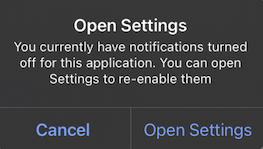
設定プロンプトへのフォールバック
optedIn:現在のプッシュサブスクリプションステータスがsubscribedの場合はtrueを返し、それ以外の場合はfalseを返します。プッシュトークンが有効でもoptOut()が呼び出された場合、これはfalseを返します。
OneSignal.User.pushSubscription.optOut()

OneSignal.User.pushSubscription.optIn()

val optedIn = OneSignal.User.pushSubscription.optedIn
OneSignal.getUser().getPushSubscription().optOut();

OneSignal.getUser().getPushSubscription().optIn();

Boolean optedIn = OneSignal.getUser().getPushSubscription().getOptedIn();
OneSignal.User.pushSubscription.optOut()

OneSignal.User.pushSubscription.optIn()

let optedIn: Bool = OneSignal.User.pushSubscription.optedIn
[OneSignal.User.pushSubscription optOut];

[OneSignal.User.pushSubscription optIn];

Boolean optedIn = OneSignal.User.subscriptions.push.optedIn;
OneSignal.User.PushSubscription.OptOut();

OneSignal.User.PushSubscription.OptIn();

OneSignal.User.PushSubscription.OptedIn;
OneSignal.User.pushSubscription.optOut();

OneSignal.User.pushSubscription.optIn();

await OneSignal.User.pushSubscription.getOptedInAsync();
OneSignal.User.pushSubscription.optOut();

OneSignal.User.pushSubscription.optIn();

OneSignal.User.pushSubscription.optedIn;
// Ionic
OneSignal.User.pushSubscription.optOut();

OneSignal.User.pushSubscription.optIn();

await OneSignal.User.pushSubscription.getOptedInAsync();

// Cordova
window.plugins.OneSignal.User.pushSubscription.optOut();

window.plugins.OneSignal.User.pushSubscription.optIn();

await window.plugins.OneSignal.User.pushSubscription.getOptedInAsync();
addEmail(), removeEmail()
現在のユーザーにメールサブスクリプション(メールアドレス)を追加または削除します。正しいユーザーコンテキストを設定するために、login()の後にaddEmailを呼び出してください。ID検証と互換性があります。
OneSignal.User.addEmail("example@email.com")

OneSignal.User.removeEmail("example@email.com")
OneSignal.getUser().addEmail("example@email.com")

OneSignal.getUser().removeEmail("example@email.com")
OneSignal.User.addEmail("example@email.com")

OneSignal.User.removeEmail("example@email.com")
[OneSignal.User addEmail:@"example@email.com"];

[OneSignal.User removeEmail:@"example@email.com"];
OneSignal.User.AddEmail("example@email.com");

OneSignal.User.RemoveEmail("example@email.com");
OneSignal.User.addEmail("example@email.com");

OneSignal.User.removeEmail("example@email.com");
OneSignal.User.addEmail("example@email.com");

OneSignal.User.removeEmail("example@email.com");
// Ionic
OneSignal.User.addEmail("example@email.com");

OneSignal.User.removeEmail("example@email.com");

// Cordova
window.plugins.OneSignal.User.addEmail("example@email.com");

window.plugins.OneSignal.User.removeEmail("example@email.com");
addSms(), removeSms()
現在のユーザーにSMSサブスクリプション(電話番号)を追加または削除します。E.164形式が必要です。正しいユーザーコンテキストを設定するために、login()の後にaddSmsを呼び出してください。ID検証と互換性があります。
OneSignal.User.addSms("+15558675309")

OneSignal.User.removeSms("+15558675309")
OneSignal.getUser().addSms("+15558675309")

OneSignal.getUser().removeSms("+15558675309")
OneSignal.User.addSms("+15558675309")

OneSignal.User.removeSms("+15558675309")
[OneSignal.User addSms:@"+15558675309"];

[OneSignal.User removeSms:@"+15558675309"];
OneSignal.User.AddSms("+15558675309");

OneSignal.User.RemoveSms("+15558675309");
OneSignal.User.addSms("+15558675309");

OneSignal.User.removeSms("+15558675309");
OneSignal.User.addSms("+15558675309");

OneSignal.User.removeSms("+15558675309");
// Ionic
OneSignal.User.addSms("+15558675309");

OneSignal.User.removeSms("+15558675309");

// Cordova
window.plugins.OneSignal.User.addSms("+15558675309");

window.plugins.OneSignal.User.removeSms("+15558675309");
プッシュ権限
requestPermission(fallbackToSettings) プッシュ
ユーザーにプッシュ通知権限を求めるネイティブシステムプロンプトを表示します。オプションで、設定アプリにリンクするフォールバックプロンプトを有効にできます。
fallbackToSettings:trueの場合、ユーザーがオペレーティングシステムの制限(iOS:1回、Android:2回)を超えてプッシュ権限を拒否した場合、フォールバックプロンプトが表示されます。
権限がブロックされたときの設定へのフォールバックプロンプト
詳細については、プッシュ権限のプロンプトを参照してください。
// We recommend removing this method after testing and instead use In-App Messages to prompt for notification permission.
// Passing true will fallback to setting prompt if the user denies push permissions
OneSignal.Notifications.requestPermission(true)
// We recommend removing this method after testing and instead use In-App Messages to prompt for notification permission.
// Passing true will fallback to setting prompt if the user denies push permissions
OneSignal.getNotifications().requestPermission(Continue.with(r -> {
    if (r.isSuccess()) {
      if (r.getData()) {
        // `requestPermission` completed successfully and the user has accepted permission
      }
      else {
        // `requestPermission` completed successfully but the user has rejected permission
      }
    }
    else {
      // `requestPermission` completed unsuccessfully, check `r.getThrowable()` for more info on the failure reason
    }
}));
// We recommend removing this method after testing and instead use In-App Messages to prompt for notification permission.
// Passing true will fallback to setting prompt if the user denies push permissions
OneSignal.Notifications.requestPermission({ accepted in
  print("User accepted notifications: \(accepted)")
}, fallbackToSettings: true)
// We recommend removing this method after testing and instead use In-App Messages to prompt for notification permission.
// Passing true will fallback to setting prompt if the user denies push permissions
[OneSignal.Notifications requestPermission:^(BOOL accepted) {
  NSLog(@"User accepted notifications: %d", accepted);
} fallbackToSettings:true];
// We recommend removing this method after testing and instead use In-App Messages to prompt for notification permission.
// Passing true will fallback to setting prompt if the user denies push permissions
var result = await OneSignal.Notifications.RequestPermissionAsync(true);

if (result)
{
  // Notification permission was accepted.
}
else
{
  // Notification permission was denied.
}
// We recommend removing this method after testing and instead use In-App Messages to prompt for notification permission.
// Passing true will fallback to setting prompt if the user denies push permissions
OneSignal.Notifications.requestPermission(true);
// We recommend removing this method after testing and instead use In-App Messages to prompt for notification permission.
// Passing true will fallback to setting prompt if the user denies push permissions
OneSignal.Notifications.requestPermission(true);
// Ionic
// We recommend removing this method after testing and instead use In-App Messages to prompt for notification permission.
// Passing true will fallback to setting prompt if the user denies push permissions
OneSignal.Notifications.requestPermission(true).then((accepted) => {
    console.log("User accepted notifications: " + accepted);
});

// Cordova
// We recommend removing this method after testing and instead use In-App Messages to prompt for notification permission.
// Passing true will fallback to setting prompt if the user denies push permissions
window.plugins.OneSignal.Notifications.requestPermission(true).then((accepted) => {
    console.log("User accepted notifications: " + accepted);
});
addPermissionObserver() プッシュ
このメソッドを使用して、次のようなプッシュ権限の変更を追跡します:
- ユーザーに通知権限プロンプトが表示されます。
- ユーザーが権限プロンプトを受け入れるまたは拒否します。
- ユーザーがデバイスのアプリ設定でアプリの通知を有効または無効にしてから、アプリに戻ります。
onOSPermissionChangedイベントをトリガーします。リスナーはfromとtoの値を持つ状態オブジェクトを受け取るため、何が変更されたかを正確に検出できます。
更新のリスニングを停止するには、関連するremovePermissionObserver()メソッドを呼び出します。
class MyObserver : IPermissionObserver {
  init {
    OneSignal.Notifications.addPermissionObserver(this)
  }

  override fun onNotificationPermissionChange(granted: Boolean) {
    if (granted) {
      // Notifications are now enabled
    }
  }

  fun cleanup() {
    OneSignal.Notifications.removePermissionObserver(this)
  }
}
public class MainActivity extends Activity implements IPermissionObserver {
  protected void onCreate(Bundle savedInstanceState) {
    OneSignal.getNotifications().addPermissionObserver(this);
  }

  @Override
  public void onNotificationPermissionChange(boolean granted) {
    if (granted) {
      // Notifications are now enabled
    }
  }

  @Override
  protected void onDestroy() {
    OneSignal.getNotifications().removePermissionObserver(this);
    super.onDestroy();
  }
}
class AppDelegate: UIResponder, UIApplicationDelegate, OSNotificationPermissionObserver {
  func application(_ application: UIApplication,
                  didFinishLaunchingWithOptions launchOptions: [UIApplication.LaunchOptionsKey: Any]?) -> Bool {
    OneSignal.Notifications.addPermissionObserver(self)
    return true
  }

  func onNotificationPermissionDidChange(_ granted: Bool) {
    print("Notification permission changed: \(granted)")
  }

  func cleanup() {
    OneSignal.Notifications.removePermissionObserver(self)
  }
}
// AppDelegate.h
@interface AppDelegate : UIResponder <UIApplicationDelegate, OSNotificationPermissionObserver>
@end

// AppDelegate.m
@implementation AppDelegate

- (BOOL)application:(UIApplication *)application didFinishLaunchingWithOptions:(NSDictionary *)launchOptions {
  [OneSignal.Notifications addPermissionObserver:self];
  return YES;
}

- (void)onNotificationPermissionDidChange:(BOOL)granted {
  NSLog(@"Permission changed: %d", granted);
}

- (void)cleanup {
  [OneSignal.Notifications removePermissionObserver:self];
}
@end
OneSignal.Notifications.PermissionChanged += (sender, e) =>
  {
    // Respond to permission change
  };
const onPermissionChange = (granted) => {
  console.log('Permission changed:', granted);
};

OneSignal.Notifications.addEventListener('permissionChange', onPermissionChange);

// Remove later if needed
OneSignal.Notifications.removeEventListener('permissionChange', onPermissionChange);
final observer = (bool hasPermission) {
  print("Notification permission: $hasPermission");
};

OneSignal.Notifications.addPermissionObserver(observer);

// Remove later if needed
OneSignal.Notifications.removePermissionObserver(observer);
const listener = (granted) => {
  console.log("Push permission changed:", granted);
};
// Ionic
OneSignal.Notifications.addEventListener("permissionChange", listener);

// Remove later if needed
OneSignal.Notifications.removeEventListener("permissionChange", listener);

// Cordova
window.plugins.OneSignal.Notifications.addEventListener("permissionChange", listener);

// Remove later if needed
window.plugins.OneSignal.Notifications.removeEventListener("permissionChange", listener);
getPermission(), getCanRequestPermission()
getPermission()は、アプリレベルの現在のプッシュ権限ステータスを返します。optOut()またはUsers and Subscriptions APIのenabledパラメータで変更した場合、OneSignalレベルのサブスクリプションステータスは考慮されません。getPermission()を使用する代わりに、アプリの実行中にデバイスの通知権限ステータスの変更を追跡するにはプッシュ権限オブザーバーを使用するか、プッシュサブスクリプションステータスの変更を追跡するにはプッシュサブスクリプションオブザーバーを使用することをお勧めします。
getCanRequestPermission()は、権限のリクエストを試みると、ユーザーにプロンプトが表示されるかどうかを返します。falseの場合、ユーザーは既に権限を拒否しており、フォールバックプロンプトまたはプロンプトなしのいずれかを表示できます。詳細については、プッシュ権限のプロンプトを参照してください。
// true if the app has permission to display notifications
OneSignal.Notifications.permission

// true if the device can display system notification permission prompt
val canRequest: Boolean = OneSignal.Notifications.canRequestPermission
// true if the app has permission to display notifications
OneSignal.getNotifications().getPermission();

// true if the device can display system notification permission prompt
OneSignal.getNotifications().getCanRequestPermission();
// true if the app has permission to display notifications
OneSignal.Notifications.permission

// true if the device can display system notification permission prompt
OneSignal.Notifications.canRequestPermission
// true if the app has permission to display notifications
[OneSignal.Notifications permission];

// true if the device can display system notification permission prompt
[OneSignal.Notifications canRequestPermission];
// true if the app has permission to display notifications
bool permission = OneSignal.Notifications.Permission;

// true if the device can display system notification permission prompt
bool canRequest = OneSignal.Notifications.CanRequestPermission;
// true if the app has permission to display notifications
await OneSignal.Notifications.getPermissionAsync();

// true if the device can display system notification permission prompt
await OneSignal.Notifications.canRequestPermissionAsync();
// true if the app has permission to display notifications
var permission = OneSignal.Notifications.permission;

// true if the device can display system notification permission prompt
var canRequest = OneSignal.Notifications.canRequestPermission;
// Ionic
// true if the app has permission to display notifications
await OneSignal.Notifications.getPermissionAsync();

// true if the device can display system notification permission prompt
await OneSignal.Notifications.canRequestPermissionAsync();

// Cordova
// true if the app has permission to display notifications
await window.plugins.OneSignal.Notifications.getPermissionAsync();

// true if the device can display system notification permission prompt
await window.plugins.OneSignal.Notifications.canRequestPermissionAsync();
permissionNative iOS
iOSデバイスのネイティブ権限の列挙型を返します。次のいずれかになります:
0= NotDetermined(未決定)1= Denied(拒否)2= Authorized(承認)3= Provisional(プロビジョナル、iOS 12+でのみ利用可能)4= Ephemeral(エフェメラル、iOS 14+でのみ利用可能)
let permissionNative: OSNotificationPermission = OneSignal.Notifications.permissionNative.rawValue
OSNotificationPermission permissionNative = [OneSignal.Notifications permissionNative]
NotificationPermission PermissionNative
await OneSignal.Notifications.permissionNative()
var permissionNative = await OneSignal.Notifications.permissionNative()
// Ionic
await OneSignal.Notifications.permissionNative()

// Cordova
await window.plugins.OneSignal.Notifications.permissionNative()
プッシュ通知イベント
addClickListener() プッシュ
ユーザーがアプリを開くプッシュ通知をクリックしたときに実行されるコールバックを設定します。
このイベントが発生する時点で、アプリのアクティビティまたはシーンは既に起動しています。このハンドラーを使用してカスタムロジックを実行します。アプリのナビゲーションを手動で再起動または複製しないでください。
Flutterアプリの場合、アプリが強制終了されて通知をクリックすると、アプリは開かず、クリックリスナーは
Debugモードで登録されません。これを修正するには、次のいずれかを実行できます:- Flutterを介してリリースビルドを使用します。例:
flutter run --release(物理デバイスが必要) - Xcodeスキームを
DebugではなくReleaseに更新します
removeClickListener()またはremoveEventListener()を使用します。
val clickListener = object : INotificationClickListener {
  override fun onClick(event: INotificationClickEvent) {
    Log.d("OneSignal", "Notification clicked: ${event.notification.title}")
  }
}
OneSignal.Notifications.addClickListener(clickListener)
OneSignal.getNotifications().addClickListener(event -> {
  Log.v(Tag.LOG_TAG, "INotificationClickListener.onClick fired" +
          " with event: " + event);
});
class AppDelegate: UIResponder, UIApplicationDelegate, OSNotificationClickListener {
  func application(_ application: UIApplication,
                  didFinishLaunchingWithOptions launchOptions: [UIApplication.LaunchOptionsKey: Any]?) -> Bool {
    OneSignal.Notifications.addClickListener(self)
    return true
  }

  func onClick(event: OSNotificationClickEvent) {
    print("Notification clicked: \(event.jsonRepresentation())")
  }
}
// AppDelegate.h
@interface AppDelegate : UIResponder <UIApplicationDelegate, OSNotificationClickListener>
@end

// AppDelegate.m
@implementation AppDelegate

- (BOOL)application:(UIApplication*)application didFinishLaunchingWithOptions:(NSDictionary *)launchOptions {
  [OneSignal.Notifications addClickListener:self];
  return YES;
}

- (void)onClickNotification:(OSNotificationClickEvent *)event {
  NSLog(@"Notification clicked: %@", [event jsonRepresentation]);
}
@end
OneSignal.Notifications.Clicked += (sender, e) => {
  var RawPayload = e.Notification.RawPayload;
  Console.WriteLine("Notification clicked: " + RawPayload);
};
OneSignal.Notifications.addEventListener('click', (event) => {
  console.log('OneSignal: notification clicked:', event);
});
OneSignal.Notifications.addClickListener((event) {
  print('Notification clicked: ${event}');
});
const myClickListener = (event) => {
  console.log("Notification clicked:", JSON.stringify(event));
};
// Ionic
OneSignal.Notifications.addEventListener("click", myClickListener);

// Cordova
window.plugins.OneSignal.Notifications.addEventListener("click", myClickListener);
addForegroundLifecycleListener() プッシュ
アプリがフォアグラウンドにあるときに通知がどのように動作するかをインターセプトして制御できます。
デフォルトでは、OneSignalは自動的に通知を表示します。event.preventDefault()を使用してこの動作を上書きできます:
- 通知を抑制
- カスタマイズ
- 非同期ロジックのために表示を遅延(例:ユーザー状態の取得、イベントのログ)
event.notification.display()を呼び出します。
これは、表示前にペイロードを変更する通知サービス拡張機能の後に実行されます。
removeForegroundLifecycleListener()またはremoveEventListener()を使用します。
val lifecycleListener = object : INotificationLifecycleListener {
  override fun onWillDisplay(event: INotificationWillDisplayEvent) {
    Log.d("OneSignal", "Foreground notification: ${event.notification.title}")
    // Uncomment to prevent the notification from being displayed while in the foreground
    // event.preventDefault()
  }
}
OneSignal.Notifications.addForegroundLifecycleListener(lifecycleListener)
OneSignal.getNotifications().addForegroundLifecycleListener(new INotificationLifecycleListener() {
  @Override
  public void onWillDisplay(@NonNull INotificationWillDisplayEvent event) {
    Log.d("OneSignal", "Foreground notification received: " + event.getNotification().getTitle());

    // Uncomment to prevent the notification from being displayed while in the foreground
    // event.preventDefault();
  }
});
class AppDelegate: UIResponder, UIApplicationDelegate, OSNotificationLifecycleListener {
  func application(_ application: UIApplication,
                  didFinishLaunchingWithOptions launchOptions: [UIApplication.LaunchOptionsKey: Any]?) -> Bool {
    OneSignal.Notifications.addForegroundLifecycleListener(self)
    return true
  }

  func onWillDisplay(event: OSNotificationWillDisplayEvent) {
    print("Foreground notification: \(event.notification.title ?? "No Title")")
    // Uncomment to prevent the notification from being displayed while in the foreground
    // event.preventDefault()
  }
}
@implementation AppDelegate

- (BOOL)application:(UIApplication*)application didFinishLaunchingWithOptions:(NSDictionary *)launchOptions {
  [OneSignal.Notifications addForegroundLifecycleListener:self];
  return YES;
}

- (void)onWillDisplayNotification:(OSNotificationWillDisplayEvent *)event {
  NSLog(@"Foreground notification: %@", event.notification.title);
  // Uncomment to prevent the notification from being displayed while in the foreground
  // [event preventDefault];
}
@end
OneSignal.Notifications.ForegroundWillDisplay += (sender, e) =>
{
  Console.WriteLine("Foreground notification: " + e.Notification.RawPayload);
  // Uncomment to prevent the notification from being displayed while in the foreground
  // e.PreventDefault();
};
OneSignal.Notifications.addEventListener('foregroundWillDisplay', (event) => {
  console.log("Foreground notification:", event.getNotification().title);
  // Uncomment to prevent the notification from being displayed while in the foreground
  // event.preventDefault();
});
OneSignal.Notifications.addForegroundWillDisplayListener((event) {
  print("Foreground notification: ${event.notification.title}");
  // Uncomment to prevent the notification from being displayed while in the foreground
  // event.preventDefault();
});
const myLifecyleListener = function(event) {
  console.log("Foreground notification:", event.notification.title);
  // Uncomment to prevent the notification from being displayed while in the foreground
  // event.preventDefault();
};
// Ionic
OneSignal.Notifications.addEventListener("foregroundWillDisplay", myLifecyleListener);

// Cordova
window.plugins.OneSignal.Notifications.addEventListener("foregroundWillDisplay", myLifecyleListener);
clearAllNotifications()
通知シェードからすべてのOneSignal通知を削除します。Androidのandroid.app.NotificationManager.cancelの代わりに使用してください。そうしないと、アプリを再起動したときに通知が復元されます。
OneSignal.Notifications.clearAllNotifications()
OneSignal.getNotifications.clearAllNotifications();
OneSignal.Notifications.clearAll()
[OneSignal.Notifications clearAll];
OneSignal.Notifications.ClearAllNotifications();
OneSignal.Notifications.clearAll();
OneSignal.Notifications.clearAll();
// Ionic
OneSignal.Notifications.clearAll();

// Cordova
window.plugins.OneSignal.Notifications.clearAll();
removeNotification() Android
Android通知IDに基づいて単一の通知をキャンセルします。
Androidのandroid.app.NotificationManager.cancelの代わりに使用してください。そうしないと、アプリを再起動したときに通知が復元されます。
OneSignal.Notifications.removeNotification(id)
OneSignal.getNotifications().removeNotification(id);
OneSignal.Notifications.RemoveNotification(id);
OneSignal.Notifications.removeNotification(id);
OneSignal.Notifications.removeNotification(id);
// Ionic
OneSignal.Notifications.removeNotification(id);

// Cordova
window.plugins.OneSignal.Notifications.removeNotification(id);
removeGroupedNotifications() Android
提供されたグループキーを持つOneSignal通知のグループをキャンセルします。通知のグループ化はOneSignalの概念です。android.app.NotificationManagerに相当するものはありません。
OneSignal.Notifications.removeGroupedNotifications("GROUP_KEY")
OneSignal.getNotifications().removeGroupedNotifications("GROUP_KEY");
OneSignal.Notifications.RemoveGroupedNotifications("GROUP_KEY");
OneSignal.Notifications.removeGroupedNotifications("GROUP_KEY");
OneSignal.Notifications.removeGroupedNotifications("GROUP_KEY");
// Ionic
OneSignal.Notifications.removeGroupedNotifications("GROUP_KEY");

// Cordova
window.plugins.OneSignal.Notifications.removeGroupedNotifications("GROUP_KEY");
アプリ内メッセージ
アプリ内メッセージにはコードは必要ありませんが、SDKを使用すると、メッセージが表示されるタイミングをカスタマイズし、ライフサイクルイベントを処理できます。addTrigger(), addTriggers()
単一または複数のトリガーに基づいて、アプリ内メッセージをいつ表示するかを決定します。詳細については、トリガーを参照してください。
トリガーはバックエンドに保存されません。ローカルデバイスにのみ存在し、現在のユーザーに適用されます。
OneSignal.InAppMessages.addTrigger("KEY", "VALUE")

OneSignal.InAppMessages.addTriggers(mapOf("KEY_01" to "VALUE_01", "KEY_02" to "VALUE_02"))
OneSignal.getInAppMessages().addTrigger("KEY", "VALUE");

OneSignal.getInAppMessages().addTriggers(new HashMap<String, String>() {{
  put("KEY_01","VALUE_01");
  put("KEY_02", "VALUE_02");
}});
OneSignal.InAppMessages.addTrigger("KEY", withValue: "VALUE")

OneSignal.InAppMessages.addTriggers(["KEY_01": "VALUE_01", "KEY_02": "VALUE_02"])
[OneSignal.InAppMessages addTrigger:@"KEY" withValue:@"VALUE"];

[OneSignal.InAppMessages addTriggers:@{@"KEY_01": @"VALUE_01", @"KEY_02": @"VALUE_02"}];
OneSignal.InAppMessages.AddTrigger("KEY", "VALUE");

OneSignal.InAppMessages.AddTriggers(new Dictionary<string, string> {
  { "KEY_01", "VALUE_01" },
  { "KEY_02", "VALUE_02" }
});
OneSignal.InAppMessages.addTrigger("KEY", "VALUE");

OneSignal.InAppMessages.addTriggers({
  "KEY_01": "VALUE_01",
  "KEY_02": "VALUE_02"
});
OneSignal.InAppMessages.addTrigger("KEY", "VALUE");

OneSignal.InAppMessages.addTriggers({
  "KEY_01": "VALUE_01",
  "KEY_02": "VALUE_02"
});
// Ionic
OneSignal.InAppMessages.addTrigger("KEY", "VALUE");

OneSignal.InAppMessages.addTriggers({"KEY_01":"VALUE_01", "KEY_02":"VALUE_02"});

// Cordova
window.plugins.OneSignal.InAppMessages.addTrigger("KEY", "VALUE");

window.plugins.OneSignal.InAppMessages.addTriggers({"KEY_01":"VALUE_01", "KEY_02":"VALUE_02"});
removeTrigger(), removeTriggers(), clearTriggers()
現在のユーザーから、提供されたキーを持つ単一、複数、またはすべてのトリガーを削除します。
OneSignal.InAppMessages.removeTrigger("KEY")

OneSignal.InAppMessages.removeTriggers(setOf("KEY_01", "KEY_02"))

OneSignal.InAppMessages.clearTriggers()
OneSignal.getInAppMessages().removeTrigger("KEY");

OneSignal.getInAppMessages().removeTriggers(Arrays.asList("KEY_01", "KEY_02"));

OneSignal.getInAppMessages().clearTriggers();
OneSignal.InAppMessages.removeTrigger("KEY")

OneSignal.InAppMessages.removeTriggers(["KEY_01", "KEY_02"])

OneSignal.InAppMessages.clearTriggers()
[OneSignal.InAppMessages removeTrigger:@"KEY"];

[OneSignal.InAppMessages removeTriggers:@[@"KEY_01", @"KEY_02"]];

[OneSignal.InAppMessages clearTriggers];
OneSignal.InAppMessages.RemoveTrigger("KEY");

OneSignal.InAppMessages.RemoveTriggers(new List<string> { "KEY_01", "KEY_02" });

OneSignal.InAppMessages.ClearTriggers();
OneSignal.InAppMessages.removeTrigger("KEY");

OneSignal.InAppMessages.removeTriggers(["KEY_01", "KEY_02"]);

OneSignal.InAppMessages.clearTriggers();
OneSignal.InAppMessages.removeTrigger("KEY");

OneSignal.InAppMessages.removeTriggers(["KEY_01", "KEY_02"]);

OneSignal.InAppMessages.clearTriggers();
// Ionic
OneSignal.InAppMessages.removeTrigger("KEY");

OneSignal.InAppMessages.removeTriggers(["KEY_01", "KEY_02"]);

OneSignal.InAppMessages.clearTriggers();

// Cordova
window.plugins.OneSignal.InAppMessages.removeTrigger("KEY");

window.plugins.OneSignal.InAppMessages.removeTriggers(["KEY_01", "KEY_02"]);

window.plugins.OneSignal.InAppMessages.clearTriggers();
paused
アプリ内メッセージがユーザーに表示されないようにします。trueに設定すると、アプリ内メッセージは表示されません。falseに設定すると、ユーザーが適格なすべてのメッセージが適切なタイミングで表示されます。
OneSignal.InAppMessages.paused = true
OneSignal.getInAppMessages().setPaused(true);
OneSignal.InAppMessages.paused = true

// Get `paused` state
let paused = OneSignal.InAppMessages.paused
[OneSignal.InAppMessages paused:true];

// Get `paused` state
BOOL paused = [OneSignal.InAppMessages paused];
OneSignal.InAppMessages.Paused = true;
OneSignal.InAppMessages.setPaused(true);
OneSignal.InAppMessages.paused(true);
// Ionic
OneSignal.InAppMessages.setPaused(true);

// Cordova
window.plugins.OneSignal.InAppMessages.setPaused(true);
addLifecycleListener()
アプリ内メッセージの表示と却下に応答または追跡します。
val lifecycleListener = object : IInAppMessageLifecycleListener {
  override fun onWillDisplay(event: IInAppMessageWillDisplayEvent) {
    print(event.message.messageId)
  }

  override fun onDidDisplay(event: IInAppMessageDidDisplayEvent) {
    print(event.message.messageId)
  }

  override fun onWillDismiss(event: IInAppMessageWillDismissEvent) {
    print(event.message.messageId)
  }

  override fun onDidDismiss(event: IInAppMessageDidDismissEvent) {
    print(event.message.messageId)
  }
}
OneSignal.InAppMessages.addLifecycleListener(lifecycleListener)
OneSignal.InAppMessages.removeLifecycleListener(lifecycleListener)
OneSignal.getInAppMessages().addLifecycleListener(new IInAppMessageLifecycleListener() {
  @Override
  public void onWillDisplay(@NonNull IInAppMessageWillDisplayEvent event) {
      Log.v(Tag.LOG_TAG, "onWillDisplayInAppMessage");
  }

  @Override
  public void onDidDisplay(@NonNull IInAppMessageDidDisplayEvent event) {
      Log.v(Tag.LOG_TAG, "onDidDisplayInAppMessage");
  }

  @Override
  public void onWillDismiss(@NonNull IInAppMessageWillDismissEvent event) {
      Log.v(Tag.LOG_TAG, "onWillDismissInAppMessage");
  }

  @Override
  public void onDidDismiss(@NonNull IInAppMessageDidDismissEvent event) {
      Log.v(Tag.LOG_TAG, "onDidDismissInAppMessage");
  }
});
// AppDelegate.swift
// Add OSInAppMessageLifecycleListener as an implemented protocol of the class that will handle the In-App Message lifecycle events.
class AppDelegate: UIResponder, UIApplicationDelegate, OSInAppMessageLifecycleListener {

  func application(_ application: UIApplication, didFinishLaunchingWithOptions launchOptions: [UIApplicationLaunchOptionsKey: Any]?) -> Bool {
    // Add your implementing class as the listener
    OneSignal.InAppMessages.addLifecycleListener(self)
  }
  // Add one or more of the following optional lifecycle methods
  func onWillDisplay(event: OSInAppMessageWillDisplayEvent) {
    print("OSInAppMessageLifecycleListener: onWillDisplay Message: \(event.message.messageId)")
  }
  func onDidDisplay(event: OSInAppMessageDidDisplayEvent) {
    print("OSInAppMessageLifecycleListener: onDidDisplay Message: \(event.message.messageId)")
  }
  func onWillDismiss(event: OSInAppMessageWillDismissEvent) {
    print("OSInAppMessageLifecycleListener: onWillDismiss Message: \(event.message.messageId)")
  }
  func onDidDismiss(event: OSInAppMessageDidDisplayEvent) {
    print("OSInAppMessageLifecycleListener: onDidDismiss Message: \(event.message.messageId)")
	}
}
// AppDelegate.h
// Add OSInAppMessageLifecycleListener as an implemented protocol of the class that will handle the In-App Message lifecycle events.
@interface AppDelegate : UIResponder <UIApplicationDelegate, OSInAppMessageLifecycleListener>
@end

// AppDelegate.m
@implementation AppDelegate

- (BOOL)application:(UIApplication*)application didFinishLaunchingWithOptions:(NSDictionary *)launchOptions {
    // Add your implementing class as the listener.
    [OneSignal.InAppMessages addLifecycleListener:self];
}

// Add one or more of the following optional lifecycle methods
- (void)onWillDisplayInAppMessage:(OSInAppMessageWillDisplayEvent *)event {
  NSLog(@"OSInAppMessageLifecycleListener: onWillDisplay Message: %@", event.message.messageId);
}

- (void)onDidDisplayInAppMessage:(OSInAppMessageDidDisplayEvent *)event {
  NSLog(@"OSInAppMessageLifecycleListener: onDidDisplay Message: %@", event.message.messageId);
}

- (void)onWillDismissInAppMessage:(OSInAppMessageWillDismissEvent *)event {
  NSLog(@"OSInAppMessageLifecycleListener: onWillDismiss Message: %@", event.message.messageId);
}

- (void)onDidDismissInAppMessage:(OSInAppMessageDidDismissEvent *)event {
  NSLog(@"OSInAppMessageLifecycleListener: onDidDismiss Message: %@", event.message.messageId);
}
OneSignal.InAppMessages.WillDisplay += (sender, e) =>
  {
    // Access the in-app message with e.Message
  };

OneSignal.InAppMessages.DidDisplay += (sender, e) =>
  {
    // Access the in-app message with e.Message
  };

OneSignal.InAppMessages.WillDismiss += (sender, e) =>
  {
    // Access the in-app message with e.Message
  };

OneSignal.InAppMessages.DidDismiss += (sender, e) =>
  {
    // Access the in-app message with e.Message
  };
OneSignal.InAppMessages.addEventListener('willDisplay', (event) => {
  console.log('OneSignal: will display IAM: ', event);
});

OneSignal.InAppMessages.addEventListener('didDisplay', (event) => {
  console.log('OneSignal: did display IAM: ', event);
});

OneSignal.InAppMessages.addEventListener('willDismiss', (event) => {
  console.log('OneSignal: will dismiss IAM: ', event);
});

OneSignal.InAppMessages.addEventListener('didDismiss', (event) => {
  console.log('OneSignal: did dismiss IAM: ', event);
});
OneSignal.InAppMessages.addWillDisplayListener((event) {
	print("ON WILL DISPLAY IN APP MESSAGE ${event.message.messageId}");
});
OneSignal.InAppMessages.addDidDisplayListener((event) {
	print("ON DID DISPLAY IN APP MESSAGE ${event.message.messageId}");
});
OneSignal.InAppMessages.addWillDismissListener((event) {
	print("ON WILL DISMISS IN APP MESSAGE ${event.message.messageId}");
});
OneSignal.InAppMessages.addDidDismissListener((event) {
	print("ON DID DISMISS IN APP MESSAGE ${event.message.messageId}");
});
// Define the lifecycle listener functions
let willDisplayListener = async function(event) {
  console.log("OneSignal: will display IAM: "+ event.messageId);
};
let didDisplayListener = async function(event) {
  console.log("OneSignal: did display IAM: "+ event.messageId);
};
let willDismissListener = async function(event) {
  console.log("OneSignal: will dismiss IAM: "+ event.messageId);
};
let didDismissListener = async function(event) {
  console.log("OneSignal: did dismiss IAM: "+ event.messageId);
};

// Listeners for each event added separately
// Ionic
OneSignal.InAppMessages.addEventListener("willDisplay", willDisplayListener);
OneSignal.InAppMessages.addEventListener("didDisplay", didDisplayListener);
OneSignal.InAppMessages.addEventListener("willDismiss", willDismissListener);
OneSignal.InAppMessages.addEventListener("didDismiss", didDismissListener);

// Cordova
window.plugins.OneSignal.InAppMessages.addEventListener("willDisplay", willDisplayListener);
window.plugins.OneSignal.InAppMessages.addEventListener("didDisplay", didDisplayListener);
window.plugins.OneSignal.InAppMessages.addEventListener("willDismiss", willDismissListener);
window.plugins.OneSignal.InAppMessages.addEventListener("didDismiss", didDismissListener);
addClickListener() アプリ内
アプリ内メッセージのクリックイベントに応答します。イベントには、次のクリックアクションメタデータが含まれています:
actionId:要素に設定したカスタム識別子。urlTarget:メッセージの起動URLがどのように表示されるかを指定する列挙型。url:アクションの起動URL(ある場合)。closingMessage:アクションがメッセージのクローズにつながったかどうかを示すブール値。
val clickListener = object : IInAppMessageClickListener {
  override fun onClick(event: IInAppMessageClickEvent) {
    print(event.result.actionId)
  }
}
OneSignal.InAppMessages.addClickListener(clickListener)
OneSignal.getInAppMessages().addClickListener(new IInAppMessageClickListener() {
  @Override
  public void onClick(@Nullable IInAppMessageClickEvent event) {
    Log.v(Tag.LOG_TAG, "INotificationClickListener.inAppMessageClicked");
  }
});
class MyInAppMessageClickListener : NSObject, OSInAppMessageClickListener {
    func onClick(event: OSInAppMessageClickEvent) {
        let messageId = event.message.messageId
        print("Message ID: \(messageId)")
        let result: OSInAppMessageClickResult = event.result
        let actionId = result.actionId
        print("Action ID: ",(actionId ?? "no actionId"))
        let url = result.url
        print("URL: ", (url ?? "No URL"))
        let urlTarget: OSInAppMessageActionUrlType = result.urlTarget
        print("URL Target: \(urlTarget)")
        let closingMessage = result.closingMessage
        print("Closing Message: \(closingMessage)")
    }
}

// Add your object as a listener
let myListener = MyInAppMessageClickListener()
OneSignal.InAppMessages.addClickListener(myListener)
// Add this method to object implementing the OSInAppMessageClickListener protocol
- (void)onClickInAppMessage:(OSInAppMessageClickEvent * _Nonnull)event {
    NSLog(@"onClickInAppMessage event: %@", [event jsonRepresentation]);
    NSString *message = [NSString stringWithFormat:@"In App Message Click Occurred: messageId: %@ actionId: %@ url: %@ urlTarget: %@ closingMessage: %i",
                        event.message.messageId,
                        event.result.actionId,
                        event.result.url,
                        @(event.result.urlTarget),
                        event.result.closingMessage];
}

// Add your object as a listener
[OneSignal.InAppMessages addClickListener:self];
OneSignal.InAppMessages.Clicked += (sender, e) =>
  {
    // Access the in-app message with e.Message and the click result with e.Result
  };
OneSignal.InAppMessages.addEventListener('click', (event) => {
  console.log('OneSignal IAM clicked:', event);
});
OneSignal.InAppMessages.addClickListener((event) {
	print("In App Message Clicked: \n${event.result.jsonRepresentation().replaceAll("\\n", "\n")}");
});
let inAppClickListener = async function(event) {
  let clickData = JSON.stringify(event);
  console.log("In-App Message Clicked: "+ clickData);
};

// Ionic
OneSignal.InAppMessages.addEventListener("click", inAppClickListener);

// Cordova
window.plugins.OneSignal.InAppMessages.addEventListener("click", inAppClickListener);
Live Activity
アプリケーションは、ユーザーがLive Activitiesにオプトインできるようにする必要があります。たとえば、アプリはボタンを使用するかIAMを表示することで、ユーザーにLive Activityを開始するオプションを提供します。通知権限または位置情報権限とは異なり、明示的なプロンプトなしで、任意の方法でLive Activityを開始および更新できます。Live ActivitiesはiOSプロビジョナル認証UIで表示されます。Live Activitiesは、アプリケーションがフォアグラウンドにあるときに開始する必要があります。Live Activitiesの詳細については、Appleの開発者ガイドラインを読むことをお勧めします。setup()
OneSignalがアプリケーションに代わってLiveActivityのライフサイクルを管理できるようにします。これには、pushToStartトークンの更新とpushToUpdateトークンの更新の両方をリッスンすることが含まれます。
//... your app's code
OneSignal.LiveActivities.setup(MyWidgetAttributes.self);
setupDefault()
クロスプラットフォームSDKがLiveActivityのライフサイクルを管理できるようにします。カスタマーアプリが独自のActivityAttributesを定義および管理する必要がなくなります。詳細については、クロスプラットフォームセットアップを参照してください。
using OneSignalSDK;

//Push To Start
OneSignal.LiveActivities.SetupDefault();

//Launching the Live Activity from within the app (not needed for push to start)
string activityId = "my_activity_id";

OneSignal.LiveActivities.StartDefault(
  activityId,
  new Dictionary<string, object>() {
      { "title", "Welcome!" }
  },
  new Dictionary<string, object>() {
      { "message", new Dictionary<string, object>() {
          { "en", "Hello World!"}
      }},
  });
import { OneSignal } from 'react-native-onesignal'

//Push To Start
OneSignal.LiveActivities.setupDefault()

//Launching the Live Activity from within the app (not needed for push to start)
const activityId = "my_activity_id"
const attributes = { title: "Sample Title" } ;
const content = { message: { en: "message" } };
OneSignal.LiveActivities.startDefault(activityId, attributes, content);
import 'package:onesignal_flutter/onesignal_flutter.dart';

OneSignal.LiveActivities.setupDefault()

//Launching the Live Activity from within the app (not needed for push to start)
const String activityId = "my_activity_id";
OneSignal.LiveActivities.startDefault(activityId!, {
  "title": "Welcome!"
  }, {
  "message": {"en": "Hello World!"},
});
//Ionic
import OneSignal from "onesignal-cordova-plugin";

//Push To Start
OneSignal.LiveActivities.setupDefault();

//Launching the Live Activity from within the app (not needed for push to start)
const activityId = "my_activity_id";
const attributes = { title: "Sample Title" };
const content = { message: { en: "message" } };
OneSignal.LiveActivities.startDefault(activityId, attributes, content);

//Cordova
//Push To Start
window.plugins.OneSignal.LiveActivities.setupDefault();

//Launching the Live Activity from within the app (not needed for push to start)
const activityId = "my_activity_id";
const attributes = { title: "Sample Title" };
const content = { message: { en: "message" } };
window.plugins.OneSignal.LiveActivities.startDefault(
  activityId,
  attributes,
  content
);
enter()
Live Activityに入ると、activityIdがサーバー上のLive Activity 一時プッシュトークンに関連付けられます。Update Live Activities REST APIを使用して1つまたは複数のLive Activitiesを同時に更新する場合に、この識別子を指定します。
// ... your app's code
let activity = try Activity<MyWidgetAttributes>.request(
  attributes: attributes,
  contentState: contentState,
  pushType: .token)
Task {
  for await data in activity.pushTokenUpdates {
      let token = data.map {String(format: "%02x", $0)}.joined()
      // ... required code for entering a live activity
      // Activity ID cannot contain "/" characters
      OneSignal.LiveActivities.enter("ACTIVITY_ID", withToken: token)
  }
}
OneSignal.LiveActivities.EnterAsync("ACTIVITY_ID", token);
var result = OneSignalSDK.DotNet.OneSignal.Default.EnterLiveActivity("ACTIVITY_ID", token);
if(result) {
    Console.WriteLine("Success");
}
OneSignal.LiveActivities.enter('ACTIVITY_ID', token, (result) => {
  console.log('Results of entering live activity: ', result);
});
OneSignal.LiveActivities.enterLiveActivity("ACTIVITY_ID", token).then((result) {
print("Successfully enter live activity");
}).catchError((error) {
print("Failed to enter live activity with error: $error");
});
//Ionic
OneSignal.LiveActivities.enter("ACTIVITY_ID", token, (result) => {
console.log("Results of entering live activity: ", result);
});
//Cordova
window.plugins.OneSignal.LiveActivities.enter("ACTIVITY_ID", token, (result) => {
console.log("Results of entering live activity: ", result);
});
exit()
Live Activityを終了すると、サーバー上のアクティビティ識別子とLive Activityプッシュトークン間の関連付けが削除されます。
OneSignal.LiveActivities.exit("ACTIVITY_ID")
OneSignal.LiveActivities.ExitAsync("ACTIVITY_ID");
OneSignalSDK.DotNet.OneSignal.Default.ExitLiveActivity("ACTIVITY_ID");
OneSignal.LiveActivities.exit('ACTIVITY_ID', (result) => {
console.log('Results of exiting live activity: ', result);
});
OneSignal.LiveActivities.exit("ACTIVITY_ID").then((result) {
print("Successfully exit live activity");
}).catchError((error) {
print("Failed to exit live activity: $error");
});
window.plugins.OneSignal.LiveActivities.exit("ACTIVITY_ID", (result) => {
console.log("Results of exiting live activity: ", result);
});
setPushToStartToken()
Live Activitiesをプッシュして開始するためのオプションの「低レベル」アプローチ。ActivityAttribute構造を変更せずに、LiveActivityの開始および更新トークンをきめ細かく制御できます。詳細はこちらで入手可能
if #available(iOS 17.2, *) {
// Setup an async task to monitor and send pushToStartToken updates to OneSignalSDK.
Task {
for try await data in Activity<MyWidgetAttributes>.pushToStartTokenUpdates {
let token = data.map {String(format: "%02x", $0)}.joined()
OneSignal.LiveActivities.setPushToStartToken(MyWidgetAttributes.self, withToken: token)
}
}
// Setup an async task to monitor for an activity to be started, for each started activity we
// can then set up an async task to monitor and send updateToken updates to OneSignalSDK.
Task {
for await activity in Activity<MyWidgetAttributes>.activityUpdates {
Task {
for await pushToken in activity.pushTokenUpdates {
let token = pushToken.map {String(format: "%02x", $0)}.joined()
OneSignal.LiveActivities.enter("my-activity-id", withToken: token)
}
}
}
}
}
removePushToStartToken()
そのアクティビティタイプが現在のサブスクリプションに対して登録されなくなった場合に、アクティビティタイプごとに呼び出されます
OneSignal.LiveActivities.removePushToStartToken(MyWidgetAttributes.self)
アウトカム
ユーザーが実行したアクションを追跡し、それらをメッセージに帰属させます。詳細については、アウトカムを参照してください。addOutcome()
提供された名前でアウトカムを追加します。現在のセッションに対してキャプチャされます。
OneSignal.Session.addOutcome("OUTCOME_NAME")
OneSignal.getSession().addOutcome("OUTCOME_NAME");
OneSignal.Session.addOutcome("OUTCOME_NAME")
[OneSignal.Session addOutcome:@"OUTCOME_NAME"];
OneSignal.Session.AddOutcome("OUTCOME_NAME");
OneSignal.Session.addOutcome("OUTCOME_NAME");
OneSignal.Session.addOutcome("OUTCOME_NAME");
//Ionic
OneSignal.Session.addOutcome("OUTCOME_NAME");
//Cordova
window.plugins.OneSignal.Session.addOutcome("OUTCOME_NAME");
addUniqueOutcome()
提供された名前で一意のアウトカムを追加します。現在のセッションに対してキャプチャされます。
OneSignal.Session.addUniqueOutcome("OUTCOME_NAME")
OneSignal.getSession().addUniqueOutcome("OUTCOME_NAME");
OneSignal.Session.addUniqueOutcome("OUTCOME_NAME")
[OneSignal.Session addUniqueOutcome:@"OUTCOME_NAME"];
OneSignal.Session.AddUniqueOutcome("OUTCOME_NAME");
OneSignal.Session.addUniqueOutcome("OUTCOME_NAME");
OneSignal.Session.addUniqueOutcome("OUTCOME_NAME");
//Ionic
OneSignal.Session.addUniqueOutcome("OUTCOME_NAME");
//Cordova
window.plugins.OneSignal.Session.addUniqueOutcome("OUTCOME_NAME");
addOutcomeWithValue()
提供された名前と値でアウトカムを追加します。現在のセッションに対してキャプチャされます。
OneSignal.Session.addOutcomeWithValue("OUTCOME_NAME", 3.14)
OneSignal.getSession().addOutcomeWithValue("OUTCOME_NAME", 3.14);
OneSignal.Session.addOutcomeWithValue("OUTCOME_NAME", 3.14)
[OneSignal.Session addOutcomeWithValue:@"OUTCOME_NAME" value: 3.14];
OneSignal.Session.AddOutcomeWithValue("OUTCOME_NAME", 3.14);
OneSignal.Session.addOutcomeWithValue("OUTCOME_NAME", 3.14);
OneSignal.Session.addOutcomeWithValue("OUTCOME_NAME", 3.14);
//Ionic
OneSignal.Session.addOutcomeWithValue("OUTCOME_NAME", 3.14);
//Cordova
window.plugins.OneSignal.Session.addOutcomeWithValue("OUTCOME_NAME", 3.14);