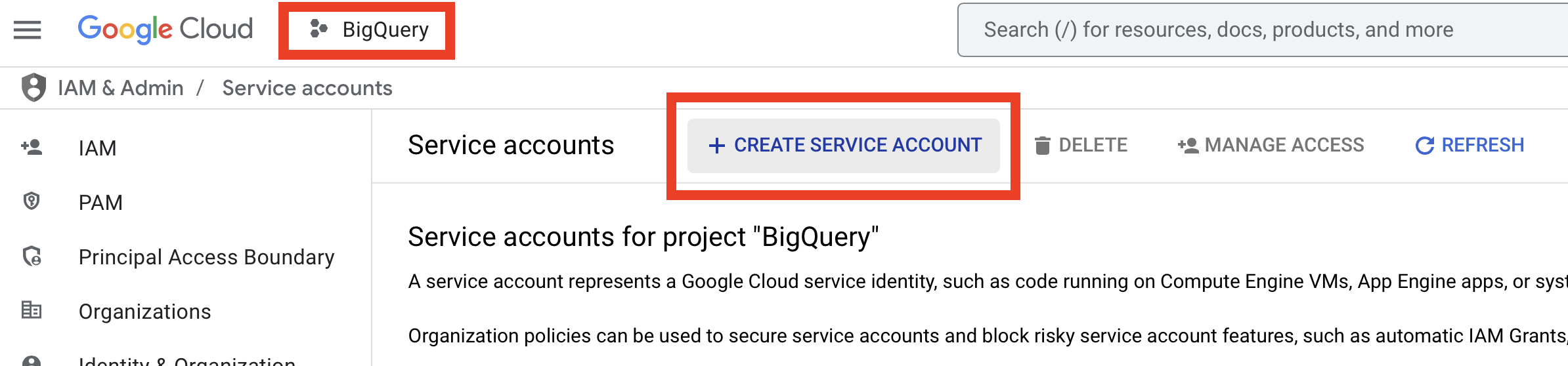
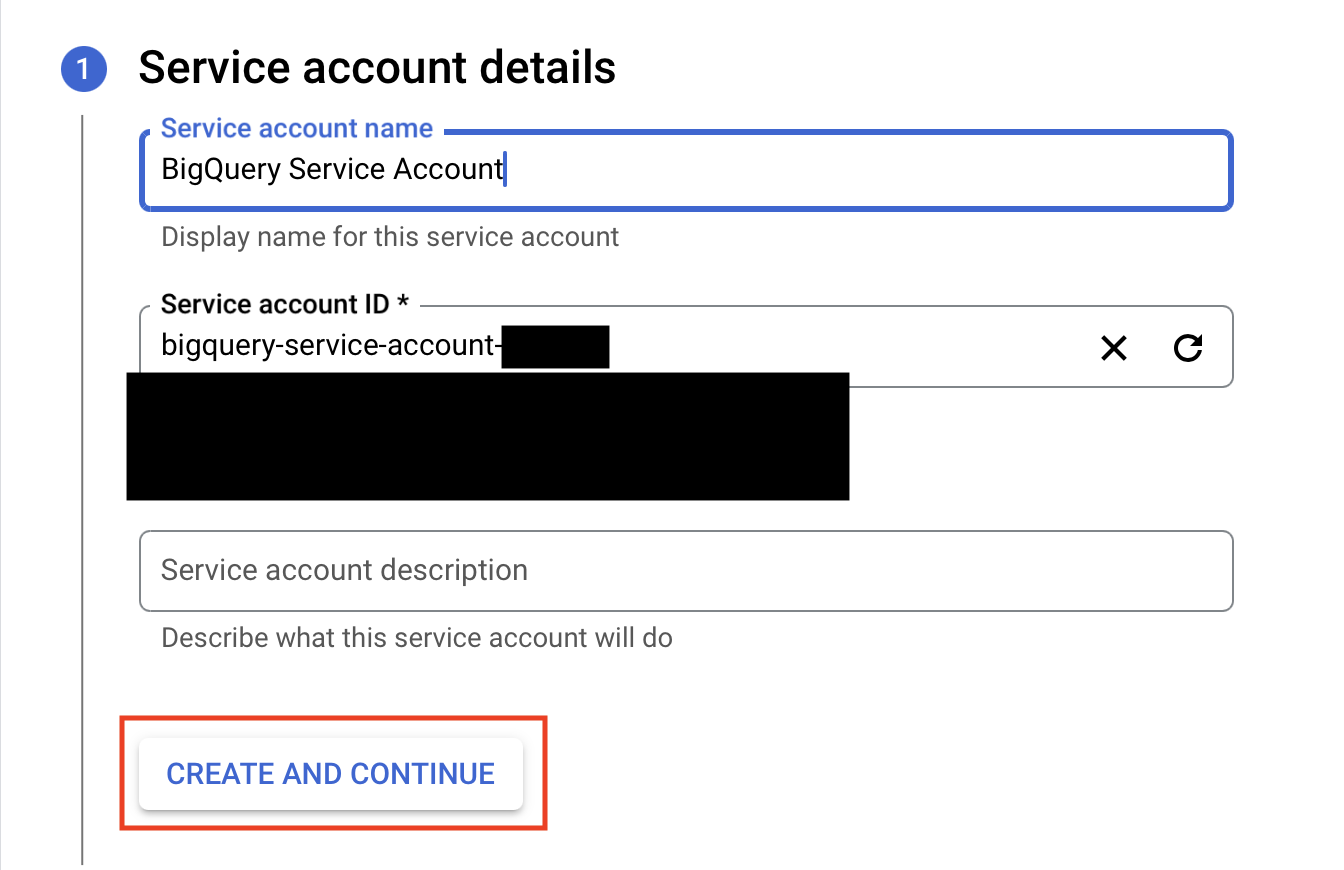
Give it any name and service account ID you choose.
4
Assign the appropriate BigQuery roles
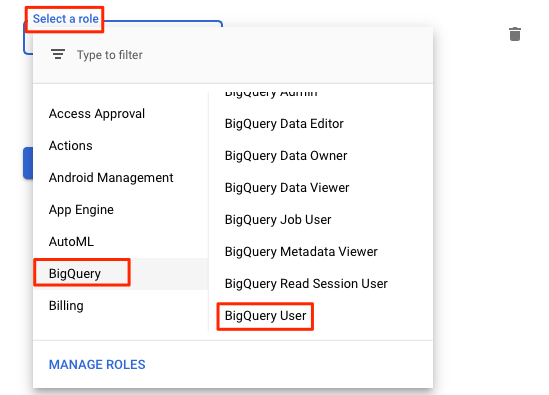
Give the service account the BigQuery User role. If you want to sync data to an existing dataset, you must also grant the service account BigQuery Data Owner on that dataset. See Roles and permissions.
For existing datasets, the service account will need the bigquery.dataOwner role (“BigQuery Data Owner”). If the dataset is not yet created, only the “BigQuery User” role is needed.
5
Create a JSON key for this account
Go to your new service account > Keys > Add Key > Create new key > select JSON. Save the file.
You’ll paste the entire contents of this JSON key file into OneSignal to activate the integration.
The minimum role required to sync OneSignal events into BigQuery is BigQuery User. This role allows OneSignal to:
Run, enumerate, and cancel its own jobs, including update jobs
Read, query, and enumerate all datasets within a project
Create new datasets within the project and grant the bigquery.dataOwner role for these new datasets
These permissions are required because OneSignal can create its own datasets. They do not allow OneSignal to modify datasets it does not own.To sync data to an existing dataset in your BigQuery project, created by another user or service account, you must grant the service account the bigquery.dataOwner role for that dataset.To grant the bigquery.dataOwner role for an existing dataset:
Dataset/Table Names: Must only contain lowercase letters, numbers and underscores, and cannot begin with a number.
Event Types: Select specific message events (e.g., sent, opened, clicked)
Note: You can select multiple event types or update selected events at a later time.
4
Click Save and wait for confirmation
Events go through a processing step that can take up to 30 minutes before they are included in a sync. With a 15-minute sync frequency, expect events to appear in BigQuery within 45 minutes.While you wait, send messages via push, email, in-app, or SMS to trigger the events selected.
message.email.sent and message.sms.sent are deprecated. They can’t be added to new exports, but exports that already include them keep receiving them. Use message.email.received and message.sms.delivered instead.
Events go through a processing step that can take up to 30 minutes before they are included in a sync. With a 15-minute sync frequency, expect events to appear in your warehouse within 45 minutes.
Deactivating may still result in one final sync after deactivation.
To ensure efficient data synchronization, our system automatically creates and manages staging datasets. These datasets, named with a pattern like fivetran_{two random words}_staging, temporarily store data during processing before it’s integrated into your main schema. These staging datasets are essential for maintaining a streamlined workflow and should not be deleted, as they will be automatically recreated.
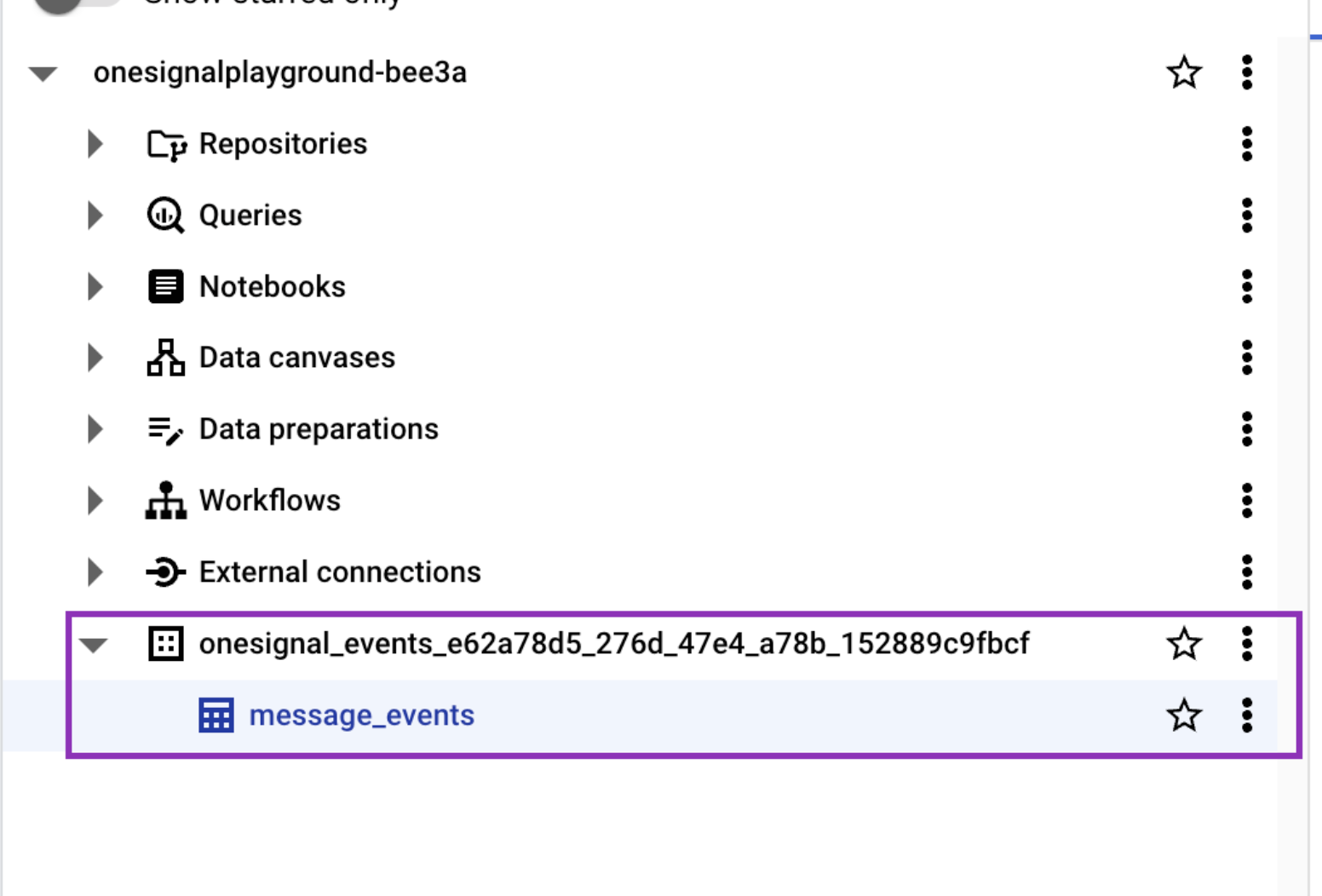
Event data tables containing behavioral data in BigQuery datasets
Setup Steps
1
Create BigQuery service account
OneSignal will generate a service account automatically when you create the connection. Alternatively, you can provide your own service account key JSON file.If creating your own service account, ensure it has the required permissions listed below.
2
Grant required permissions
The OneSignal service account needs these BigQuery IAM roles:
bigquery.dataViewer - Read access to datasets and tables containing event data
bigquery.jobUser - Permission to create jobs for data queries
In OneSignal, go to Data > Integrations and click Add Integration.
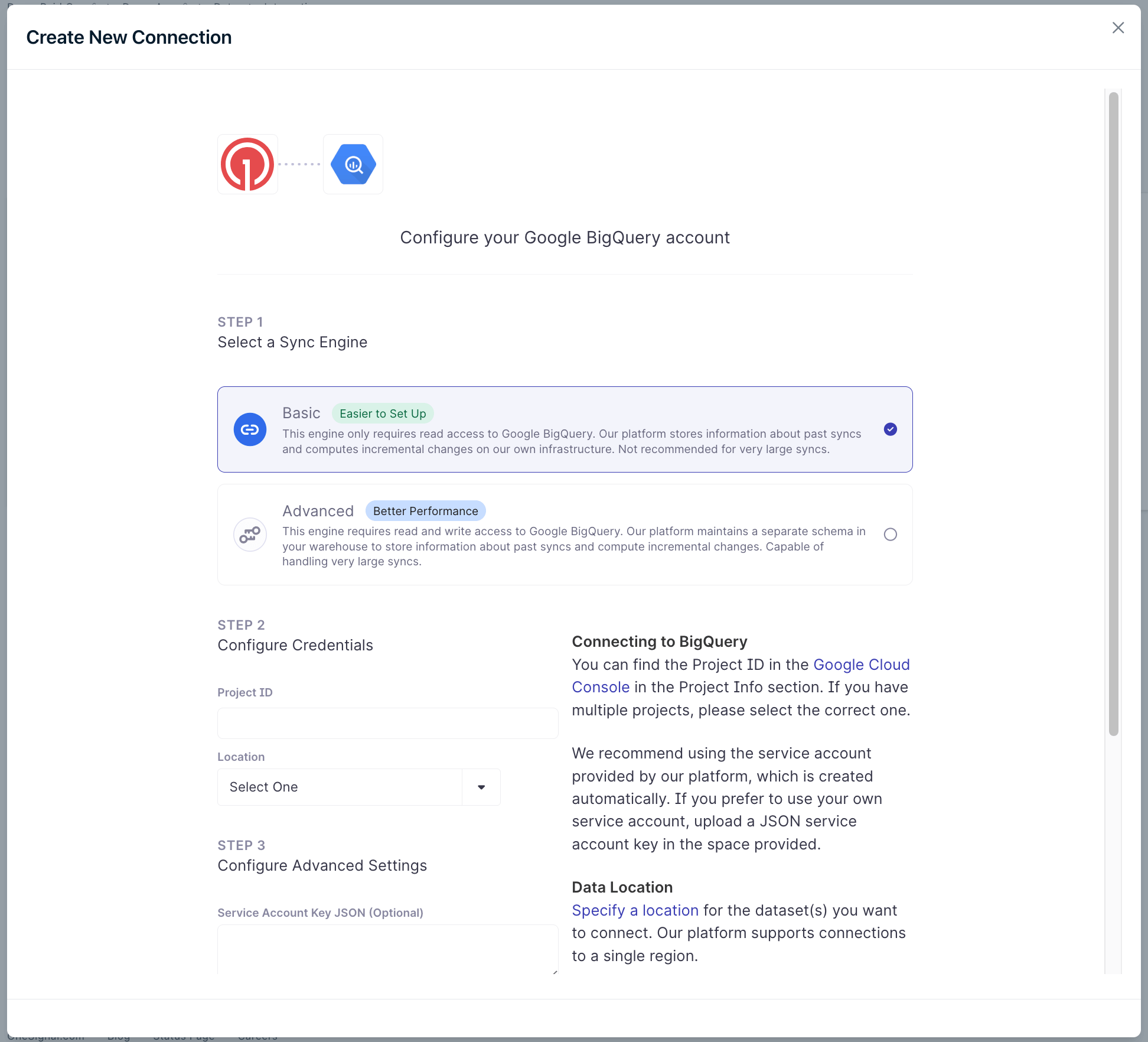
Add BigQuery integration
Sync Engine: Advanced sync is recommended for large datasets or complex event data queries. You can start with basic sync and switch to advanced sync later if needed.
Google Cloud Project ID: Your GCP project containing BigQuery datasets
Dataset Region: Location where your BigQuery datasets are stored
Service Account Key (optional): JSON key file if using your own service account
4
Configure event data source
Specify the BigQuery dataset and table containing your event data:
Dataset: BigQuery dataset name (e.g., analytics_events)
Table/View: Table or view containing event records
Event Query: Optional SQL query to filter or transform event data
Your event table should contain columns for:
Event name/type
User identifier
Event timestamp
Additional event properties
5
Test the connection
Click Test Connection to verify OneSignal can access your BigQuery project and read event data.