Create and manage dynamic user segments in OneSignal to target personalized messaging based on activity, location, tags, and more.
A segment is a dynamic group of users defined by filters on Subscription attributes, behavior, and custom data. OneSignal segments update automatically as users interact with your app or site, with no extra tracking required. Use segments to target messages, exclude audiences, and trigger Journeys.
User-based segmentation is coming soon. With it, segments contain users instead of Subscriptions. Learn how it works in advance in User-based segmentation.
Push notifications, emails, and SMS messages are only sent to opted-in (subscribed) Subscriptions. The segment editor shows both subscribed and unsubscribed counts for transparency, but only subscribed Subscriptions receive messages when you target a segment. In-App Messages are displayed to all mobile Subscriptions, regardless of status.When used in Journeys, all Subscriptions in a segment, regardless of status, are evaluated to their respective Users and those users are entered into the Journey.
Event-based segments are built using filters on user-level activity rather than individual Subscriptions. A segment is event-based when it includes message event or Custom Event filters. You can add other filter types, such as tags and session filters, to the same segment. Examples include:
When a user last opened an email, SMS, or push notification sent via OneSignal.
Specific Custom Events tracked in your app or website.
An event-based segment includes all users who meet the criteria and automatically makes all of their Subscriptions eligible to be targeted, enabling richer audience definitions that can reach any of the user’s devices.
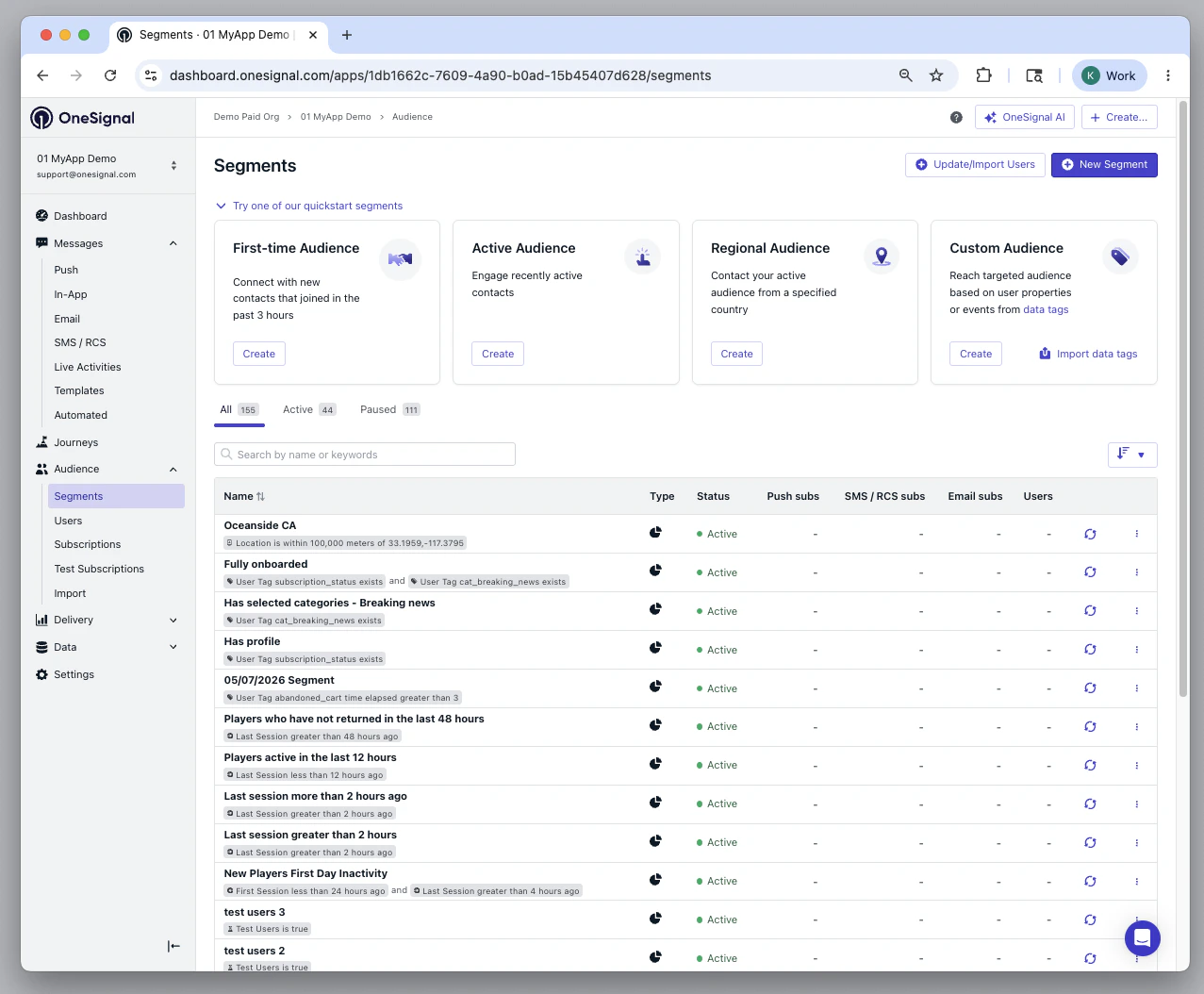
Segments can be created in the dashboard, via the API, or by uploading a CSV. Target your audience by including and excluding segments when sending messages or building Journeys.
Dashboard
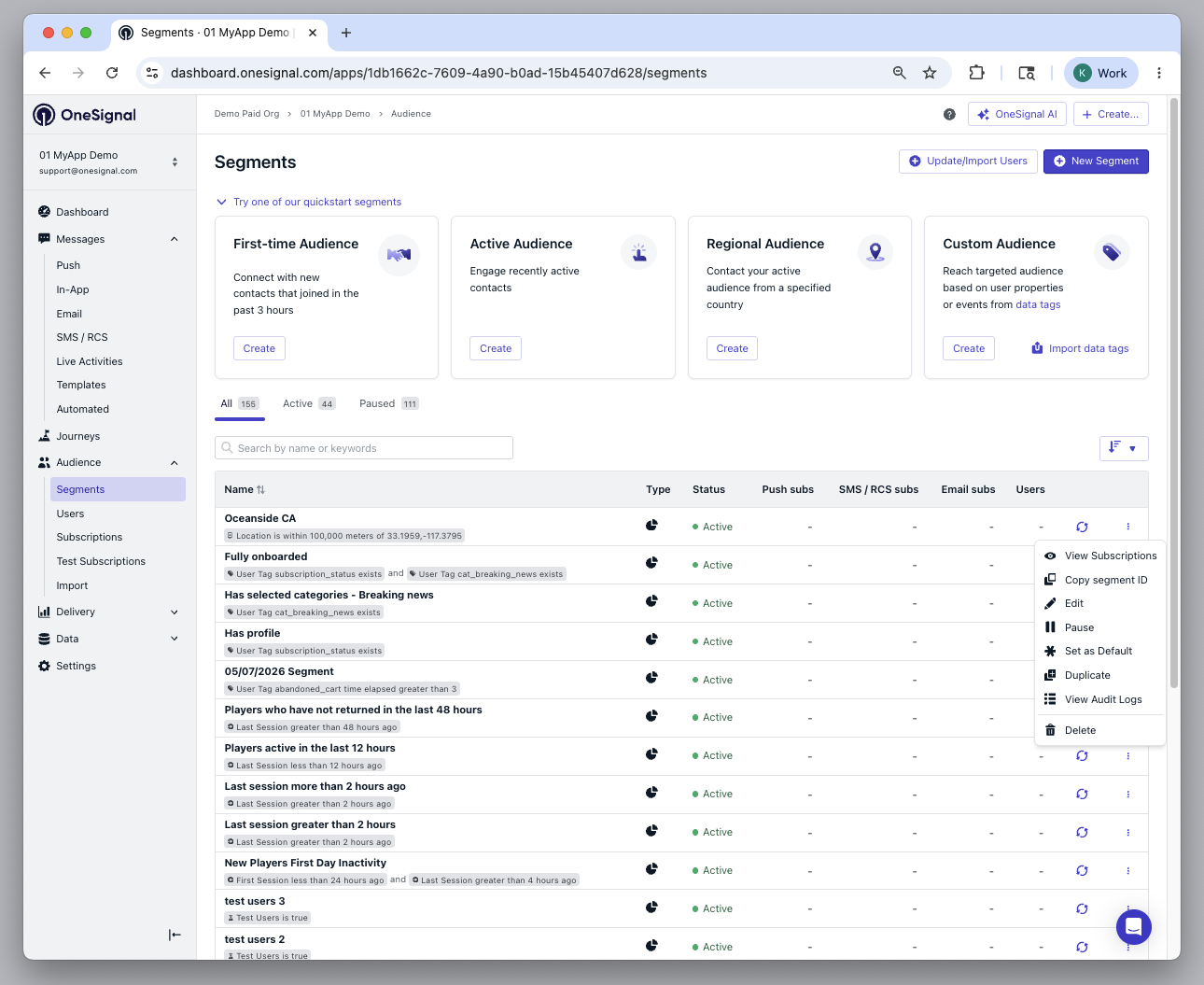
Create and manage segments from Audience > Segments.
API
Create segments programmatically using the Create Segment API.
CSV Import
Bulk-import Subscriptions and Tags via CSV, then build segments that match them.
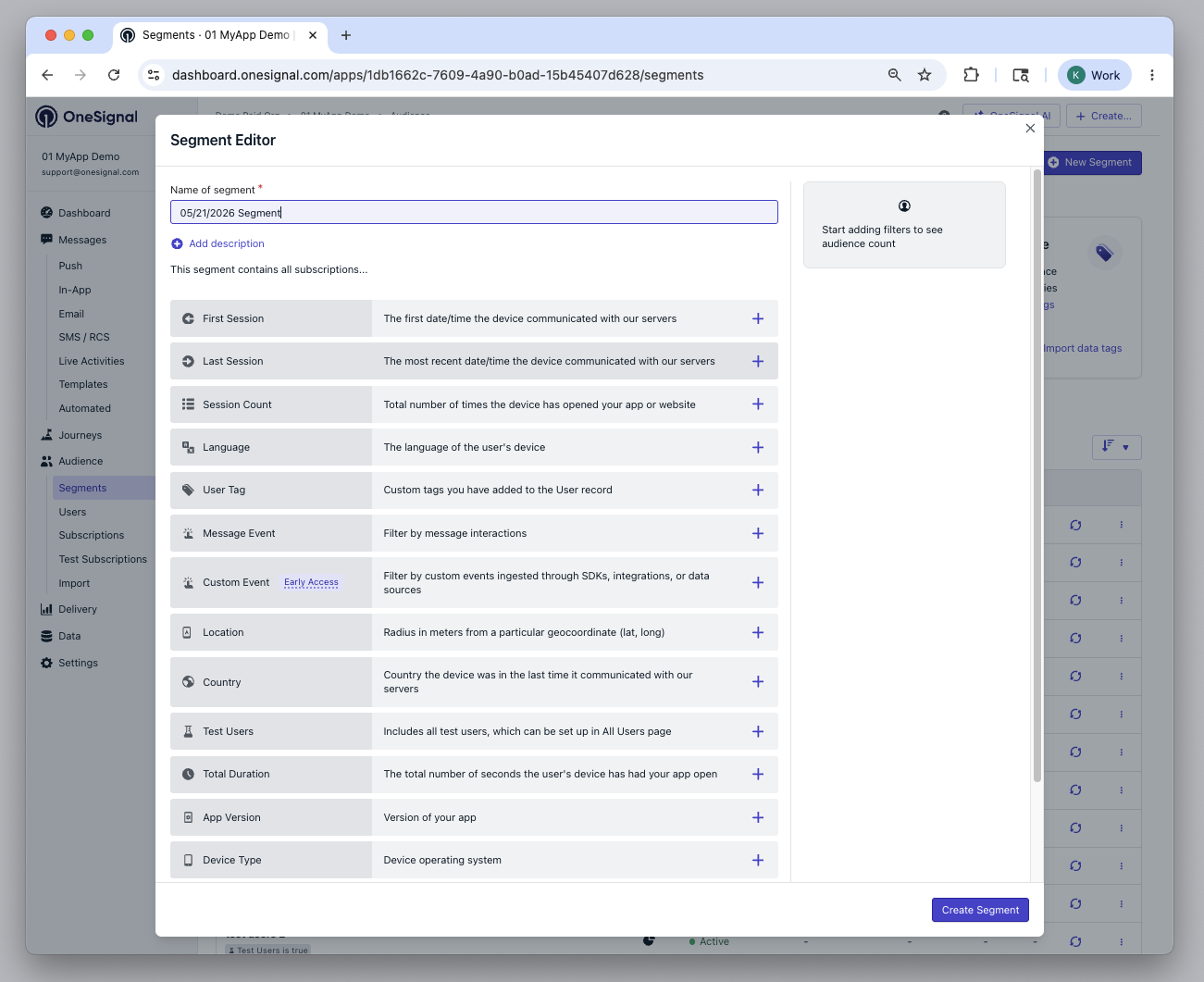
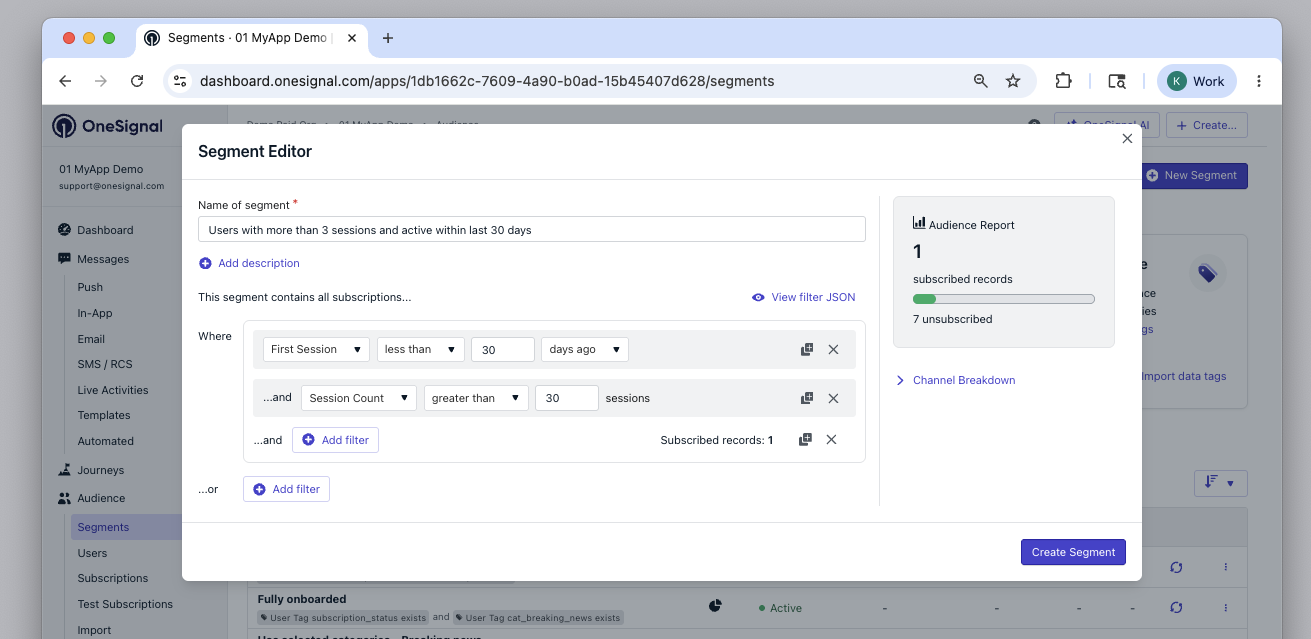
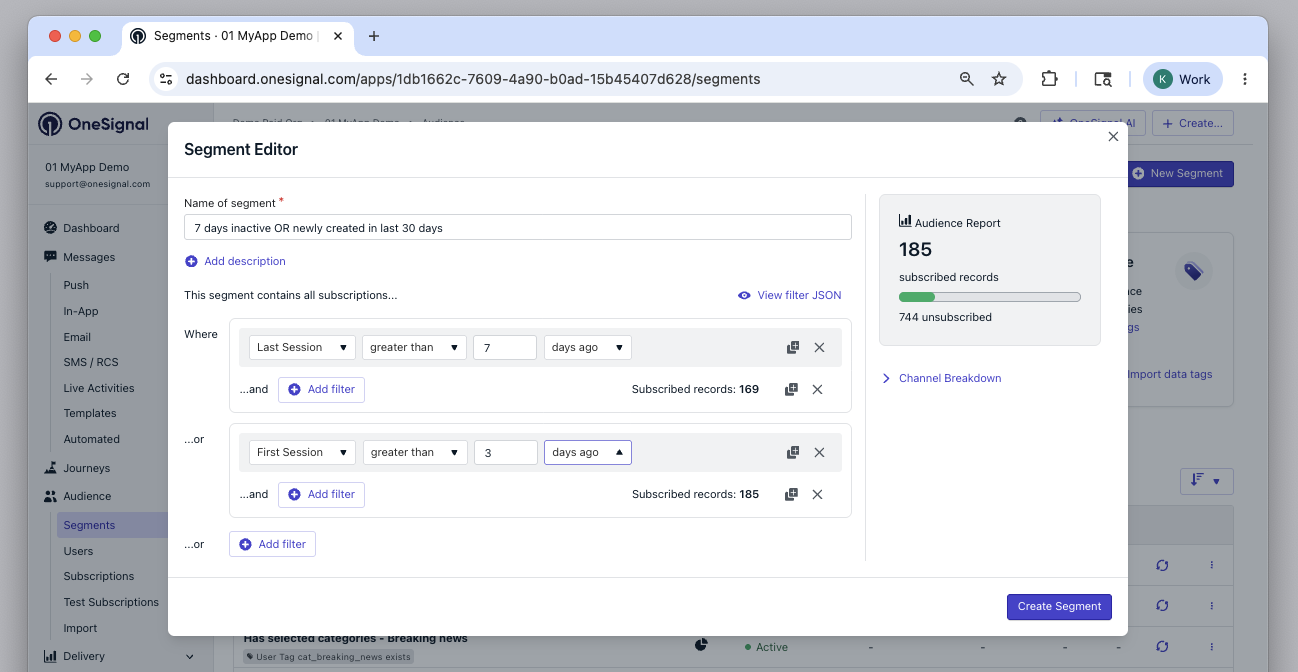
Filters define which Subscriptions belong to a segment. You can combine multiple filters using AND or OR logic. If no filters are selected, the segment defaults to every user of your app.
Filter
Description
First session
The first time OneSignal saw this user active on any device, including email or SMS. Equivalent to the user’s created_at timestamp.
Last session
The last time OneSignal saw this user active on any SDK-tracked device.
Session count
Number of times Subscription opened the app or visited the site. See Sessions.
Usage duration
Total seconds the Subscription had your app/site open.
Pulled from Android versionCode or iOS CFBundleShortVersionString. Combine with Device type to filter by different app versions per platform. See Target outdated app versions.
Device type
iOS, Android, Web Push (browser), Email, etc. Select multiple device types in one filter with “is any of”, or exclude them with “is not any of”.
User tag
Custom Tags you set via the SDK or API. See Add Tags.
Location
Filter by radius from coordinates (lat/long). Requires at least 1 meter and up to 2 decimal places of precision. See location permission.
Country
Based on last IP geolocation (ISO 3166-1 alpha-2 code).
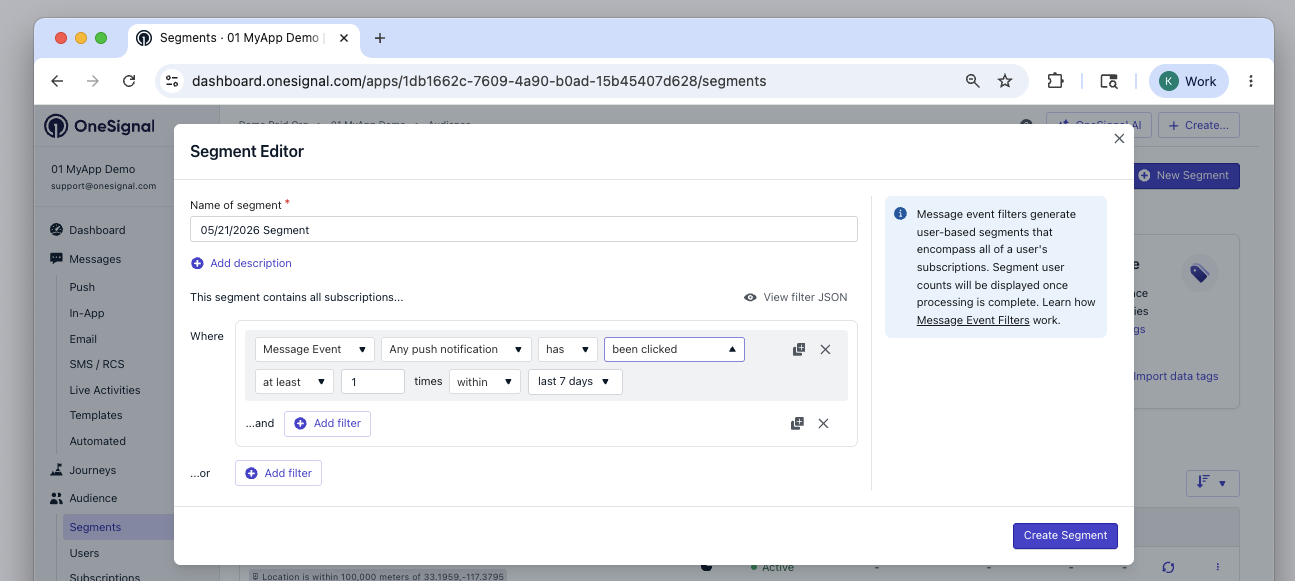
Message event filters target users based on their interaction with one of your messaging channels within a certain window. See Message events for the full event catalog and conceptual reference.
Message event filters
First select the messaging channel you want to filter on, then specify the action to track and whether the user has or has not performed that action.You can specify a minimum, maximum, or exact number of times the user must have performed the action, as well as a time window ranging from the last 24 hours to the last 90 days. Use the between option to define a custom start and end range (in days ago).
The amount of time message event data is retained depends on your plan. The dashboard time window selector shows up to 90 days, but data beyond your plan’s retention period will not return results.
Retention by plan
Free, Growth, Pro, and Enterprise retention windows for message event data.
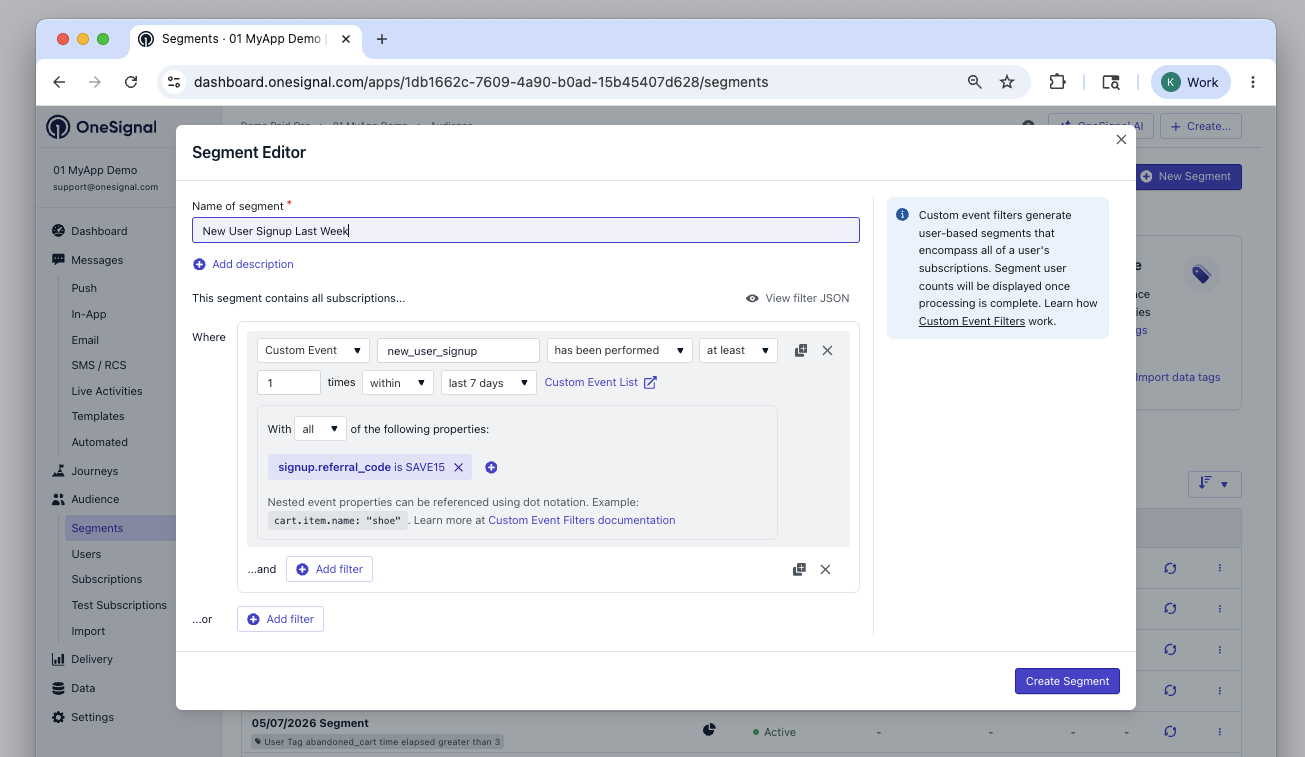
Custom Event filters let you target users based on meaningful actions they have taken in your app, website, or external systems.Custom event filters read stored events. Turn on storage for each event you segment on.
Custom event filters
Start by selecting:
The event name you want to filter on.
Whether the user has or has not performed that action.
The minimum, maximum, or exact number of times the action must be performed.
A time window during which the action must (or must not) occur. Choose a preset range or define a custom window using the between option (start and end in days ago).
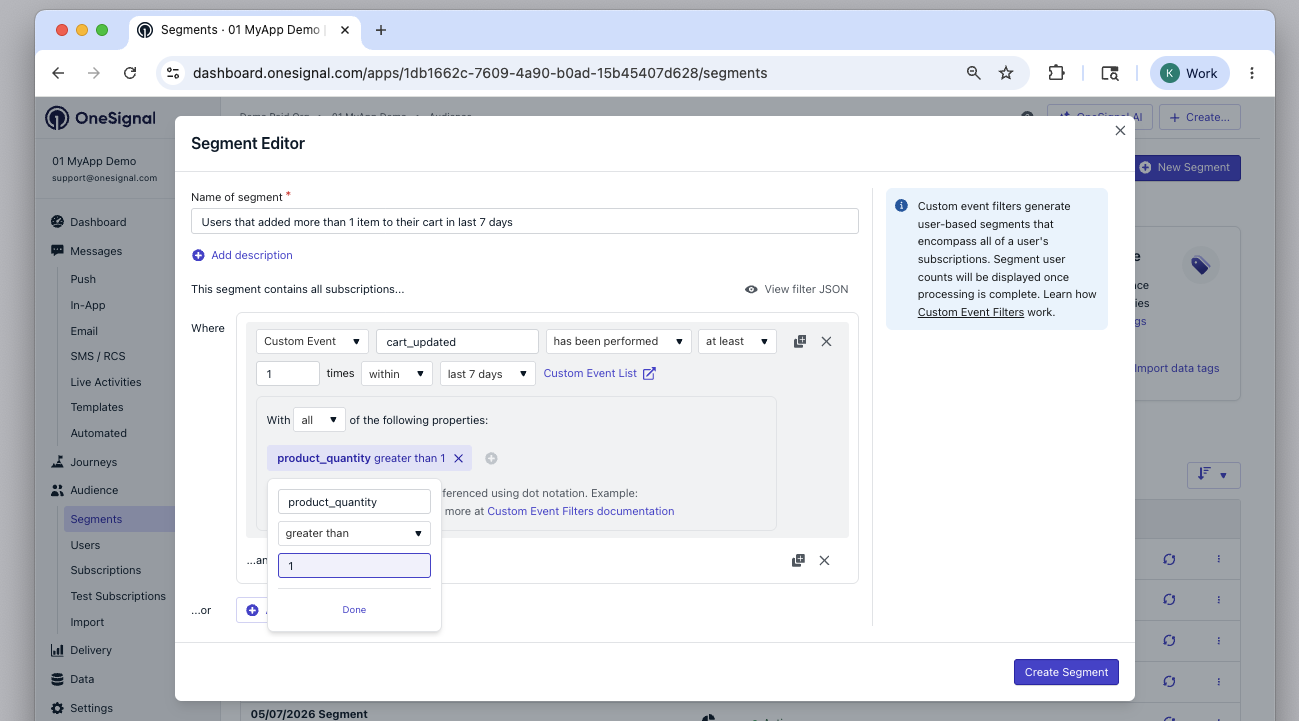
After specifying the event, you can optionally filter on specific or multiple properties:
all: applies an AND condition across properties.
at least one: applies an OR condition.
Then set the properties you want to filter on using dot notation.
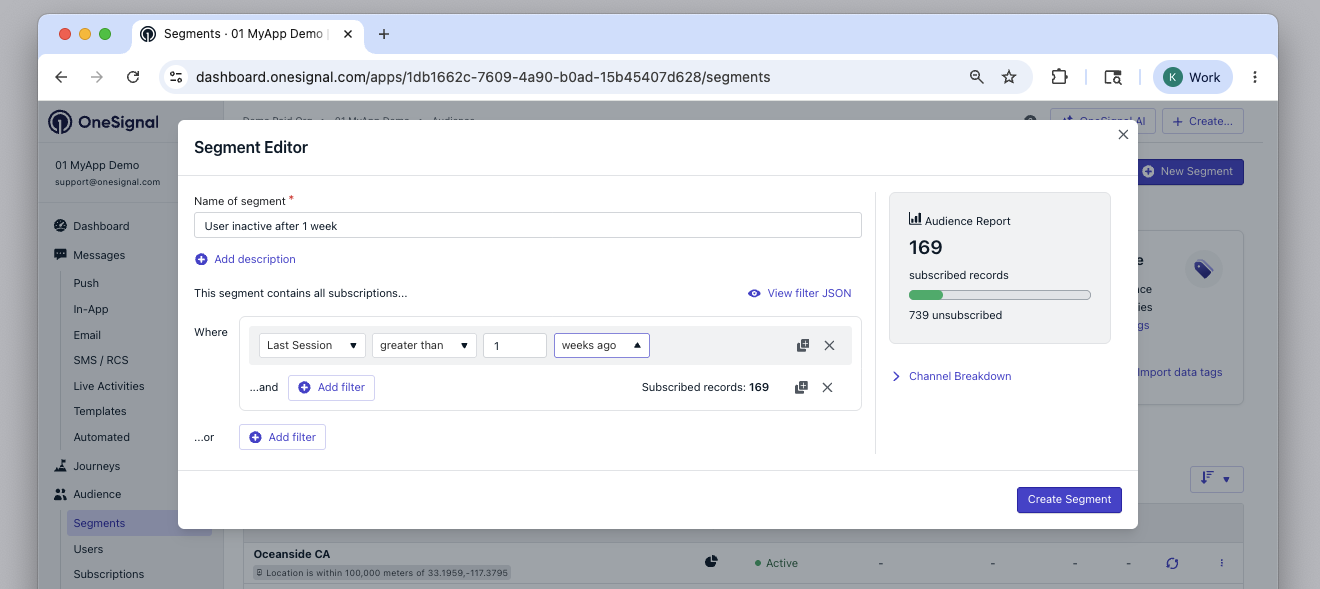
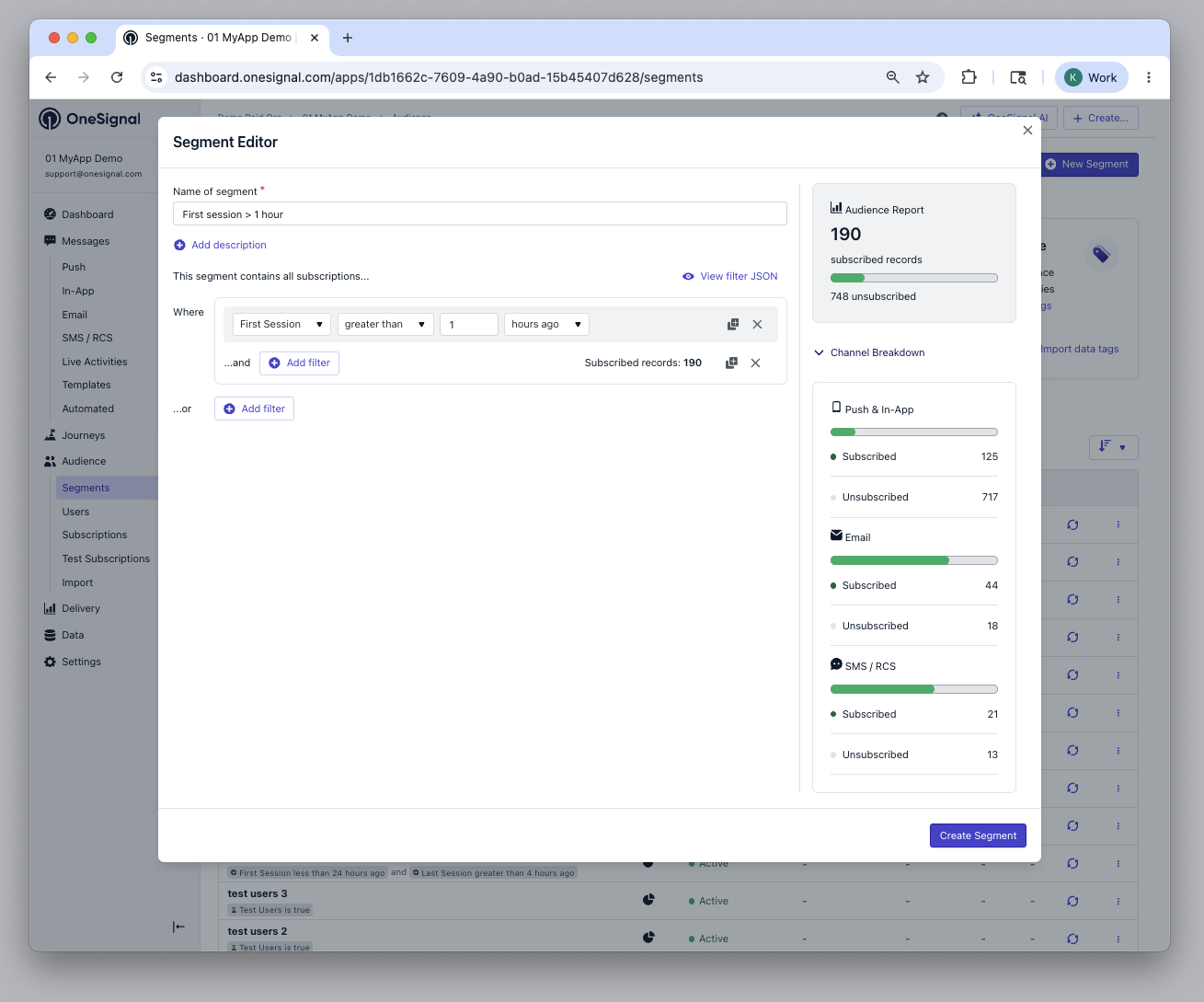
The segment editor shows how many subscribed and unsubscribed Subscriptions are in your segment, with a breakdown by channel (push, email, and SMS).
Subscribed Subscriptions are opted in and will receive messages when you target this segment.
Unsubscribed Subscriptions match your segment filters but are opted out and will not receive messages.
The channel breakdown lets you see reachable vs. unreachable Subscriptions per channel, which helps you understand which channels will be most effective before you build a message or Journey.
OneSignal always returns a count within approximately 15 seconds. Whenever possible within that time limit, you will see an exact count. For large or complex segments where exact counts can take a long time to compute, an estimate is shown instead.Estimates are labeled to make clear they are not exact:
Segment size
Format
Example
Above 10,000
Count with margin of error
140,000 +/- 5,000
Below 10,000
Less-than value
<4,800
Both formats are rounded to signal the number is approximate. Estimates will never display as 0: if your segment has very few members, the estimate reflects a small non-zero estimate to avoid implying the segment is empty when records may exist.
Segments with message event or custom event filters show counts on the Segments page once they finish processing. The segment editor doesn’t show a live estimate for them.
Your plan determines how many segments you can have at one time. Only active (non-paused) segments count toward this limit. Paused segments stay in your account but do not count, so you can pause segments you no longer use instead of deleting them.To free up capacity:
Pause segments you may want to use again later. The filter configuration is preserved and the segment can be resumed at any time.
Delete segments you no longer need.
See the pricing page for the segment limit on each plan.
Deleting a segment removes it from your list of segments. It does not delete the users inside it. To delete the users inside a segment, see Delete Users.
Dashboard
API
Go to Audience > Segments
Click the three-dot menu next to a segment
Select Delete
Segment options menu
Use the Delete Segment API. This only removes the segment definition, not the users inside it.
Not directly. Segments are dynamic groups defined by filters, so there is no option to hand-pick individual members. To group specific users:
Add a shared Tag to those users via the SDK, the API, or a CSV import.
Create a segment with a User tag filter matching that tag.
The CSV importer can also do both steps at once: enable Automatically create a Segment on the Review screen to tag every imported user and create a matching segment.To test with a small group, such as your own team’s devices, mark those devices as Test Users and create a segment with the Test Users filter.
Yes. The segment editor shows counts for both subscribed and unsubscribed Subscriptions. Subscribed Subscriptions are opted in and will receive messages. Unsubscribed Subscriptions match your filters but are opted out and will not receive messages.Only subscribed Subscriptions are targeted when you send a message.When used in Journeys and in-app messages, segments include both subscribed and unsubscribed Subscriptions.
OneSignal always returns a count within approximately 15 seconds. For smaller or simpler segments, this is an exact count. For larger or more complex segments, an estimate is shown instead.Estimates are clearly labeled with their precision. See Audience counts for details on how estimates are formatted and what they mean.
Can I combine custom event or message event segments with other segments?
Yes, with some send-time limits. A custom event segment can include other filter types such as message events, tags, and session filters.When sending messages outside of Journeys, you cannot include or exclude event-based segments (custom event or message event) with segments that have no event filters. In the dashboard, you can send custom event segments and message event segments together. The API accepts message event segments only with other message event segments, and custom event segments only with other custom event segments.Inside Journeys, you can combine event-based segments with any other segments.
No. Only active (non-paused) segments count toward your plan’s segment limit. Pause segments you no longer use to free up capacity without losing the filter configuration. See Segment limit for details.