

If your company already has a OneSignal App or Organization, email the account admin to request an invite. Share the Manage Team Members guide to help them give you access.
OneSignal account structure
Your email address is used to log in to your OneSignal account. From there, you can access the Apps and Organizations in which you are a Team Member.Apps vs. Organizations
- A OneSignal App holds user and messaging data for a single project, across all platforms (web, iOS, Android, email, etc.). Each app exists within a single Organization.
- A OneSignal Organization is a container for managing multiple apps, billing, and team permissions.
- Unlimited apps (free to create)
- Multiple organizations (free or paid)
- Apps for separate environments (e.g., dev, staging, production)
- Different access levels per app or organization
Access levels and roles
OneSignal supports two levels of access:App-level access
- Access to only the specific app(s) a user is invited to.
- Cannot view billing or upgrade plan settings.
Organization-level access
- Access to all apps within the organization.
- Only Admin roles can manage billing and upgrades.
User roles
Access can be further scoped by roles:Organization Roles
App Roles
Manage team members
Invite users, assign roles, and manage access at the app or organization level.
Managing your user account
Enable two-factor authentication to add an extra layer of security to your account. See Data collection & security FAQ for details.Open your settings
Click the Settings (gear) button in the bottom-left corner of the dashboard sidebar. The sidebar switches to settings and stays there until you click Back to app at the top. Settings is organized into three groups:User preferences
You can customize how the dashboard looks and displays information from the Preferences page. Go to Settings > Account settings > Preferences, or go directly to dashboard.onesignal.com/settings/preferences. Available preferences:- Date format — choose day-first (DD/MM) or month-first (MM/DD) display.
- Time format — choose 12-hour or 24-hour clock display.
- Table density — choose compact or comfortable row spacing in tables.
- Dark mode (beta) — enable an early dark mode theme across the dashboard.
Preferences are saved to your browser’s local storage. They are per-browser and do not sync across devices or other browsers.
Change your email address
- Go to Settings > Account settings > Profile, or open dashboard.onesignal.com/settings/profile.
- Under Personal information, update your Email address.
- Save the field. OneSignal emails your new address to confirm the change.
Reset your password
- Go to Settings > Account settings > Security, or open dashboard.onesignal.com/settings/security.
- Under Authentication, enter and confirm your new password.
- Click Submit. OneSignal signs you out so you can log back in with the new password.
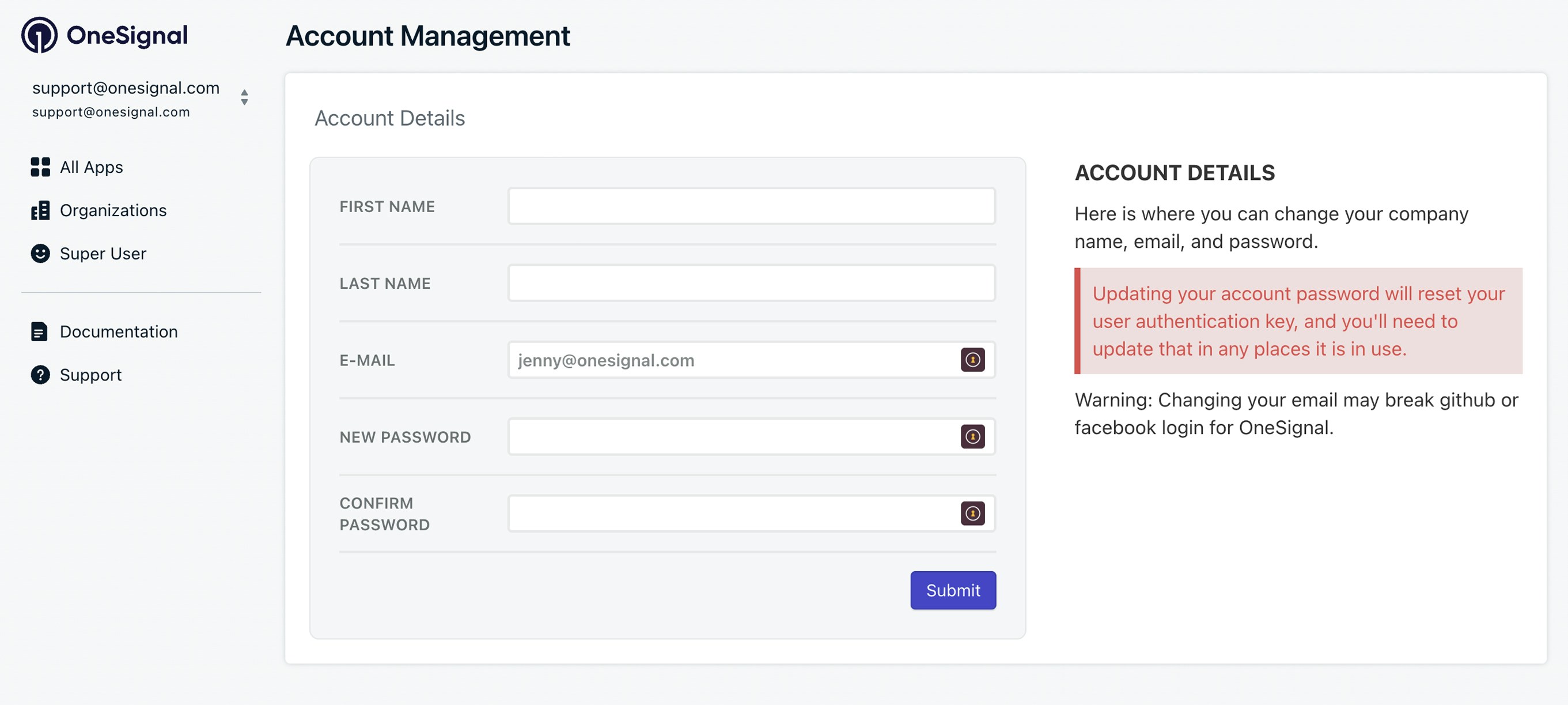
Reset account password
Your password and 2-step authentication live on the Security page. Your name and email live on the Profile page.
Delete your account
To delete:- Go to Settings > Account settings > Profile.
- Scroll down to Danger zone and click Delete account.
- If you don’t have the option to delete your account, contact
ar@onesignal.com.
Manage apps
-
Create an app:
- Log in at onesignal.com and click New App/Website.
- Or use the Create an App API.
-
Rename an app:
- From the dashboard All Apps page, click Options > Rename next to the app.
- Or use the Update an App API
-
Find App ID:
- See Keys & IDs.
-
Delete an app:
- You can delete apps within Free organizations and under 5,000 total subscriptions from the All Apps page via Options > Delete.
- For larger apps, contact
support@onesignal.com.
Manage organizations
Enable two-factor authentication at the organization level to require all team members to use 2FA.-
Create an organization:
- Visit the Organizations page or click New Organization in the dashboard (no paid plan required).
-
Rename an organization:
- In Organizations, click Options > Rename next to the organization.
-
Find Org ID:
- Go to Organizations, select your organization, and copy the UUID from the address bar. Example:
https://dashboard.onesignal.com/organizations/THE_ORG_ID/apps
- Go to Organizations, select your organization, and copy the UUID from the address bar. Example:
-
Delete an organization:
- Go to Organizations, click Options > Remove.
- You must move the apps out of the organization before deleting it.
- If you need assistance, contact
support@onesignal.comwith the Org ID you want to delete.
Add or move apps between organizations
- Add app to organization:
- Go to Organization settings > Organization apps > Move Apps Into Organization.
- Select your apps and click Move Apps.
- You need:
- Admin access to the source Organization (where the app currently lives)
- Admin access to the destination Organization (where you want to move it)
- Admin access to the App itself
- The app must currently belong to a Free Organization (apps in paid organizations cannot be moved self-service).
If you need assistance, email
support@onesignal.com with:- The App ID(s) you want to move
- The Org ID to move them to.
- You must contact Support from an email with Admin access to the Apps and Organization.
FAQ
Where can I see when my app was created?
Use the View App or View Apps API to get thecreated_at timestamp.
Why do I see limitations on a paid plan?
Your app might not be assigned to the correct paid Organization. Follow Add or move apps between organizations to move your app to the paid org. If you need help, see the support contact details in that section.What are the best practices for agencies?
Agencies can manage client apps using one of two approaches:- Centralized billing Use a single Organization to manage and pay for all client apps.
- Client-managed billing Each client sets up their own Organization and handles their own billing.
How can we access analytics, messages, and users across multiple Apps?
OneSignal does not have a single cross-app dashboard view. Each app’s data is accessed separately. Here are the recommended approaches for working across apps:- Analytics — Use Event Streams to route message delivery and engagement data from each app to a centralized analytics platform like Snowflake, BigQuery, or Amplitude.
- Messaging — Use the Create message API to send messages to multiple apps in parallel from your backend. You can also create Templates once and copy them across apps using the Copy template API.
- Users — Use the REST API to query user data per app. If you need a unified view across apps, export Subscription records per app via CSV export or stream events via Event Streams to an external data warehouse.
How do we change our dashboard timezone?
Dashboard graphs display in UTC and cannot be changed. All other dates and times use your browser’s timezone. To change the displayed timezone, update the timezone setting in your browser or operating system. To change how dates and times are formatted (day-first vs. month-first, 12h vs. 24h), use User preferences.Related pages
Manage team members
Invite users, assign roles, and manage access at the app or organization level.
Keys & IDs
Find your App ID, REST API key, and other credentials.
Two-factor authentication
Enable 2FA for your account or require it for your organization.
Billing FAQ
Manage plans, billing, and subscriptions across organizations.