

Use this guide to identify and resolve the most common OneSignal email issues, including setup problems, deliverability challenges, and design errors.Documentation Index
Fetch the complete documentation index at: https://documentation.onesignal.com/llms.txt
Use this file to discover all available pages before exploring further.
Before troubleshooting, review our Email Setup and Email Deliverability guides. These cover the most common causes of email issues.
Setup issues
Most setup problems come from incorrect DNS records or limitations from your Email Service Provider (ESP).Verify DNS records
- Open your DNS provider.
- Confirm that SPF, DKIM, and MX records match our Email DNS Configuration guide.
- Allow up to 24 hours for DNS changes to propagate.
Monthly send limits (non-OneSignal ESPs)
If you use SendGrid, Mailchimp, or Mailgun directly (not via OneSignal Email), your sending volume is limited by your ESP plan.Check your provider’s logs:
Too many DNS lookups
When testing SPF records with tools like URI test, you may see: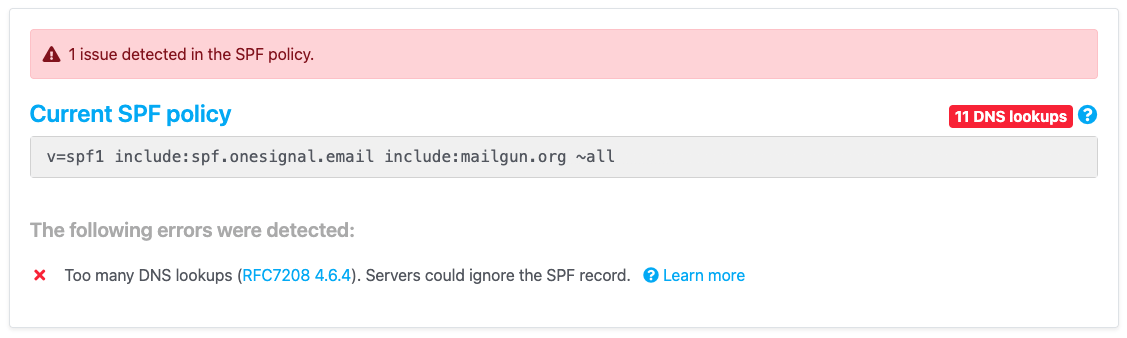
Multiple TXT records for sender domain
You can only have one SPF record for your sending domain.Check with WhatsMyDNS TXT lookup to confirm you do not have multiple entries.
Deliverability issues
Deliverability problems include slow sends, spam folder placement, and email bounces.Delayed emails
If your sending domain is new or has low reputation, ISPs (Gmail, Outlook, Yahoo) may delay delivery. This is called rate limiting or greylisting. When looking at your Email Message Reports, you can check the details of how long it took us to send the message.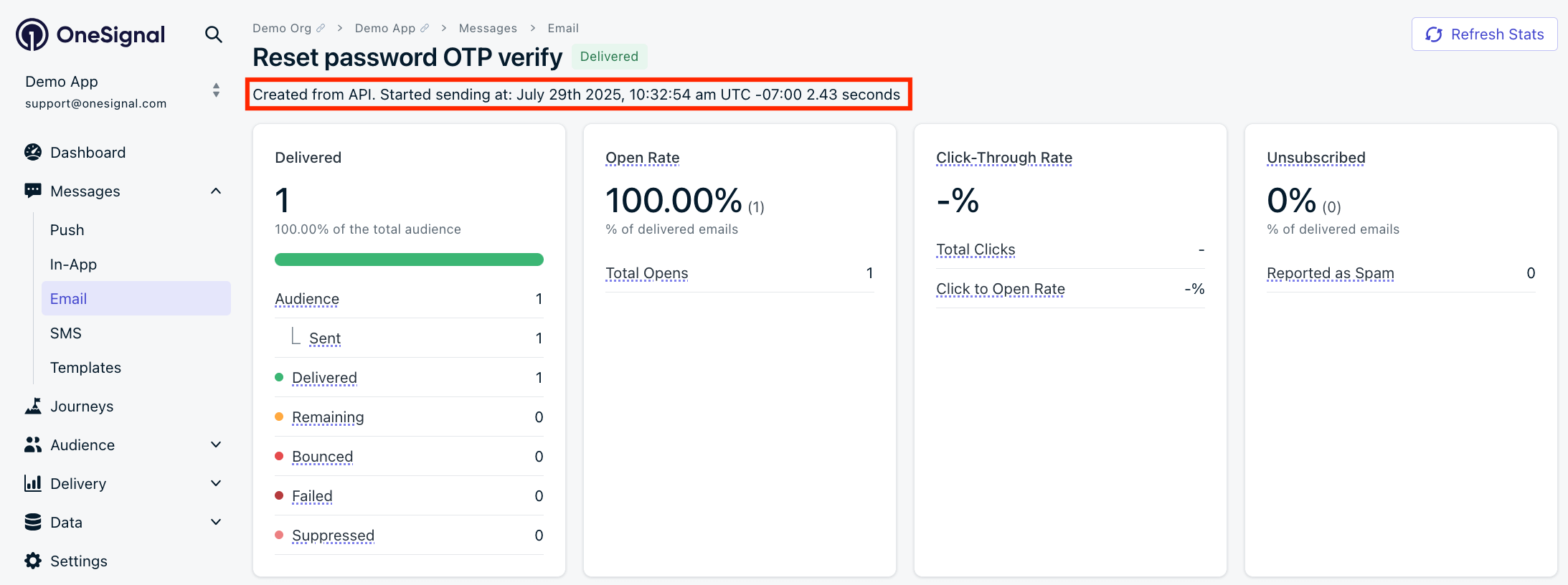
Follow our Email Reputation Best Practices to speed up delivery.
Too old failures
A “Too old” failure means the recipient’s mail server did not accept the message within the 8-hour retry window. The most common cause is recipient-side email security policy, not your sending configuration. If you see “Too old” failures in your Email Message Reports, work through the steps below to identify the cause.Group failures by recipient domain
Export your failure logs and group the “Too old” failures by recipient domain. A concentrated pattern (many failures across multiple recipients at the same company or using the same email security vendor) points to a recipient-side gateway policy rather than a sender-side issue.
Check for recipient-side email security gateways
Recipients using corporate email security gateways like Barracuda, Mimecast, Proofpoint, or Cisco IronPort may have policies that defer or block mail from senders not on their allowlist. These gateways issue repeated 451 deferrals, and after 8 hours of retries the message is marked “Too old.”To confirm, check whether affected domains share a common email security vendor by looking up their MX records.
Verify your sender reputation
Confirm your sending IPs and domain are not on major blocklists:
- Barracuda: Barracuda Central reputation lookup
- Spamhaus: Spamhaus IP and domain lookup
- General: MXToolbox blacklist check
Verify authentication is passing
Send a test message to About My Email to confirm SPF, DKIM, and DMARC are aligned. Authentication failures can cause some gateways to defer messages.
Identify invalid or typo domains
Filter your failure logs for domains that do not exist in DNS, such as
gmial.com or yaho.com. These failures count against your sender reputation. Remove invalid addresses from your list and add email address validation to prevent future typos from entering your audience.If your IPs and domain pass reputation checks and authentication is aligned, the failures are originating on the recipient side.
Resolving recipient-side blocks
When the cause is a recipient-side email security gateway, the fix is a policy change in the recipient’s environment. You can either:- Ask the affected recipient’s IT admin to allowlist your sending domain, such as
mail.yourdomain.com, in their email security gateway. - Remove the affected addresses from your list if allowlisting is not possible.
Recipient-side policy blocks are not caused by your ESP and will behave the same way across any email service. OneSignal uses Mailgun to deliver email, and the underlying SMTP retry behavior follows standard industry conventions.
Emails landing in spam
The most common cause is poor sender reputation. Follow our Email Deliverability guide. If you are using a third-party ESP, see:Sending & receiving from the same domain
A single domain cannot use the same MX records for sending and receiving mail simultaneously. If you want to send from@yourdomain.com and also receive on the same domain:
- Keep your sending DNS with OneSignal.
- Point your MX records to your inbound email provider (e.g., Google Workspace MX records).
Suppression lists
If an address unsubscribed or marked you as spam, your ESP will suppress sends to it.To resubscribe:
- Go to Audience > Subscriptions in OneSignal.
- Search for the email address.
- Click Unsubscribe from Email (if subscribed) then Resubscribe to Email.
- Send a test email to confirm.
Apple Private Relay
If you send to@privaterelay.appleid.com addresses, you must verify your sending domain in your Apple Developer account.Unverified domains will result in dropped emails.
API key too restrictive
If using SendGrid or Mailchimp, ensure your API key has the minimum required permissions.Email design
These are problems inside the email content itself.Links not working
Usually caused by missing or incorrect CNAME configuration.If using a third-party ESP, follow their tracking domain setup.
Buttons not clickable
- Ensure the URL is correct and starts with
https://. - Avoid testing from your spam folder—some email clients block links there.
Adding images to preheader
Gmail supports promotional images in preheaders (deal annotations, product carousels).See Gmail Developer Portal for setup.